


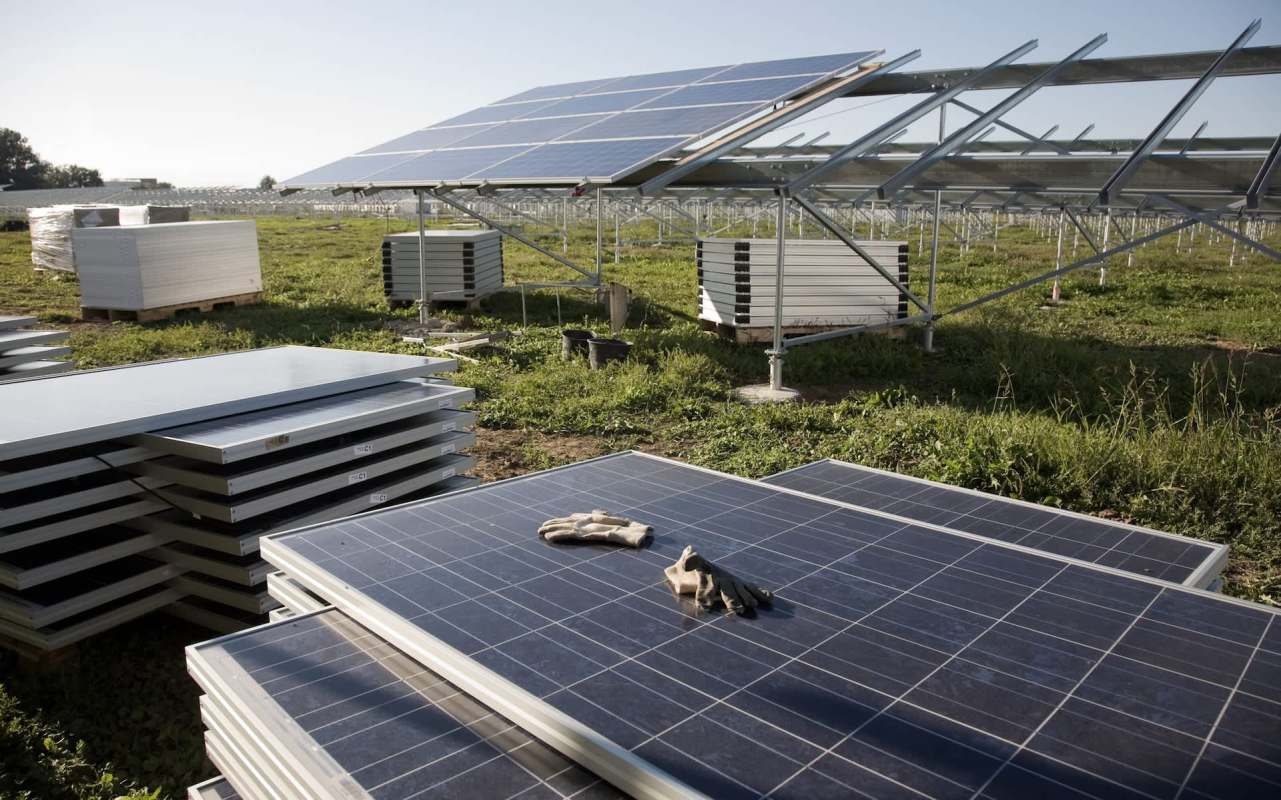
As Michigan has made efforts to meet both growing electricity demand and aggressive renewable energy targets, land-use debates have grown increasingly contentious, particularly in rural parts of the state.
Here's what to know
In the coming years, large-scale commercial solar arrays will likely become a common sight in Michigan. For example, Ranger Power received Michigan Public Service Commission approval for its 90-megawatt Acceleration Solar project in southern Ingham County, according to MITechNews. Construction was scheduled to start in 2027, with commercial operation beginning in 2028.
The project was the first to be authorized under the 2023 law known as Public Act 233, which allowed state-level siting of large renewable-energy projects under certain circumstances. Michigan has set the goal of generating 50% of its electricity from renewable sources by 2030 and 60% by 2035, per MITechNews.
Meanwhile, massive, energy-intensive data centers have also been making their way to Michigan, causing electricity demand to soar. One planned data center in Saline Township could require 1,383 megawatts of power around the clock, roughly 15 times the amount that the Acceleration Solar project will generate.
For homeowners, going solar remains one of the best ways to save money on home energy. Solar leases can deliver hundreds of dollars in monthly savings without upfront costs. EasyHome's free explorer tool can help you see potential savings from vetted installers in your area.
More background
In order to meet its renewable energy targets amid rapidly increasing demand, Michigan will need to install a great deal of solar capacity, which requires land. According to the Michigan Department of Natural Resources, as reported by MITechNews, the combined solar capacity envisioned by DTE and Consumers Energy could reach 23,400 megawatts by 2040.
Based on an estimate of five to 10 acres for each megawatt, the Michigan Department of Natural Resources puts the potential footprint at 117,000 to 234,000 acres. While this might sound like a lot of land, even the upper range of the estimate amounts to less than 3% of Michigan's roughly 10 million agricultural acres, per MITechNews.
Because projects depend on suitable land and access to transmission infrastructure, these solar arrays could end up concentrated in certain areas, with potentially hundreds or thousands of acres within a single township being transformed. Concerns about losing local control over such changes have fueled much of the opposition to PA 233.
Crushed by your bills? See instant solar savings from vetted installers in just a few clicks With energy prices through the roof, there's never been a better time to go solar — and EasyHome can help you find the best prices from the best installers in your area. EasyHome takes the guesswork and headaches out of energy upgrades by showing you estimated savings from a network of vetted local partners. To get started, just enter your ZIP and share a few details about your home — seeing your estimate is really that easy. |

However, as arguments over solar panels versus farmland have heated up, an unlikely ally has appeared: sheep.
A growing number of studies and test projects have shown that allowing sheep to graze around solar panels can be mutually beneficial. Additionally, going solar could represent an additional source of income for farmers and other landowners.
Agrivoltaics — the practice of combining farming and solar generation on the same property — has already been underway in Michigan. According to Michigan State University, sheep have been grazing more than 400 acres of the state's solar installations. Rather than relying entirely on mowing to clear grass and other vegetation around solar panels, operators can pay farmers to manage vegetation with their flocks.
Grazing could lower costs and emissions, according to the Michigan Department of Natural Resources, as reported by MITechNews. Making the system work, however, required planning for appropriate fencing, water, and vegetation from the outset.
Michigan State University estimated that the state's existing sheep industry could potentially support grazing across 7,200 to 22,000 acres at solar sites, according to MITechNews. Farmers could help maintain the properties while continuing to produce an agricultural product.
Whether on a household or community scale, battery storage allows owners to maximize the benefits of solar power while also making sure that they have access to electricity when they need it most. EasyHome can help homeowners explore backup battery storage options. Pairing solar with a battery allows homeowners to maximize savings and power their property with solar energy when the grid goes down.
Where can I learn more?
Michigan's push for more solar power amid data center expansion is part of the debate about electricity costs and the future of farmland.
• Pennsylvania and Texas have been telling AI data centers to bring their own power.
• Michigan's Ypsilanti Township imposed a six-month power moratorium to stall a proposed data center.
• Growing AI data center demand could push electric bills higher as America's power grid strains.
• Aligned lined up $500 million for solar and storage as U.S. electricity demand rises.
• Maryland's Cecil County weighed 21 solar projects on 651 acres of farmland.

Get TCD's free newsletters for easy tips, smart advice, and a chance to earn $5,000 toward home upgrades. To see more stories like this one, change your Google preferences here.






