


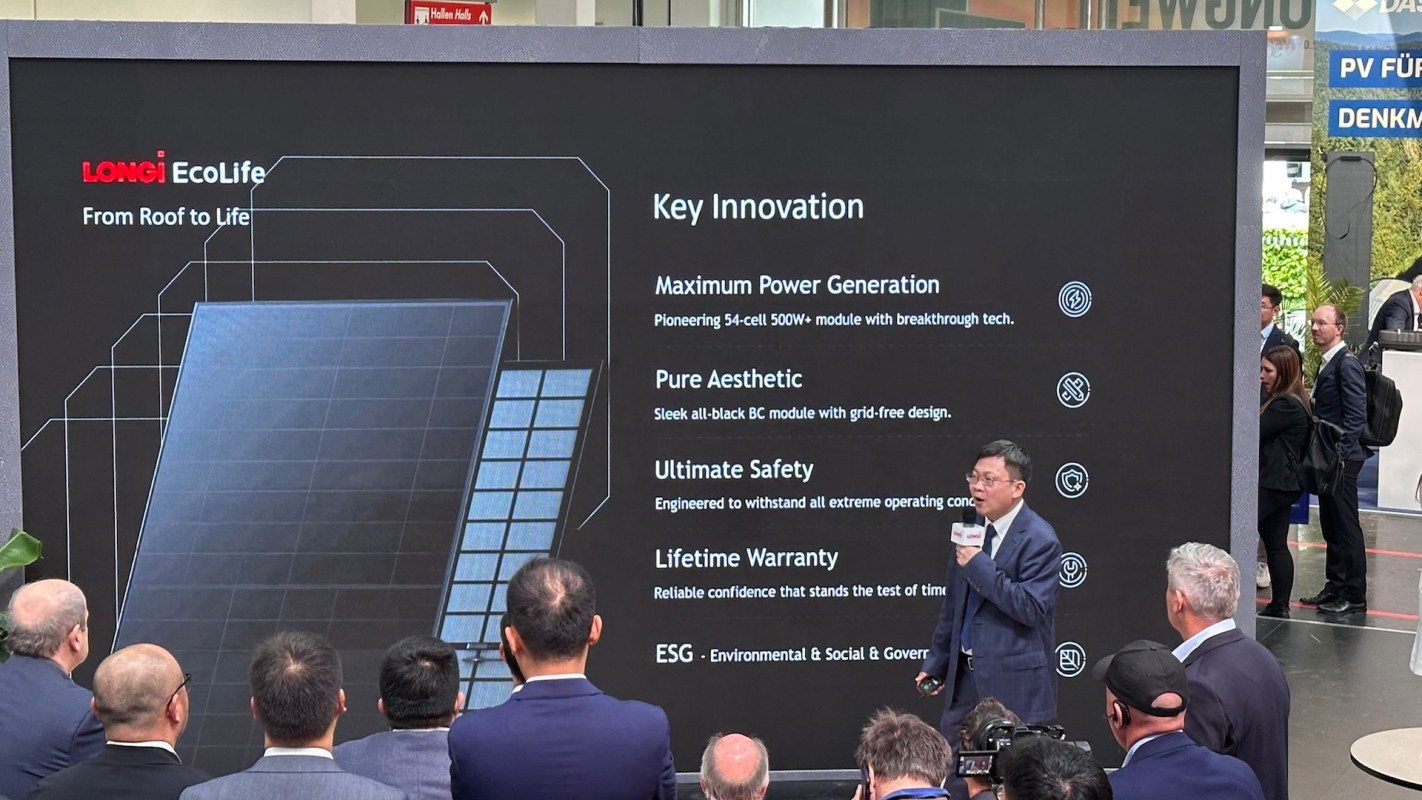
Solar power's steady march forward has reached another milestone, as Chinese photovoltaic module manufacturer LONGi announced in a news release that it has achieved a 28.29% power conversion efficiency for a hybrid interdigitated-back-contact, or HIBC, silicon solar cell.
Now, the company is saying the result pushes the technology closer to its theoretical ceiling.
Here's what to know
The result was confirmed by Germany's Institute for Solar Energy Research Hamelin, as pv magazine reported. With that verification, LONGi moved past the 28.13% efficiency it posted in May and set a record for single-junction crystalline silicon solar cells.
Higher efficiency lets a solar cell generate more electricity from the same amount of sunlight and footprint. LONGi said this was its third record in 2026.
"LONGi has broken the world records three times this year, pushing cell efficiency to 28.04%, 28.13%, and 28.29%," the company wrote.
By its estimate, crystalline silicon solar cells have now reached 96.2% of their theoretical maximum efficiency.
TCD Picks » Quince Spotlight
💡These best-sellers from Quince deliver affordable, sustainable luxury for all




More background
Crystalline silicon remains the dominant material in the global solar market. Improvements at this level can ripple across the industry, potentially making clean electricity more affordable and more practical in places where roof area or land availability is limited.
In a scientific paper last November, LONGi described the HIBC cell's construction, as pv magazine recounted. It said the architecture pairs passivated tunneling contacts with dielectric passivation layers and includes both n-type and p-type contacts.
The company said the device is built on a high-resistivity half-cut M10 wafer and incorporates edge passivation along with optimized n-type contacts made through a mix of high- and low-temperature processing.
LONGi also said an indium tin oxide (ITO) layer aids lateral transport, while multilayer aluminum oxide and silicon nitride coatings curb surface recombination, per pv magazine.
More efficient panels can also help companies and utilities generate more energy from existing footprints, potentially reducing installation and land-use costs.
What's being done?
During fabrication, LONGi said its in situ passivated-edge approach handles edge passivation. The company also pointed to deep-trenched metal fingers and selective ITO etching as ways to limit leakage between the n-type and p-type contacts, per pv magazine.
LONGi said it also uses a thicker amorphous silicon layer to improve junction coverage and better encapsulate the sidewalls. The company said it then crystallizes that layer with a pulsed green nanosecond laser to cut contact resistivity while preserving passivation.
According to LONGi, the approach may be suitable for heterojunction solar cell manufacturing. The company added that resistive losses in the p-type contact still need further reduction.
"This marks the successful mass production of this cutting-edge technology and demonstrates Longi's robust capability to develop premium PV products and commercialize advanced technologies," the company concluded.
Where can I learn more?
Records from other solar developers and labs show how quickly cell design is improving.
• In Singapore, researchers achieved a certified world-record efficiency with a new perovskite solar cell.
• In China, scientists solved a hidden leak problem and pushed tandem-cell efficiency past 33%.

Get TCD's free newsletters for easy tips, smart advice, and a chance to earn $5,000 toward home upgrades. To see more stories like this one, change your Google preferences here.






