


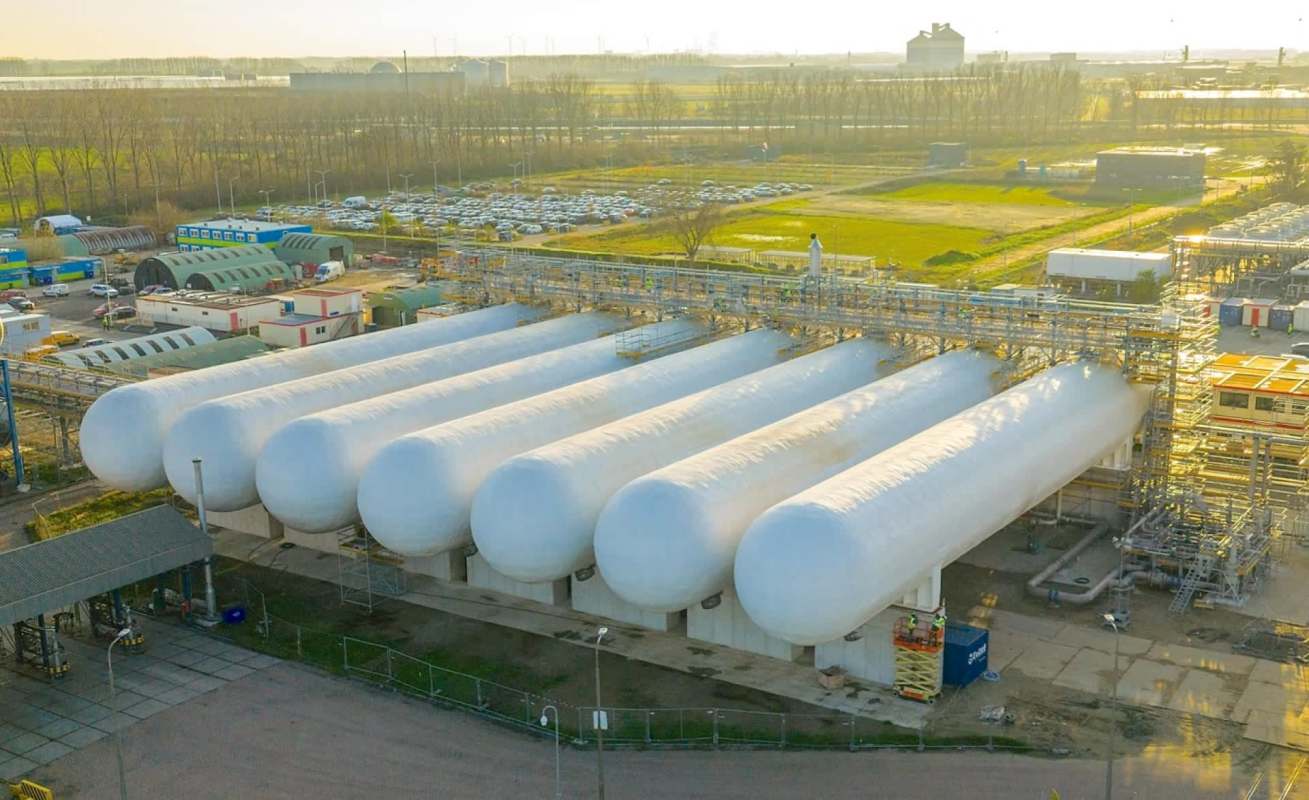
Europe's biggest industrial carbon capture site has officially started operating at Norwegian chemical company Yara's fertilizer plant in Sluiskil, Netherlands, marking a major step for industries counting on the technology to reduce pollution that can be difficult to avoid.
The system will remove 800,000 tons of carbon dioxide a year from ammonia manufacturing and direct that material to permanent storage under the seabed, New Atlas reported.
Here's what to know
The facility was opened by Norwegian chemical company Yara at its ammonia and fertilizer plant in Sluiskil, Netherlands.
The facility first liquefies the carbon dioxide, then stores it temporarily in large on-site tanks before shipping it to Norway.
Once the carbon dioxide arrives there, Norwegian CO2 transport firm Northern Lights places it in a reservoir roughly 8,530 feet beneath the seabed, keeping it from entering the atmosphere.
Current projections indicate the site will store about 12 million tons of carbon dioxide over the next 15 years.
TCD Picks » Quince Spotlight
💡These best-sellers from Quince deliver affordable, sustainable luxury for all




The project is also notable because ammonia and fertilizer production can produce comparatively pure carbon dioxide streams, which are easier and less expensive to capture than emissions from some other industrial sources.
More background
Carbon capture and storage, often called CCS, is attracting more interest because some industries are still hard to clean up with today's technology.
Cement, steel, chemicals, and fertilizer manufacturing all release substantial amounts of planet-warming pollution.
In national terms, 800,000 tons a year is roughly one-two-hundredth of the Netherlands' annual greenhouse gas emissions.
Globally, the scale is much larger: The Global Carbon Budget estimated fossil-fuel carbon dioxide emissions for 2025 at more than 42 billion tons worldwide.
That helps explain why projects like this are viewed as useful for cutting emissions from processes that are difficult to replace or electrify as other technologies advance toward clean energy.
What's being done?
The Sluiskil launch also reflects a wider European effort to expand the infrastructure needed to move and store captured carbon.
Northern Lights currently has capacity for 1.5 million tons of carbon dioxide a year and is working to increase that to 5 million tons annually as demand from European industries rises.
Facilities need pipelines or ships, storage sites, and long-term monitoring to ensure the carbon remains locked away.
Companies are working to decarbonize existing industrial operations while cleaner production methods continue to develop.
Industrial pollution plays a major role in climate change and in the costs communities shoulder due to extreme weather, disrupted supply chains, and health impacts linked to dirty air.
Although Yara's site is now Europe's largest industrial carbon capture facility, it remains smaller than a major project at China's Huaneng Longdong Energy Base, which can trap 1.5 million tons of carbon dioxide annually from flue gas at a coal-fired unit.
Where can I learn more?
These articles look at new carbon capture plants and broader industrial emissions cuts, illustrating how the process is unfolding around the world.
• At Thyssenkrupp, engineers unveiled a method to capture all emissions from cement production.
• In Iceland, Swiss startup Climeworks opened the largest air-pollution removal factory at commercial scale.
• In North America, Equatic is building an ocean carbon removal plant with permanent storage.

Get TCD's free newsletters for easy tips, smart advice, and a chance to earn $5,000 toward home upgrades. To see more stories like this one, change your Google preferences here.






