


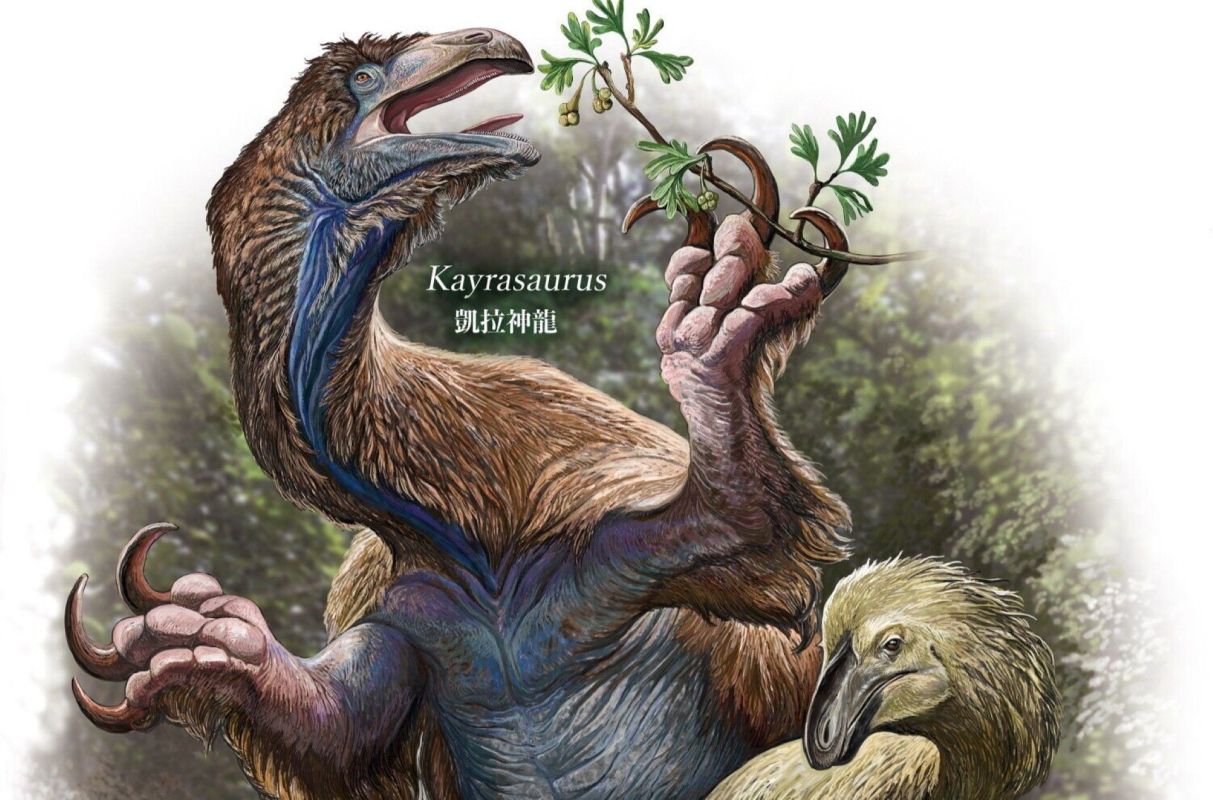
A newly described dinosaur from northeastern China may have looked a bit like a feathered bear walking on two legs and carrying a set of oversized claws.
The animal, Kayrasaurus changliensis, is giving paleontologists a closer look at one of the strangest branches on the dinosaur family tree.
Here's what to know
An almost complete skeleton from the Early Cretaceous Yixian Formation in western Liaoning, China, has been identified as a new therizinosaur genus and species, according to Phys.org.
Though therizinosaurs belonged to the theropod group that also produced predators like Tyrannosaurus rex, many are thought to have fed mainly on plants. They are typically recognized by their long necks, rounded bellies, and large claws, which may have played a role in feeding.
The study estimated the animal at more than 11.8 feet (3.6 meters) in length, with a body mass of about 258 to 604 pounds (117 to 274 kilograms). Researchers said it's the biggest therizinosaurian yet found in the Jehol Biota, an Early Cretaceous ecosystem in northeastern China, and at least 1.6 times the size of Beipiaosaurus inexpectus, the previous record holder.
In the Journal of Systematic Paleontology, paleontologists Chun-Chi Liao, William J. Freimuth, Lindsay E. Zanno, and Xing Xu described traits that set the fossil apart, including very small, tightly packed teeth, elongated neck vertebrae, and a claw with a raised lip absent in other known therizinosaurs.
TCD Picks » Quince Spotlight
💡These best-sellers from Quince deliver affordable, sustainable luxury for all




More background
Its anatomy appears unusual even by therizinosaur standards. Researchers noted a large opening near the front of the upper jaw, nasal bones that reached back toward the middle of the eye sockets before ending in a forked tip, and a tall triangular opening along the side of the lower jaw.
The researchers also proposed that Jehol therizinosaurs may have occupied at least two separate ecological niches, according to Phys.org. In their interpretation, Beipiaosaurus and perhaps Kayrasaurus were more heavily built, had stronger bites, and were not as well adapted for running, whereas Jianchangosaurus and Lingyuanosaurus seem to have been better adapted for running and to have relied more on their forelimbs for feeding.
As the study stated, "As the largest therizinosaurian yet known from the Jehol Biota, K. changliensis bridges morphological gaps between previously described taxa."
Where can I learn more?
This find is part of a run of unusual dinosaur discoveries and new clues about how paleontologists interpret ancient anatomy.
• At a Chinese bird fossil site, a huge four-winged dinosaur may explain bizarre bone piles.
• In Thailand, the largest dinosaur ever found in Southeast Asia has been named Nagatitan.
• Among giant predators, tiny arms may have evolved as hunting shifted toward powerful heads.
• In New Mexico, a buried bone sparked a dinosaur mystery after a mosasaur jaw mix-up.
• In Texas, old fossils revealed a 43-foot predator of ancient seas called Tylosaurus rex.

Get TCD's free newsletters for easy tips, smart advice, and a chance to earn $5,000 toward home upgrades. To see more stories like this one, change your Google preferences here.






