


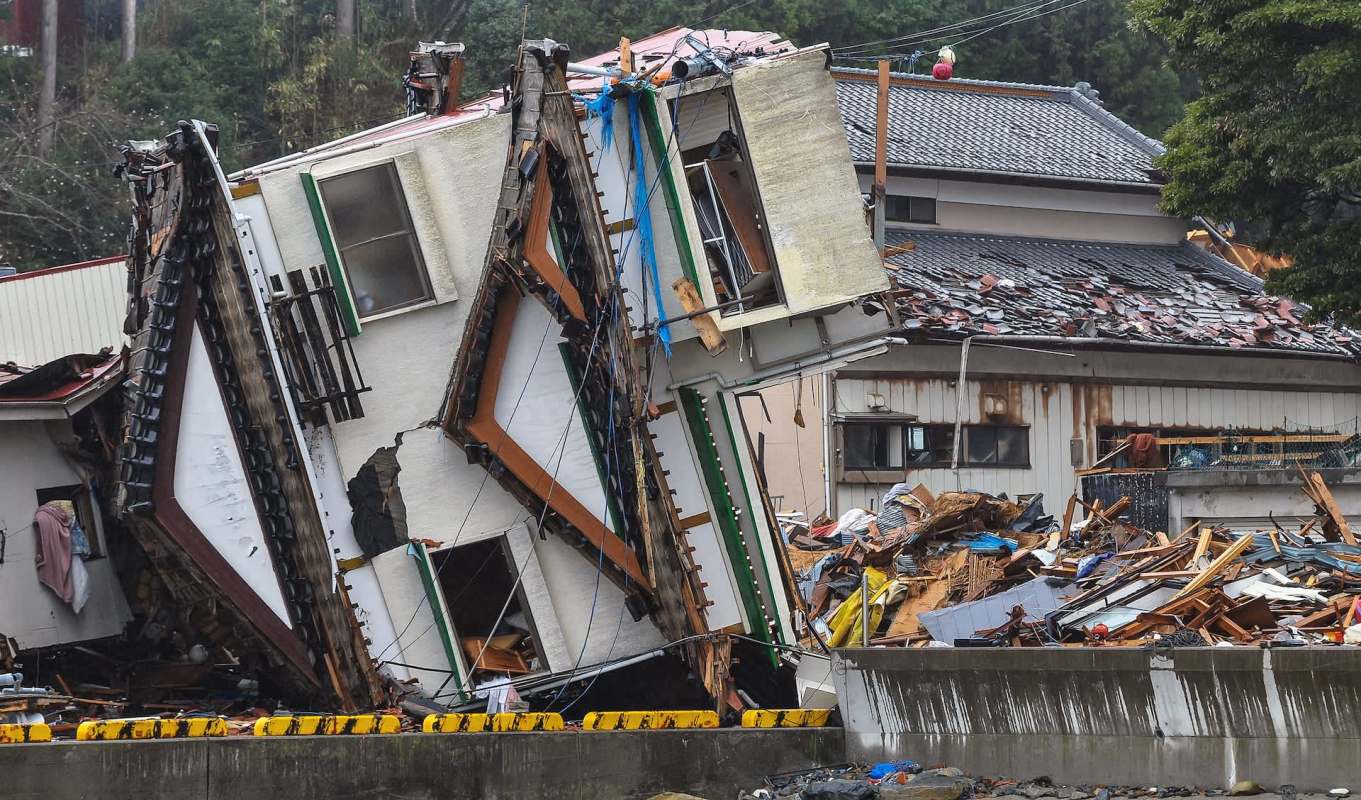
Despite scientific agreement on what caused a recent, lethal earthquake in Japan, conspiracy theories about how it happened spread.
According to AFP Fact Check, the magnitude 7.1 quake that struck the Kumamoto region on July 28 was the result of natural tectonic activity.
What happened?
At least 38 people died, homes and bridges were badly damaged, and many households lost water and power. Tremors were also felt in Busan, South Korea.
Both Japanese and U.S. authorities said the quake involved strike-slip movement, where masses of rock slide sideways past each other. The Japan Meteorological Agency described it that way, and the United States Geological Survey published the same assessment.
On July 28, Korean- and Japanese-language social media posts pointed to HAARP as the cause. The High-frequency Active Auroral Research Program is an Alaska-based research facility. Once operated by the United States Air Force, the University of Alaska Fairbanks now runs it.
One Threads post claimed, "After HAARP attacked Busan and Japan two days ago, earthquakes struck both places today."
TCD Picks » Quince Spotlight
💡These best-sellers from Quince deliver affordable, sustainable luxury for all




Scientists who spoke with AFP said there is no evidence that HAARP's radio transmissions can set off earthquakes.
Why is this concerning?
False claims after major disasters can make an already frightening situation even worse.
In the aftermath of an earthquake, accurate information about things like aftershocks and safety risks is far more useful, and can be far more comforting, than unsupported theories.
Speaking to AFP on Aug. 4, Ryan Schultz, a senior researcher at the Swiss Seismological Service at ETH Zurich, said some human activities, including mining and fluid injection, can trigger earthquakes. HAARP, however, has not been shown to do so.
He said human-induced seismicity is generally limited to a few kilometers, or at most a few tens of kilometers, from the activity involved. Those amounts are nowhere near the roughly 4,000 miles (6,500 kilometers) between HAARP and the Kumamoto epicenter.
Japan is among the world's most seismically active places. It sits on four major tectonic plates along the Pacific Ring of Fire, making strong earthquakes a recurring geological reality.
What's being done?
Researchers and fact-checkers continue to push back on disaster myths with basic earth science and transparent analysis.
In comments to AFP on Aug. 6, Emily Brodsky, a professor of Earth and planetary sciences at the University of California, Santa Cruz, said, "There is no evidence that electromagnetic pulses can be used to deliberately induce earthquakes."
Experts said these rumors also follow a familiar pattern.
Dongwoo Lim, a sociology professor at Kansai University who studies earthquake misinformation, told AFP that major quakes in Japan often bring back the same false narratives, including claims about "HAARP as well as artificial seismic waves, earthquake clouds and government-related conspiracy theories."
Regardless, studied information about how earthquakes happen remains true.
As Brodsky explained, "Earthquakes are created by stresses due to the movement of rocks and fluids underground that are not stimulated by electromagnetic pulses."

Get TCD's free newsletters for easy tips, smart advice, and a chance to earn $5,000 toward home upgrades. To see more stories like this one, change your Google preferences here.






