


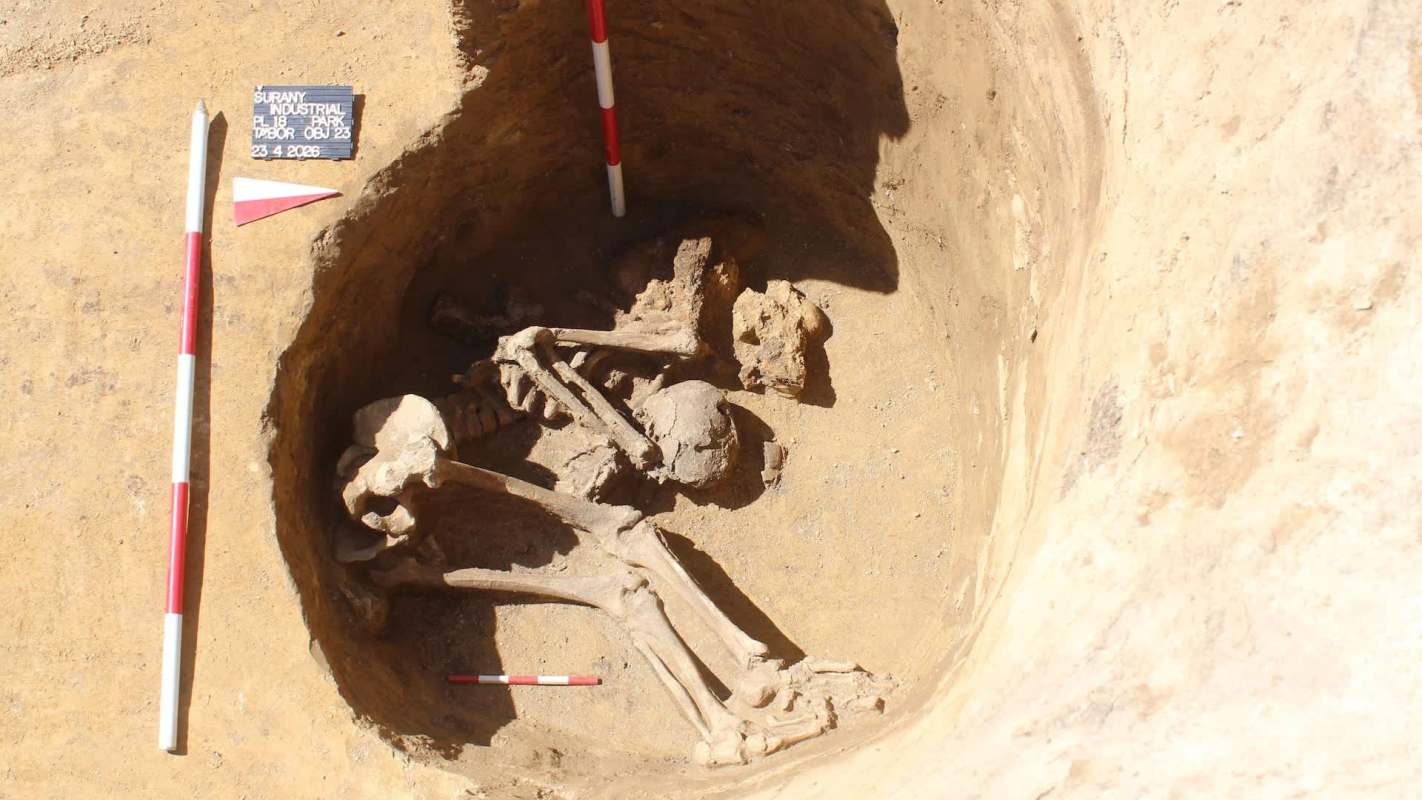
Construction crews preparing to build an industrial park in Slovakia expected to find little beyond soil and stone. Instead, they uncovered what appears to be the remains of a Roman military camp, a finding that could help fill in important gaps in the region's history.
Made near the town of Surany, the discovery is giving archaeologists an uncommon window into Roman movement north of the Danube during a turbulent stretch of the second century.
What happened?
While some researchers have supported a long-standing theory that Roman soldiers once passed through this part of present-day Slovakia, that hypothesis now has strong new support. As Popular Mechanics reported, archaeologists say the roughly 18-acre site dates to the Marcomannic Wars, a series of conflicts fought between 166 and 180 C.E.
Within the site, archaeologists identified defensive works, five gates, and a clavicula-style entrance protected by a semicircular ditch and rampart, which researchers said is the first gate of that type found in what is now Slovakia.
Ditches and shallow graves at the site held skeletal remains, and excavators also recovered a wide array of Roman military objects. Among them were spears, arrowheads, helmet pieces, segmented and scale armor, legionary brooches, coins, and military sandals fitted with iron sole nails, as well as everyday items such as an axe, a cutting tool, and a gaming die.
Why does it matter?
Finds like this can deepen historians' understanding of how war reshaped communities, borders, and migration routes across Europe. In this case, the camp helps address a major gap in the history of Roman presence north of the Danube in the late second century.
TCD Picks » Quince Spotlight
💡These best-sellers from Quince deliver affordable, sustainable luxury for all




The artifacts also offer evidence about the daily lives of the people involved, including what they wore and carried, even how they spent idle time.
An inscription from 179 C.E. below nearby Trencin Castle had already marked a Roman victory in the region. Taken together with the newly uncovered camp, that earlier evidence strengthens the argument that this area played a role in the Marcomannic Wars.
What's being done?
Researchers are now moving from excavation to lab work to tackle the biggest unanswered questions: Who was buried there? How did they die? And why were so many valuable objects left behind instead of being looted or recovered at the time?
Highlighting the international scope of the effort, the planned analysis includes radiocarbon work in Poland, sediment analysis in the Czech Republic, archaeogenetic research at the University of Vienna, and isotope testing across Germany, Poland, and South Africa. Those methods are used in archaeology to verify information such as age, origin, and diet.
Matej Ruttkay, director of the Institute of Archaeology of the Slovak Academy of Science, said "the context makes the find unique," noting that "the camp ceased to exist right after fighting."
If further testing supports that conclusion, Surany could become one of the clearest snapshots yet of a Roman force stopped in its tracks.

Get TCD's free newsletters for easy tips, smart advice, and a chance to earn $5,000 toward home upgrades. To see more stories like this one, change your Google preferences here.







