


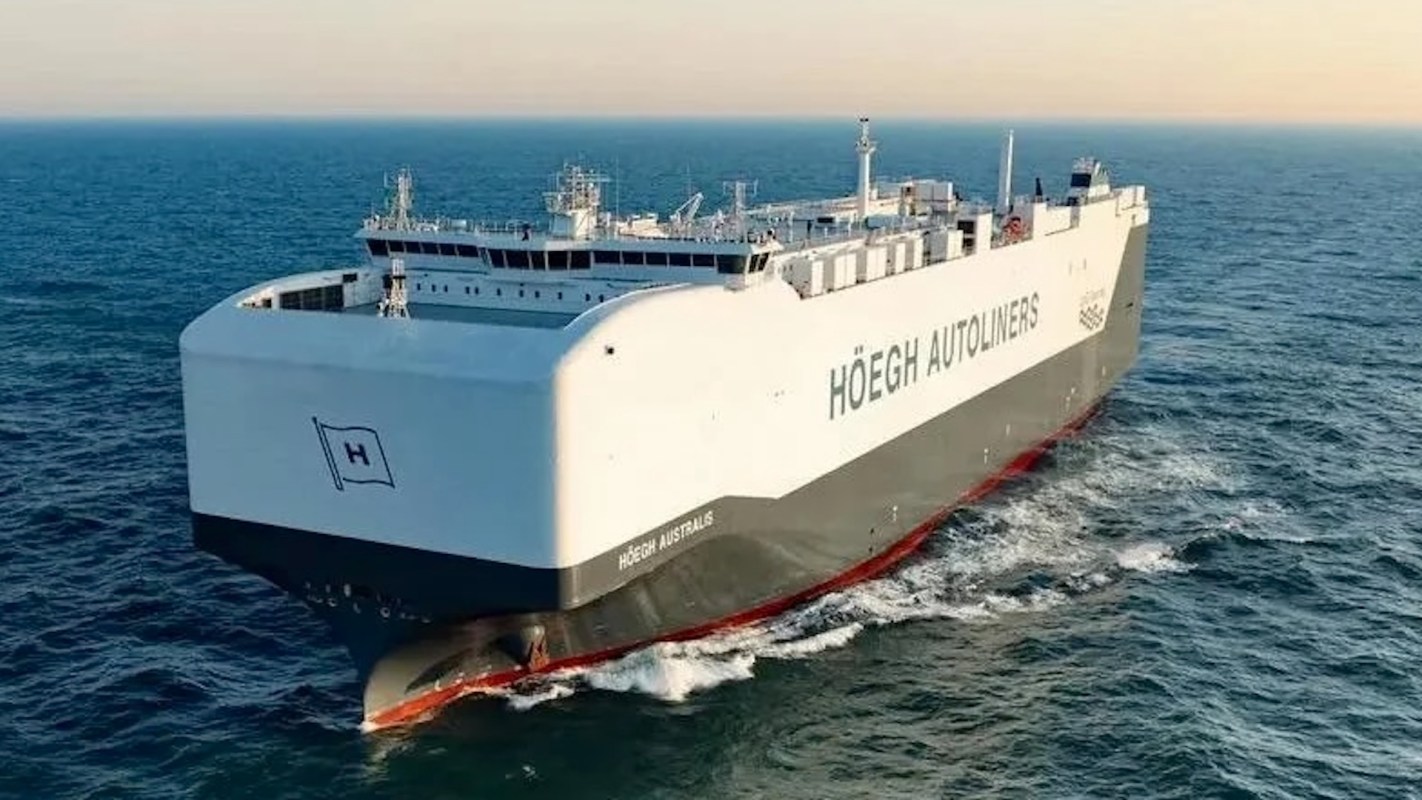
A car carrier capable of transporting up to 9,100 vehicles is set to combine four energy technologies to reduce fuel use and planet-warming pollution.
Höegh Autoliners plans to supplement the vessel's ammonia propulsion with a shaft generator, batteries, and solar panels.
Here's what to know
Aurora No. 12 is due for delivery in May 2028, with ammonia propulsion available from the outset. Höegh has agreed to have Chinese battery manufacturer BYD equip the ship with an integrated energy system, gCaptain reported.
Höegh said the combination will be a first for deep-sea car carriers and will establish a new fuel-efficiency benchmark for pure car and truck carriers. The companies signed their agreement at COP31 in Antalya, Turkey.
Höegh Autoliners CEO Andreas Enger said:
"This shows that shipping can take the lead in the green transition. We are combining every green technology available on one vessel capable of running on ammonia from day one. Nobody has done that on a deep-sea car carrier before."
TCD Picks » Quince Spotlight
💡These best-sellers from Quince deliver affordable, sustainable luxury for all




More background
The battery system will help manage onboard energy alongside the solar panels and shaft generator, according to gCaptain. Höegh estimates that the combination will avoid approximately 1,100 U.S. tons (1,000 metric tons) of carbon dioxide-equivalent greenhouse gas emissions each year while reducing fuel costs.
Green ammonia costs more than conventional marine fuels. Using less fuel could help Höegh offset that expense as it introduces ammonia propulsion.
While ammonia releases no carbon dioxide when burned, its environmental impact depends largely on how it is produced.
What's being done?
Aurora No. 12 is part of Höegh's Aurora-class shipbuilding program at the Chinese yard China Merchants Heavy Industry, gCaptain reported. The company said the class can cut per-vehicle carbon emissions by up to 58% relative to conventional car carriers.
Höegh's August order added six Aurora-class ships, taking the program's total to 18 vessels, according to gCaptain. The total could reach 26 if options and reserved construction slots are used.
Everllence supplies the engines, Kongsberg Maritime provides the bridge systems, and DNV class notations cover ammonia and methanol readiness.
BYD says the Aurora No. 12 partnership will showcase the deep-sea shipping capabilities of its containerized batteries, adding another application for the manufacturer's energy-storage equipment.
Höegh Autoliners chief operating officer Sebjørn Dahl said:
"We want to push ourselves technologically and learn what green technology can achieve when it is combined at its best."
Where can I learn more?
Batteries and solar panels are changing how vehicles use energy on land, too. These stories cover electric freight trucks, a solar-equipped motorhome, and sodium-ion batteries.
• In Australia, battery-swap truck retrofits aim to reduce freight costs, emissions, and charging downtime.
• Scania has launched a 474-mile electric truck in Europe as long-haul electric trucking gains ground.
• A solar-equipped motorhome in Africa ran two air conditioners, plugging in just three times yearly.
• Sodium-ion batteries are reaching EVs and home storage without using lithium or cobalt.

Get TCD's free newsletters for easy tips, smart advice, and a chance to earn $5,000 toward home upgrades. To see more stories like this one, change your Google preferences here.
Cool Picks






