


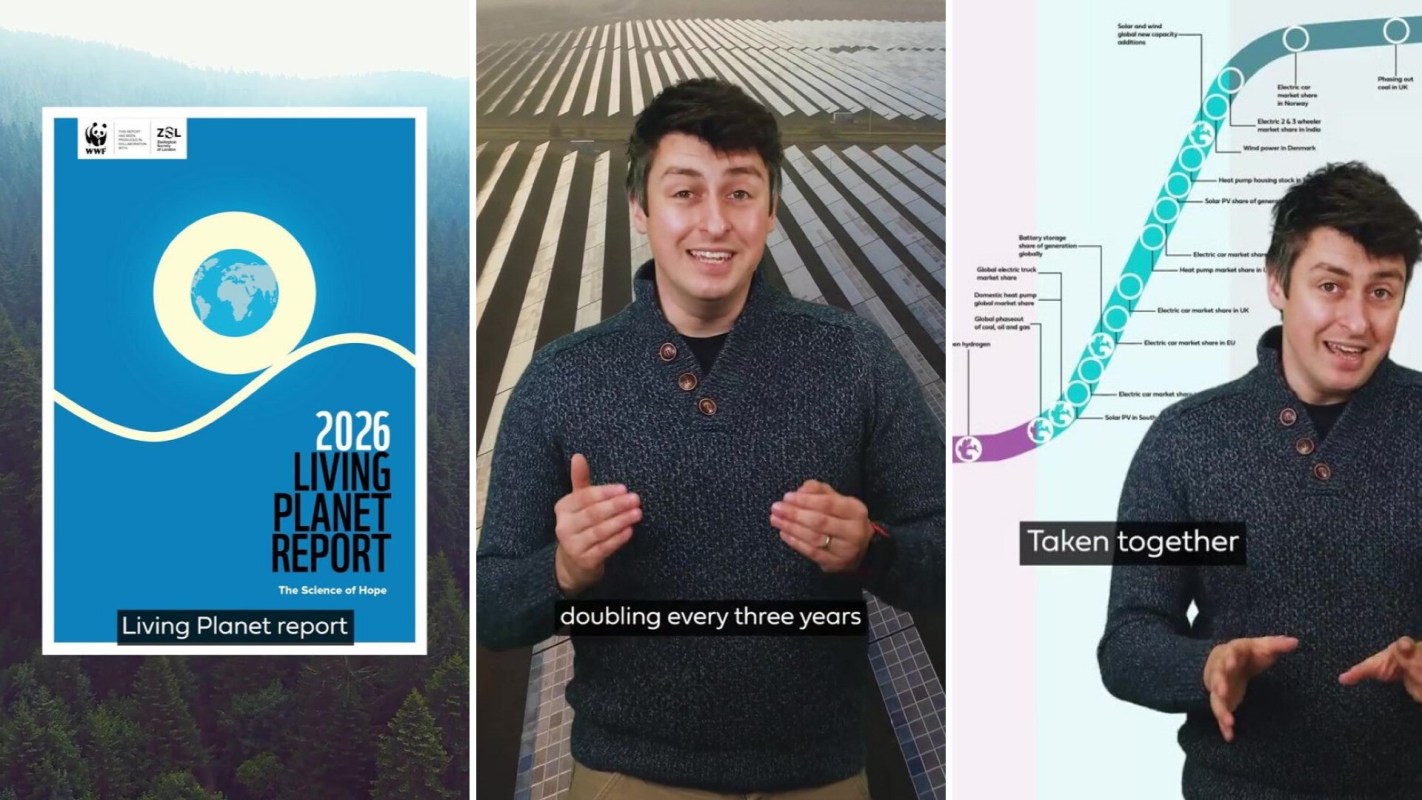
Climate communicator Dr. Simon Clark said global solar power is no longer inching forward; it's now scaling fast enough to reshape the outlook for climate action, with global solar capacity doubling every three years.
Here's what to know
In a TikTok explainer, Clark declared that "Solar has reached a positive tipping point."
Citing an S-curve graphic from the WWF's Living Planet Report 2026, Clark (@simonoxfphys) said parts of the energy transition are already moving beyond the experimental stage and into the mainstream.
Clark, who has a PhD in atmospheric physics, framed the shift in three stages: enabling, accelerating, and stabilizing. He noted that the world's energy system produces "three-quarters" of our greenhouse gas pollution.
He used national examples to show how far some sectors have already come.
"Already the UK has phased out coal power. Already 96% of Norway's new car sales are EVs," Clark said, adding that India is also seeing a major share of new two- and three-wheeler sales go electric for "last leg urban transport."
TCD Picks » Quince Spotlight
💡These best-sellers from Quince deliver affordable, sustainable luxury for all




For Clark, solar is the clearest example of how that shift happens. He said solar's rise shows what the curve looks like in practice.
"20 years ago, it was expensive and slow to deploy," Clark said. But after costs fell below gas power in many cases, "the world's solar capacity is now doubling every three years."
One commenter wrote, "It's definitely looking less depressing than 5-10 years ago."
More background
Clark placed agriculture alongside green hydrogen, green steel, and green ammonia used for fertilizer and shipping fuel as sectors that remain earlier on the curve and still need "lots of work." He added that all these things add up.
He tied that warning to the current trajectory, saying the world is "on course for 2.8 degrees of warming" at its current pace, while "we're at 1.4 now and already seeing significant impacts." Keeping peak warming to 1.8 degrees before bringing it back down to 1.5 would require global pollution to fall 18% by 2030 and 45% by 2035.
Some viewers also pointed to bottlenecks beyond generation itself. Constraints involving transmission, labor, or permitting can slow the expansion of cheaper clean power.
Clark's broader point was that more affordable solar helps drive EVs, electric heating, and other technologies that spread more widely as clean electricity becomes easier to deploy.
What's being done?
Clark argued that the next step is to accelerate financially and politically.
"We need governments and the finance sector to rapidly scale up investments in the clean economy of the future and dial down subsidies for polluting industries," he said.
He also highlighted what he described as a stark imbalance: "Right now, for every dollar the world spends on protecting nature, it spends $30 destroying it."
In the UK, Clark pointed to several policy steps he said would speed the transition, like stopping new fossil fuel extraction, such as the Rosebank field, backing EVs, and "generously funding the Warm Homes Plan."
Other commenters called out slowing the growth of data centers, while touting Lula's recent win in Brazil as a victory for the Amazon.
Where can I learn more?
Solar's rapid rise is already showing up in power systems and markets worldwide.
• In China, solar capacity overtakes coal in a landmark shift for the power system.
• In the U.S., enough installed capacity now exists to power 50 million homes.
• Across emerging markets, solar now beats fossil fuels on upfront costs and financing.
• Globally, solar factories can make 1.2 TW more panels than annual demand.
• On Australia's main grid, rooftop solar tops half of demand during 80% renewable days.

Get TCD's free newsletters for easy tips, smart advice, and a chance to earn $5,000 toward home upgrades. To see more stories like this one, change your Google preferences here.






