


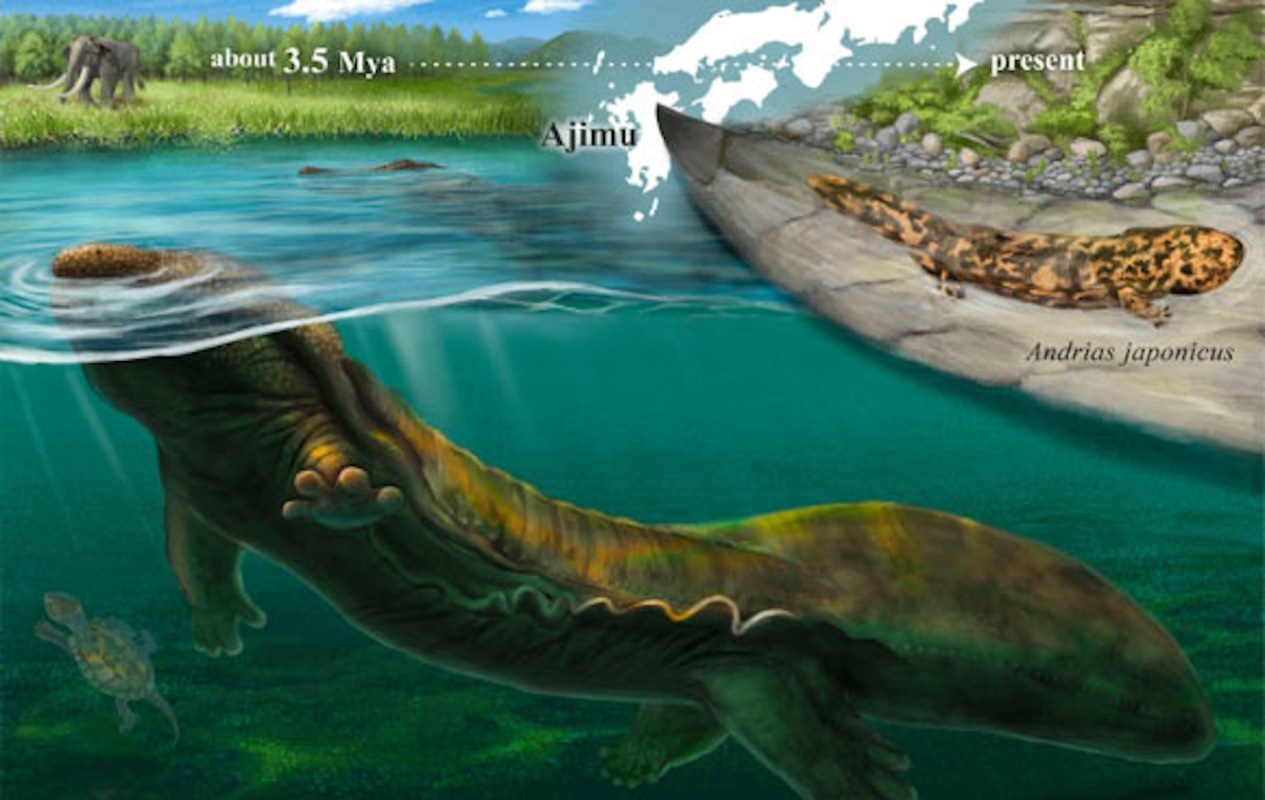
Three vertebrae unearthed in Japan have been linked to a newly named giant salamander from roughly 3.5 million years ago, indicating that this extinct amphibian lived in lake environments instead of the swift rivers used by its surviving relatives.
The discovery also closes an important gap in the known history of a very ancient amphibian family, according to Sci.News.
What happened?
The bones were originally placed in the living giant salamander genus Andrias, but researchers later reassessed them and recognized a separate genus and species, Limnospondylus ajimuensis.
As Sci.News reported, the remains were collected between 1995 and 1997 from deposits in the Tsubusagawa Formation on Kyushu Island.
Using micro-computed tomography alongside geometric morphometric analysis, Dr. Masahiro Noda of Kyoto University and his coauthors compared the vertebrae with giant salamanders living today as well as fossil forms.
They determined the remains represented a previously unknown animal, estimated at about 3.6 feet in length.
TCD Picks » Quince Spotlight
💡These best-sellers from Quince deliver affordable, sustainable luxury for all




Although shorter than today's biggest giant salamanders, which can reach about 6 feet, it was still a large, fully aquatic predator.
The modern Cryptobranchidae family now survives in Japan, China, and the United States.
The team said, "The Tsubusagawa Formation has yielded exceptionally abundant vertebrate and invertebrate fossils. This assemblage is referred to as the Ajimu fauna."
Why does it matter?
Giant salamanders have a history stretching back more than 60 million years, but East Asian fossils from that lineage are rare.
A newly recognized Japanese genus therefore gives researchers a better basis for tracing how these amphibians changed over time and how widely they were distributed.
The discovery points to a past in which giant salamanders used habitats beyond those seen in living species.
Whereas modern members of the group are typically tied to fast-moving rivers, Limnospondylus ajimuensis seems to have inhabited freshwater lake systems surrounded by wetlands and forests.
That distinction helps researchers reconstruct what western Japan looked like during the Pliocene.
According to the study, the region hosted a subtropical ecosystem with crocodilians, turtles, rhinoceroses, elephants, birds, and fish — a very different world from the one seen there today.
Researchers think the species may have disappeared as temperatures cooled beginning about 2.6 million years ago and freshwater environments contracted, leaving the lake-dwelling salamander without the habitat it needed.
What's being done?
By publishing a formal description of the species in the journal PeerJ, the researchers have established a new comparison point for future work on East Asian salamander evolution.
The fossils also show the value of revisiting museum and field collections with newer imaging tools. Bones collected decades ago can still reshape the scientific record when they are studied with updated methods and broader comparisons.
Amphibians are especially sensitive to changes in water quality and habitat fragmentation, and wetlands, streams, and lake systems often require long-term conservation before species disappear.
In Japan, living giant salamanders face habitat destruction and hybridization with nonnative species.
"Recently, Japan's native giant salamanders have faced challenges such as hybridization with foreign species and habitat destruction," Dr. Noda said. "This research has given me a renewed appreciation for the importance of preserving extant species for the future."

Get TCD's free newsletters for easy tips, smart advice, and a chance to earn $5,000 toward home upgrades. To see more stories like this one, change your Google preferences here.






