


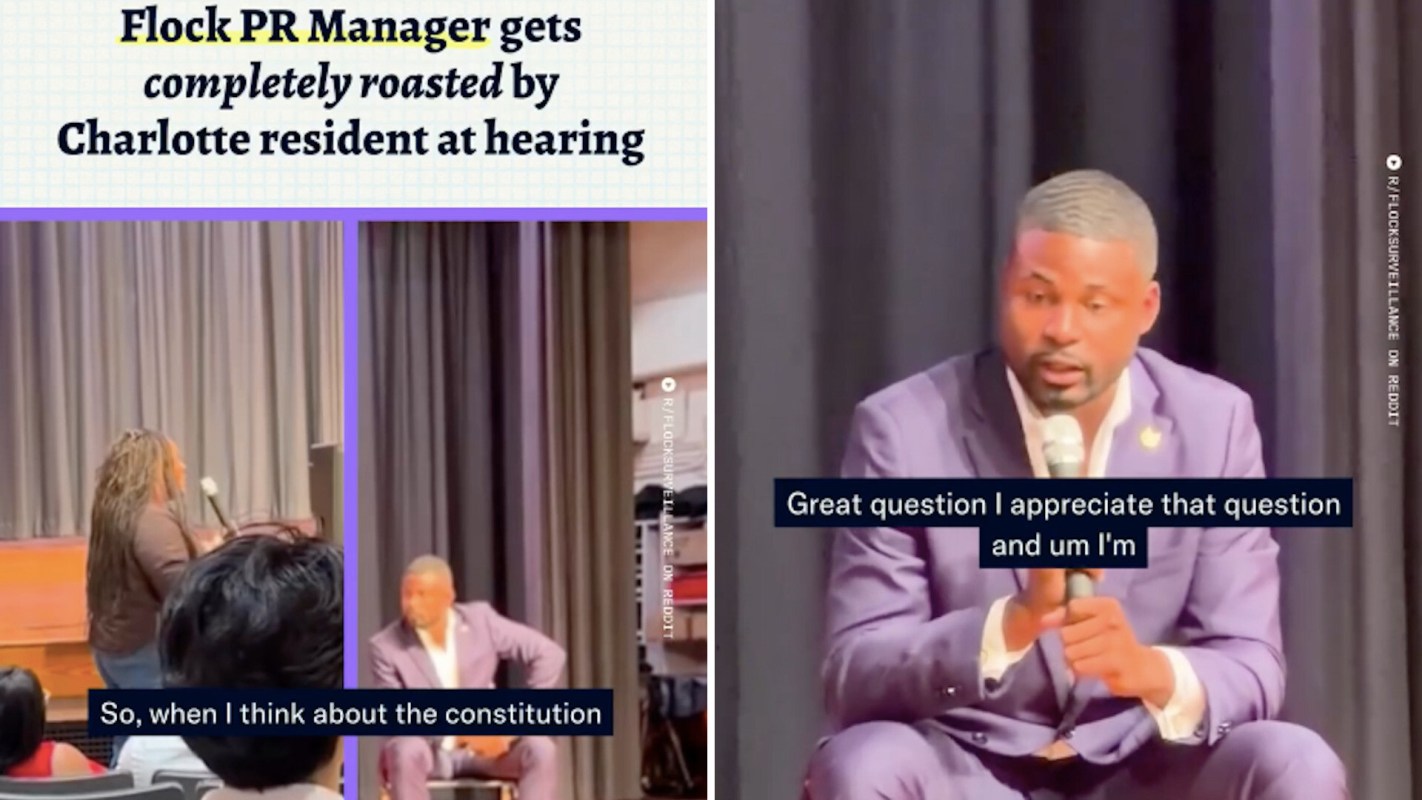
A meeting in Charlotte, North Carolina, turned into a sharp rebuke of private surveillance when a resident pressed a Flock representative on constitutional privacy and public accountability.
Instead of answering directly, the representative said he felt "lightheaded."
Here's what to know
A video shared on Instagram by More Perfect Union (@perfectunion) shows a Charlotte resident steering the discussion past Flock's internal abuse monitoring and toward a different question about surveillance power, asking, "How do we hold Flock Cameras accountable?"
She also argued that Flock's private-company status creates a public oversight problem, telling the representative, "Y'all aren't elected, y'all aren't appointed, y'all aren't connected to the elected officials that we elect to represent us." From there, she invoked the Fourth Amendment and the idea that people have a "reasonable expectation of privacy" in spaces courts recognize as protected.
His answer did not describe any way for the public to hold the company accountable. He responded, "Great question. I appreciate that question. And I'm sorry, I'm not feeling too well for some reason."
While he may have been experiencing an unrelated medical issue or overheating in the lights, the result was not a good look. The video's caption got even more straight to the point, saying, "A Flock representative met with residents of Charlotte, North Carolina where he got roasted on public accountability and then claimed he was 'feeling a little light-headed.'"
TCD Picks » Quince Spotlight
💡These best-sellers from Quince deliver affordable, sustainable luxury for all




The Instagram video then cuts off after he says this, though in fairness to him, a longer clip on Reddit shows he collected himself and continued on to provide an answer, largely pertaining to the company giving localities control over how the technology is used.
"We go hands-off in that process and allow your voices, the people you elect, to say 'this is how we think the system should be used,'" he said as part of his response.
The resident then continued into more concerns, such as what happens if Flock were bought by another person or entity that could then gain access to such a powerful network of surveillance tools with different protocols, illustrating that her concerns would remain from the core existence of the surveillance system without much consolation earned by how its current policies would be adaptable by local governments to potentially limit the scope of their use.
More background
The resident framed her critique through constitutional law, not as a generalized objection to cameras, saying, "The Fourth Amendment protects people from warrantless seizures, searches, which they have a reasonable expectation of privacy."
She connected that principle to life in Charlotte-Mecklenburg by arguing that people are entitled to privacy in "their safe space," while also contending that a private surveillance company should not escape the kind of scrutiny residents can direct at elected officials.
A commenter identifying herself as the speaker wrote, "Hey ya'll, that's me! I'm a lawyer, organizer and lifelong Charlottean who doesn't believe that Flock Camera or any AI Mass Surveillance belongs in my city or yours!"
Another commenter focused on how forcefully she delivered the question, writing, "This lady was laying out attorney-level context & background before she really got started."
What's being done?
The speaker explicitly set aside whether Flock was "the newest camera company to be working with law enforcement," keeping the conversation centered on accountability rather than product rollout.
After noting that the company had already said it was tracking "misuse and abuse," she narrowed the focus to what many residents seem to care about most: what happens when internal safeguards aren't enough, and who the public can turn to when a private company holds that power.
Where can I learn more?
The Charlotte exchange is part of a fight over how surveillance tech and data collection can outpace public oversight, as shown in the similar disputes below.
• In Pennsylvania, lawmakers moved to ban AI surveillance pricing as privacy and fairness concerns grew.
• At an apartment building, tenants objected after a camera inside the entrance recorded residents without consent.
• Homeowners said their HOA used controversial tactics for surveillance with drones over neighborhood property.

Get TCD's free newsletters for easy tips, smart advice, and a chance to earn $5,000 toward home upgrades. To see more stories like this one, change your Google preferences here.






