


Evolution may be less of a stop-and-go process than scientists once believed.
A team in Israel argues that adapting successfully to an environment does not necessarily leave a species in a state of purely random change. Even then, evolutionary change can keep trending in one direction.
Here's what to know
Using a mathematical model, Technion Israel Institute of Technology biologists Naama Brenner and Razi Fachareldeen found that evolution can remain patterned even without any newly introduced selective pressure.
In Popular Mechanics, the finding is presented as a challenge to the classic view that once a population is already well matched to its surroundings, later changes are mostly a matter of chance.
Their analysis depends on the idea of a fitness landscape, a framework geneticist Sewall Wright introduced in the 1930s. In that picture, evolution plays out across peaks and valleys, with higher ground standing for trait combinations that improve survival and reproduction.
Another central idea is degeneracy: different mixes of traits can deliver the same level of success. In other words, different evolutionary routes can lead to the same favorable outcome.
TCD Picks » Quince Spotlight
💡These best-sellers from Quince deliver affordable, sustainable luxury for all




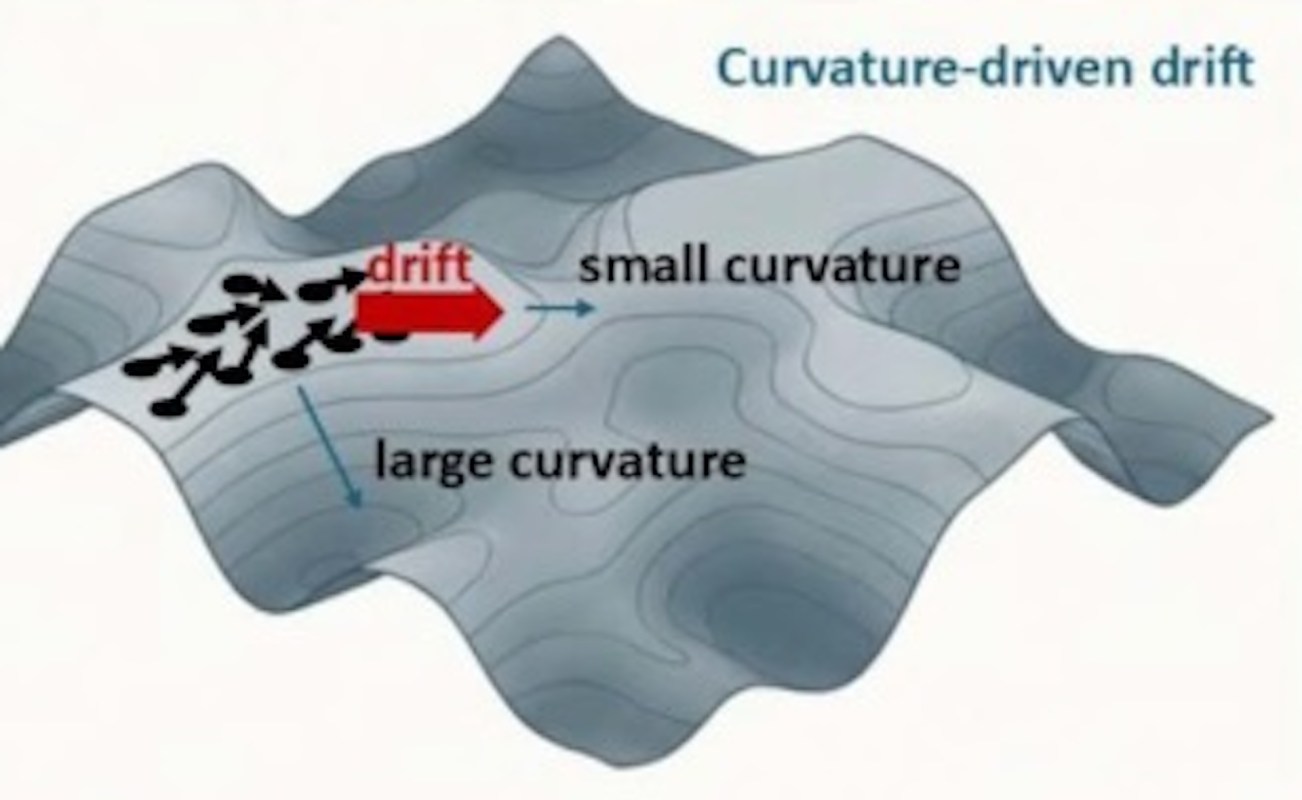
"This drift arises from an interaction between population variability and landscape curvature," the researchers said in their study published in PNAS. "Curvature shapes phenotypic variation, which in turn biases evolutionary exploration even when fitness gradients vanish. As a result, evolution exhibits an implicit bias, preferentially selecting flat and robust regions of the degenerate fitness manifolds, without explicit optimization for these properties."
More background
For years, the standard assumption was that once a population reached one of these high-fitness positions, any further shifts would mainly come from random genetic drift.
Their model instead points to a patterned process they call directional drift.
Under that process, populations tend to move toward flatter, more stable parts of the landscape. Because mutations are less likely to knock them off course there, a species can become more robust even without facing a new challenge.
A species may appear unchanged on the surface for millions of years while still undergoing subtle shifts that make it sturdier and better buffered against disruption.
It also suggests that tiny phenotypic differences, small variations in observable traits, may preserve a record of where a population has been and where it may still be headed.
That could give researchers new ways to study resilience in everything from wild animal populations to microbes and crops.
What's being done?
One implication is that researchers may need to pay closer attention to curvature, or the rate at which fitness declines when traits change slightly. In the model, steeper directions limit certain kinds of variation, while flatter ones leave more room for populations to keep moving through safer territory.
In practical terms, this kind of research could improve how biologists interpret natural diversity. Small differences between individuals may not be meaningless noise after all. They may reveal how a population has been shaped over time and how resistant it is to future disruptions.
"Our results provide a complementary geometric and dynamical interpretation of such observations as potentially reflecting gaps in curvature of directions in trait space," the researchers said. "Further study of natural variability in connection to our model is an important direction for future work."
Where can I learn more?
These stories examine how different species respond to real-world pressures.
• In the eastern Baltic, cod have shrunk under intensive fishing, revealing evolution's ecological costs.
• In barley, a flowering mutation could steady harvests as climate stress intensifies.
• White-lipped peccaries show behavioral resilience to rising heat, hinting that some species can adjust.
• In the US South, hybrid fire ants are spreading through habitat-friendly conditions.
• On farms, mice can't evolve resistance to a seed treatment based on oil.

Get TCD's free newsletters for easy tips, smart advice, and a chance to earn $5,000 toward home upgrades. To see more stories like this one, change your Google preferences here.






