


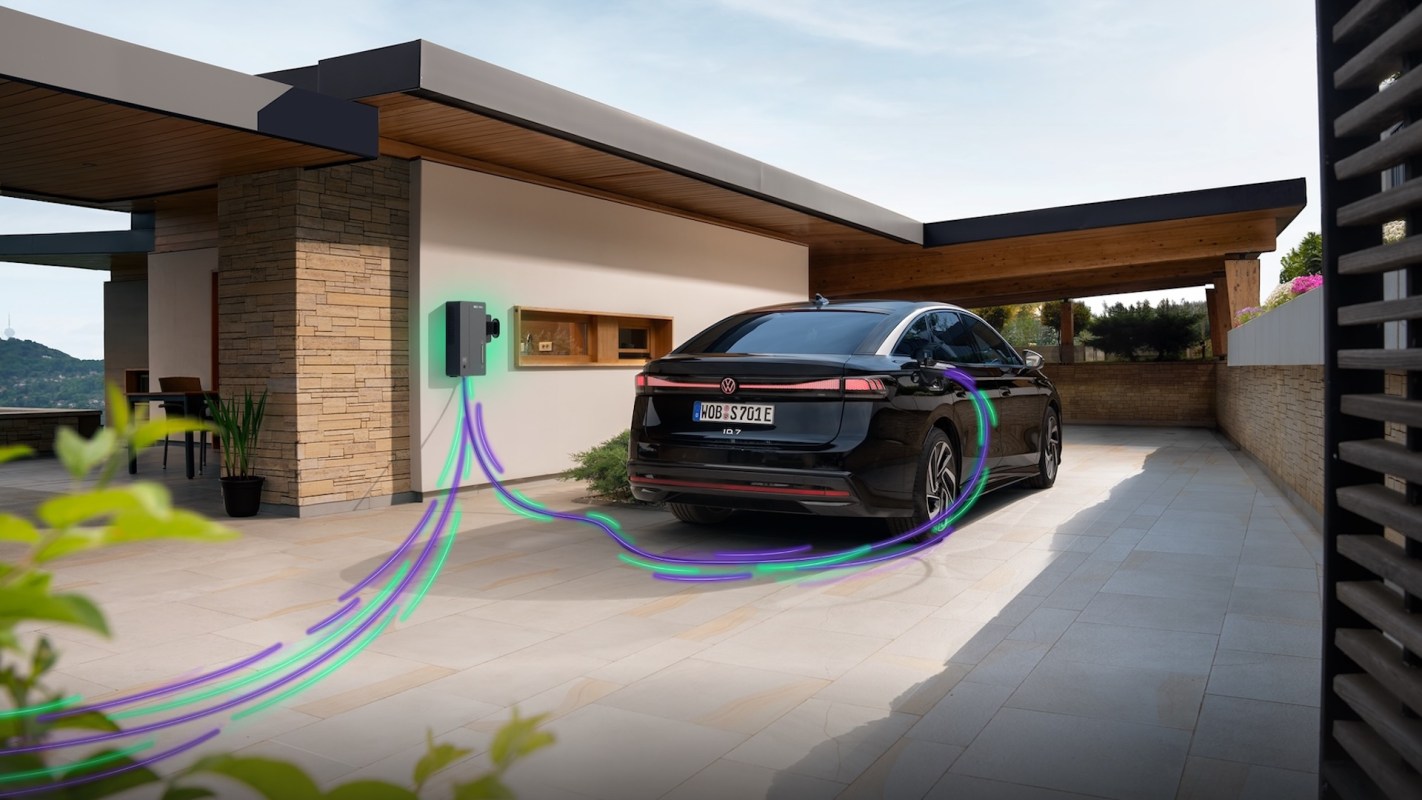
As heat waves, severe storms, and wildfires strain Europe's power grid, more people are looking for ways to make their homes more energy independent and better prepared for outages. Luckily for EV drivers, a growing number of vehicles can now be plugged into a home, offering a valuable power source during emergencies.
For drivers in Germany, a parked EV may soon double as both a household power reserve and a source of extra income.
What's happening?
According to Euronews, some new EVs are being designed to move electricity in more than one direction: into a house when the power goes out and out to the grid when electricity is especially needed.
In practice, that means one car battery could cover basics such as refrigeration, lighting, and running medical equipment and other necessities during a blackout, then later be used in ways that may generate money.
The outlet reported that Volkswagen and its energy brand, Elli, are preparing a complete vehicle-to-grid, or V2G, offer for private customers in Germany, with a launch set for the fourth quarter.
Volkswagen says, as Euronews reported, that, under its new program, drivers can give permission to utility operators to send electricity from their EVs to the grid during periods of high demand. In return, they could be paid €900, or $1,038, each year for their vehicle's excess energy.
TCD Picks » Quince Spotlight
💡These best-sellers from Quince deliver affordable, sustainable luxury for all




"Electric mobility can only realise its full potential if it also makes economic sense for our customers," Martin Sander, a Volkswagen board member responsible for sales and marketing, said, per Euronews. "With vehicle-to-grid, we are delivering exactly that."
Why does it matter?
This technology could make the grid more reliable and provide savings for consumers in multiple ways.
For households facing more frequent disruptions from extreme weather, an EV in the driveway could function like a backup battery for the home without the need for a generator, avoiding the fuel, noise, and maintenance costs associated with conventional standby systems.
Euronews cited a Fraunhofer Society study that showed widespread, effective vehicle-to-grid programs in Europe could lower energy system costs by $25 billion a year by 2040, reducing the rates consumers pay for their energy.
It may also put excess renewable power to use. The outlet reported that Germany curtailed about 9,374 gigawatt-hours of renewable electricity in 2024 because supply outpaced demand; with vehicle-to-grid programs, some of that electricity could be stored in EV batteries and delivered later when it is needed.
What's being done?
Automakers and charging companies are moving quickly to make the technology a practical option for consumers.
Examples are already emerging across Europe. Kia and Hyundai have reportedly started offering a vehicle-to-grid service in the Netherlands, Mercedes-Benz has introduced bidirectional charging, and in the United Kingdom, BYD has linked one model to an Octopus Energy tariff that allows drivers to send electricity back to the grid, according to Euronews. Nissan, meanwhile, plans to introduce affordable bidirectional charging in 2026, beginning in the U.K.
The setup is not yet simple, though.
Euronews noted that full bidirectional charging is still available in only some EVs, and a charger and installation can cost several thousand euros more than a standard home charging system. Utilities must also approve the connection, and some automakers have expressed concerns about battery wear and warranty coverage.
However, despite the early learnings, experts quoted by Euronews say bidirectional charging programs have significant potential.
"We already know [the impact of] providing electricity to the home during an outage," said Scott Samuelsen, an engineering professor emeritus at the University of California, Irvine. "This is going to become very, very popular."

Get TCD's free newsletters for easy tips, smart advice, and a chance to earn $5,000 toward home upgrades. To see more stories like this one, change your Google preferences here.






