


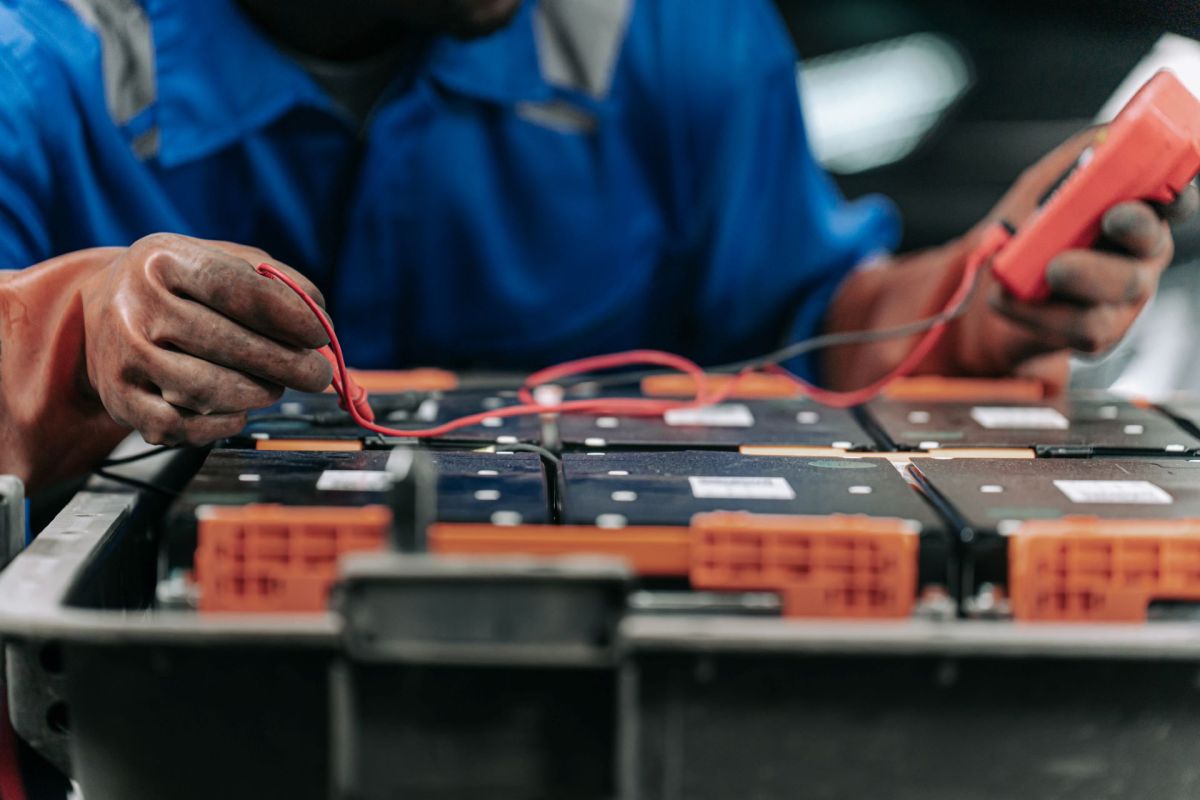
A new study found that an electric vehicle battery pack can lose a significant amount of useful life due to just a handful of underperforming cells.
The finding matters for individual drivers as well as transit systems and delivery fleets. Longer-lasting batteries can help cut costs, reduce vehicle downtime, and make EV performance more reliable over time.
Here's what to know
Drawing on more than three years of EV data, the study followed passenger cars with nickel-manganese-cobalt batteries and buses with lithium-iron-phosphate batteries. Some of the vehicles logged as many as 186,000 miles (300,000 kilometers), according to Interesting Engineering.
The work was led by Professor Chen Zhongwei of China's Dalian Institute of Chemical Physics and Professor Zou Changfu of Sweden's Chalmers University of Technology.
The results suggest that battery-pack aging is not governed simply by how the average cell performs. Instead, the researchers found a "weakest-cell" effect in which a small cluster of faster-degrading cells can reach voltage or safety limits ahead of the others.
As a result, just a few weaker cells can effectively determine when the whole pack must be retired, even if the vast majority of a battery's cells remain healthy.
TCD Picks » Quince Spotlight
💡These best-sellers from Quince deliver affordable, sustainable luxury for all




"Our findings show that the performance and lifetime of an EV battery pack are not determined solely by the average aging level of their cells, but can be strongly constrained by a small number of faster-aging cells," said Chen Zhongwei, per Interesting Engineering.
The impact on battery life was significant. Measured against a common retirement threshold, passenger-car packs lost 17.7% of their lifespan and bus packs lost 22.8% due to the weakest cell effect.
More background
Rather than studying batteries only in laboratory settings, the researchers looked at packs during real-world vehicle use. They collected voltage, current, temperature, and state-of-charge data, then combined battery models with neural networks to model how individual cells evolved over time.
In passenger cars, cell-to-cell differences stayed relatively small at lower mileage. However, as vehicles crept above 105,000 miles (about 170,000 kilometers), some cells began deteriorating much faster than others, and performance gaps between different cells became much more pronounced.
What's being done?
The researchers pointed to several ways the industry could curb the weakest-cell effect, including more consistent manufacturing, smarter cell grouping, stronger balancing controls, better thermal management, and reconfigurable battery systems.
"By quantifying this weakest-cell effect under real-world EV operation, our study provides a basis for improving battery utilization, lifetime management, and system-level optimization," said Chen Zhongwei, per Interesting Engineering.
Where can I learn more?
The stories below look at other battery-related challenges, from efforts to reduce lithium-ion failure risks and improve battery designs to projects focused on recycling or reusing packs after road service ends.
• Researchers are advancing solutions to fiery lithium-ion failures that can threaten EV battery safety.
• At McGill University, chemists made progress bringing solid-state batteries closer to practical EV use.
• In Germany, engineers are building a battery recycling project to recover valuable EV materials.
• Near San Antonio, B2U is proving a second life for batteries can support city-scale storage.

Get TCD's free newsletters for easy tips, smart advice, and a chance to earn $5,000 toward home upgrades. To see more stories like this one, change your Google preferences here.






