


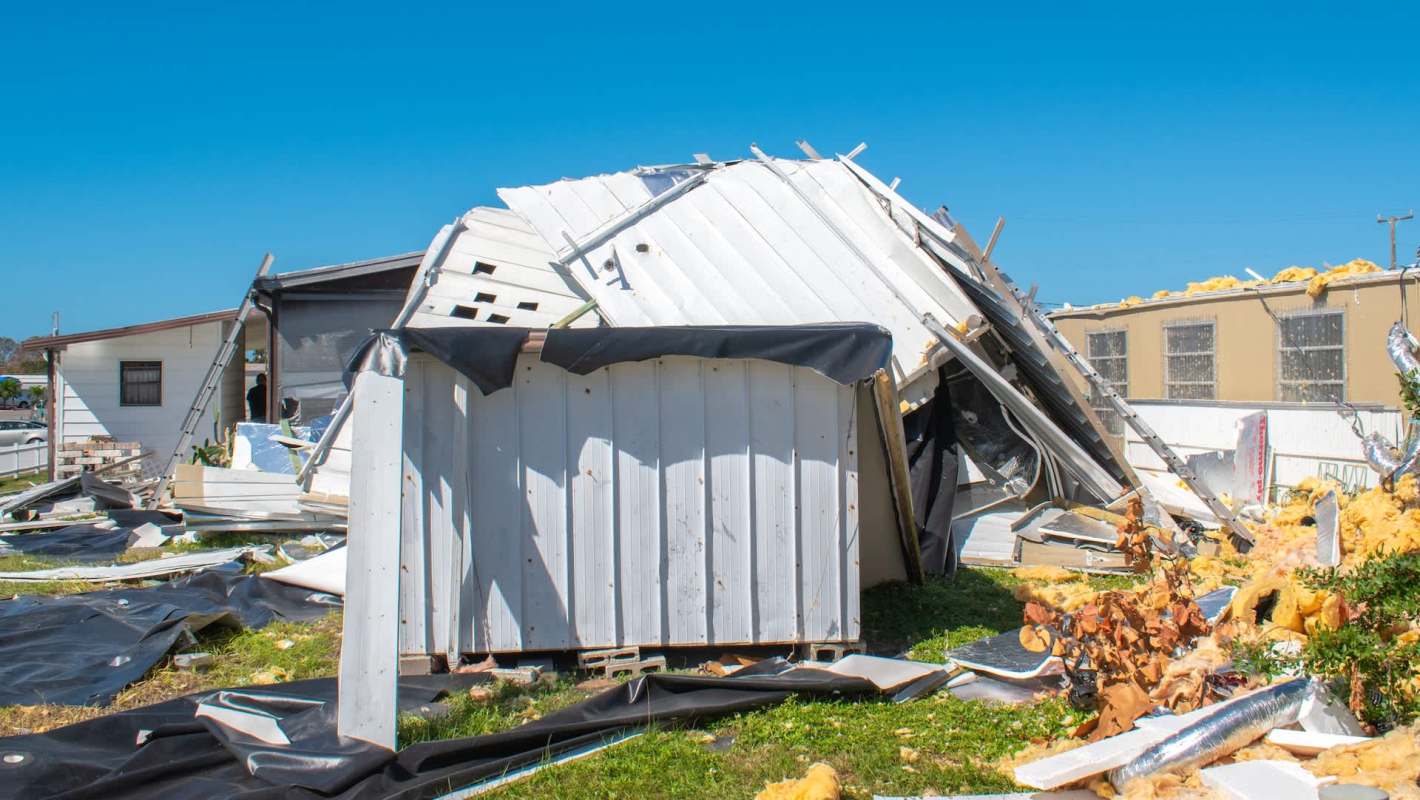
To improve public safety, researchers at Florida International University's Wall of Wind are intentionally pushing manufactured homes until they overturn.
In the lab, full-scale homes are exposed to 157-mph winds and wind-driven rain so scientists can identify weak points in the straps, anchors, and other connections before storms do.
Here's what to know
According to Grist, Elaina Sutley, a structural engineer and professor of civil, environmental, and architectural engineering at the University of Kansas, is leading experiments that test manufactured homes to the point of failure under different installation methods. The research aims to show whether simple upgrades could help millions of households stay safer in extreme winds.
Grist reported that 6.7 million manufactured homes house more than 20 million Americans, and many predate the tougher federal wind rules adopted after Hurricane Andrew in 1994. Because these homes typically rest on piers rather than conventional site-built foundations, their storm performance depends heavily on the tie-downs, anchors, and supports below.
Where a home is installed is another concern. The Department of Housing and Urban Development, or HUD, sorts the country into three wind zones, and in much of Wind Zone 1, vertical ties aren't required; Sutley's early findings suggest a lighter standard may not be enough.
Her team sees stronger retention systems, including Wind Zone 3-style vertical ties, as a possible way to lower the odds of failure.
TCD Picks » Quince Spotlight
💡These best-sellers from Quince deliver affordable, sustainable luxury for all




More background
Manufactured housing is both affordable and highly exposed to climate-related danger. Andrew Rumbach, whom Grist describes as a senior fellow at the Urban Institute, explained, "When we look across the country, we see that manufactured housing is exposed at a higher rate to certain climate hazards than other forms of housing."
A study Rumbach co-authored, per Grist, found roughly 5 million manufactured homes sitting in some of the areas most exposed to climate disasters. Another review found that more than half of the 1 million new manufactured homes installed went into Gulf states, where hurricane risk is especially high.
Citing FEMA, Grist reported that average yearly losses from hurricane winds alone reach $29 billion. Rumbach also argued that poor performance during floods or heat waves can cost a homeowner "much more costly to a homeowner" than paying upfront for stronger protections.
What's being done?
In addition to documenting how homes fail, Sutley's team is evaluating practical fixes. One proposal is to require vertical ties nationwide, since they link the frame to the ground anchors and better resist the upward pull that can tear a home off its supports.
The research is also looking at options beyond standard tie-down straps. In one test, Sutley worked with Clayton Homes on metal struts, or rigid bracing, that can resist both pushing and pulling forces, and those systems could be a less expensive retrofit than building a new foundation outright.
Regina Blanchard, owner of Blanchard's Mobile Home Removals and Transport in Hollywood, Florida, warned that some newer tie systems are weaker at key connection points: "They're just riveted in. And that's horrifying because all of the torque and stress of an uplift on a house is on those anchors and on those sidewalls."
Grist reported that HUD plans to review Sutley's findings as it decides whether to adopt the recommendations. Because manufactured homes are built under a single federal code, any effective changes could spread across the industry at scale.
When Grist asked whether stronger anchors, vertical ties, and metal bracing could truly change outcomes for families during severe storms, Elaina Sutley, a University of Kansas structural engineer, said, "I absolutely believe they could save lives."
Where can I learn more?
These stories explore other efforts to make homes more resilient in extreme wind. They cover hurricane-ready designs, storm-resistant materials, and a Gulf Coast fight over tougher roofing.
• Some builders are now using storm-resistant home designs meant to endure Category 5 hurricane winds.
• North Carolina-based Deltec Homes is building houses that can withstand 190-mph hurricane winds.
• Engineers have created a low-cost home from bamboo and cement that resists major storms.
• On Texas' Gulf Coast, one homeowner is battling an HOA over hurricane-proof roofing approval.
• In the Hamptons, architects designed a storm-resilient oceanfront home for a vulnerable barrier island.

Get TCD's free newsletters for easy tips, smart advice, and a chance to earn $5,000 toward home upgrades. To see more stories like this one, change your Google preferences here.






