


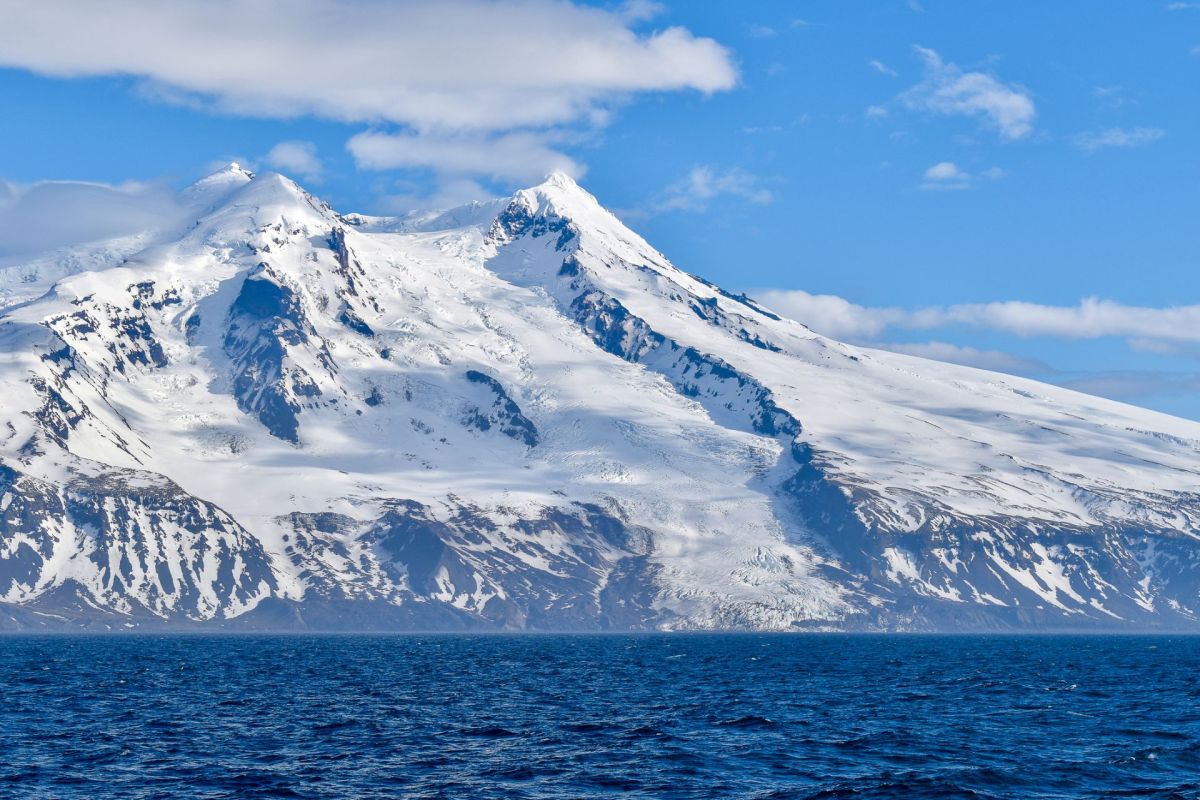
A powerful earthquake on March 10, 2025, did more than shake Jan Mayen, a remote Norwegian island in the Arctic Ocean. It also unleashed a massive rock avalanche that buried a large section of a glacier, and researchers say rising temperatures likely made the destruction far more possible.
Here's what to know
The quake, which measured magnitude 6.5 and was the region's largest in 100 years, is the focus of a new Proceedings of the National Academy of Sciences study highlighted by Gizmodo. Researchers concluded it triggered a rock avalanche that blanketed 30% to 50% of the Kjerulf Glacier's surface.
Less than three minutes separated the main shock from the avalanche, which researchers estimate produced about 1.3 million cubic yards of debris. To reconstruct the event, they combined seismic and infrasound data with satellite imagery, ground-displacement measurements, and climate records. Satellite radar imagery taken four hours after the quake also showed an ice-calving event along the shoreline of the neighboring Weyprecht Glacier.
Jan Mayen's location near an active plate boundary means earthquakes there are not unusual. Even so, 40 years of satellite observations show no evidence that earlier quakes triggered a rock avalanche that produced as much debris as the March 2025 event.
More background
The study set out to explain why this quake caused such an extreme collapse. Researchers pointed to permafrost, the permanently frozen ground that helps keep steep slopes stable.
The researchers found that summer averages on Jan Mayen rose from roughly 36 to 37 degrees Fahrenheit in the 1970s to about 41 to 43 degrees. Average winter temperatures climbed from roughly 19 to 21 degrees Fahrenheit to 28 to 30 degrees, and extreme cold below -4 degrees Fahrenheit had become rare by the 1990s.
TCD Picks » Quince Spotlight
💡These best-sellers from Quince deliver affordable, sustainable luxury for all




These changes align with Arctic amplification, the phenomenon in which the Arctic warms faster than the rest of the planet. The frozen "cement" holding icy terrain together can weaken, increasing the risk of more destructive cascading hazards.
Jan Mayen is mostly uninhabited except for a weather station crew, but similar thaw-driven instability could affect other parts of the Arctic, including populated or heavily trafficked areas.
What's being done?
In a statement, lead author Guilherme W. S. de Melo, a postdoctoral researcher in the Marine Geodynamics research unit at GEOMAR Helmholtz Centre for Ocean Research in Kiel, Germany, said: "This 2025 earthquake is a striking example of cascading natural hazards. Our study documents, for the first time, an earthquake-triggered rock avalanche on Jan Mayen Island. The volcanic slope may have become increasingly unstable due to permafrost degradation."
Where can I learn more?
These stories look at the same forces reshaping Jan Mayen — warming seas, shrinking glaciers, and thawing ground across some of the coldest parts of the world. They offer a broader view of how climate-driven instability can raise the stakes well beyond a single Arctic quake.
• In Svalbard, ocean warming accelerated Austfonna's retreat, deepening concern over Norway's vulnerable Arctic ice.
• Across Antarctica and Greenland, glacial ice melt keeps accelerating, steadily amplifying long-term sea-level threats.
• In Italy, the Alps' Marmolada Glacier is becoming increasingly fragile under mounting heat.
As the cryosphere warms, familiar hazards can spiral into far more destructive cascades.

Get TCD's free newsletters for easy tips, smart advice, and a chance to earn $5,000 toward home upgrades. To see more stories like this one, change your Google preferences here.






