


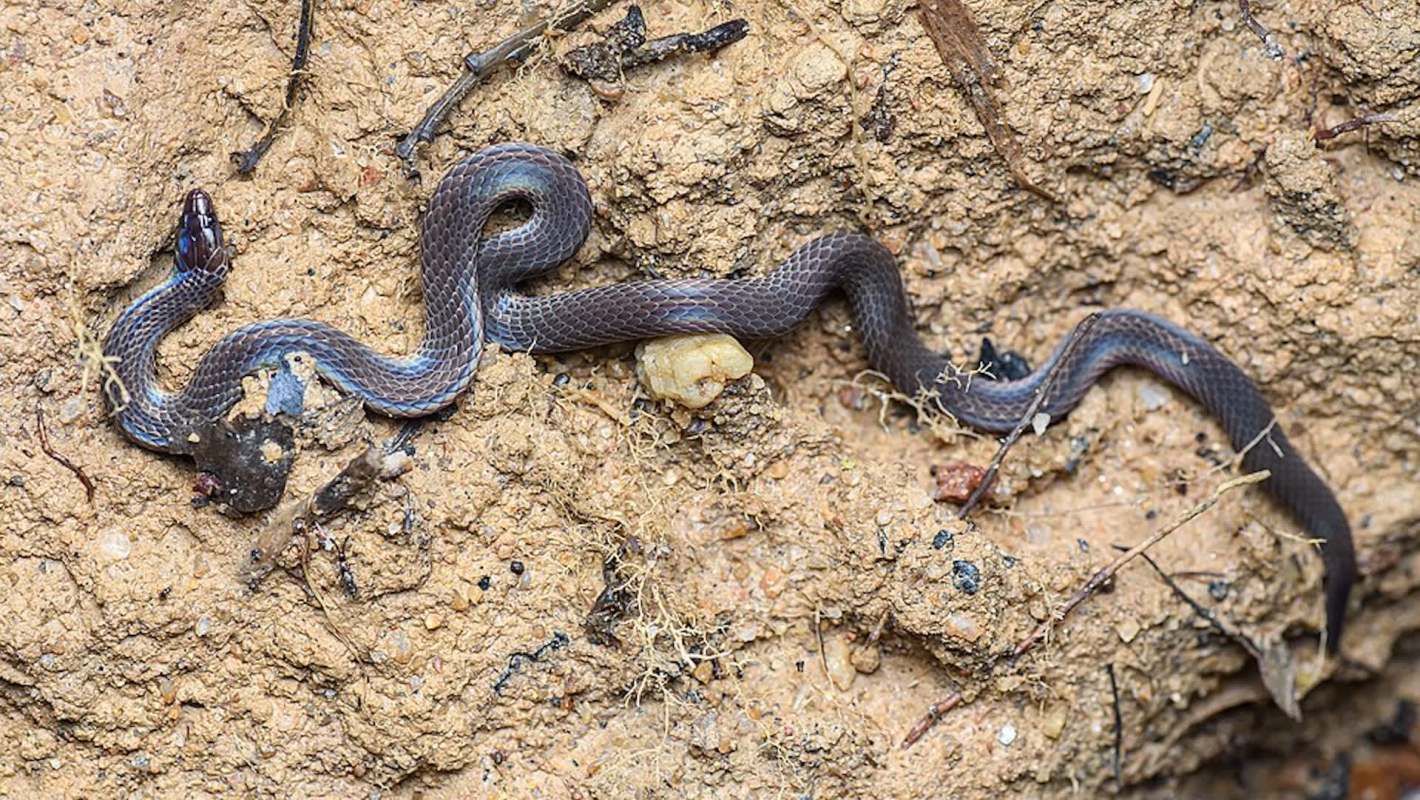
It sounds improbable, but scientists at Japan's Toho University have reported that the dwarf reed snake responds to danger by curling into a wheel-like roll.
Here's what to know
According to Popular Science, the researchers used high-speed cameras to capture the small snake moving in a straight line. Remarkably, it appears to dive forward, tuck into a roll, and then repeat that motion to travel at speed.
In a study published in the journal Current Biology, the Toho University team examined how the dwarf reed snake, or Pseudorabdion longiceps, moves during this escape behavior.
The experts found the roll can propel the animal at about a foot per second, or around four times faster than its normal slithering speed.
This Southeast Asian species stays under a foot long even in adulthood. Even so, when threatened, it uses a carefully coordinated retreat instead of simply wriggling away.
The video indicates the snake is not just spinning its entire body forward as a single ring. In each cycle, one side snaps down toward the ground while a bent section close to the head swings downward in what the authors called a "stroke."
TCD Picks » Quince Spotlight
💡These best-sellers from Quince deliver affordable, sustainable luxury for all




On the next "stroke," contact with the ground shifts to the opposite side of the body. By alternating left and right, the snake maintains speed without tipping its head or sensory organs out of an upright, forward-facing position.
More background
Many snakes defend themselves by biting, shaking their tails, or even spitting venom.
The dwarf reed snake does something far less typical: it escapes by rolling in a wheel-like motion. What looks at first like a tumble is actually tightly managed movement.
The snake can hold a straight course instead of veering randomly, showing the escape is directed rather than chaotic — an impressive level of control for an animal less than 12 inches long.
The researchers said this behavior undercuts the idea that wheel-like motion needs a structure comparable to a central axle. Here, the snake produces that effect through precisely timed body rotations while its head remains stable.
Additionally, the study pointed to the limits of judging an animal's capabilities from anatomy alone. Even a species adapted for slithering may have another way to move when escaping danger matters.
What's being done?
High-speed camera footage let the Toho University researchers slow the action enough to pick out the distinct motions that make up each rolling cycle. That approach provided a biomechanical account far more detailed than what ordinary viewing could offer.
Instead of describing the snake as one body spinning as a unit, the study separates the maneuver into alternating rotations and head-stabilizing actions centered around the head.
In other words, the roll spreads movement across multiple parts of the body rather than relying on a single rotating structure.
Where can I learn more?
If the dwarf reed snake's rolling escape caught your attention, these stories explore other unusual snake behaviors and wild discoveries. They cover everything from a tail that mimics a second head to unsettling snake behavior caught on video.
• In southern China, a snake's tail fakes a second head to confuse would-be predators.
• Across gardens worldwide, the tiny flowerpot snake clones itself without males and spreads unnoticed.
• In a tense video, a rearing snake strikes repeatedly at the nearby camera.

Get TCD's free newsletters for easy tips, smart advice, and a chance to earn $5,000 toward home upgrades. To see more stories like this one, change your Google preferences here.






