


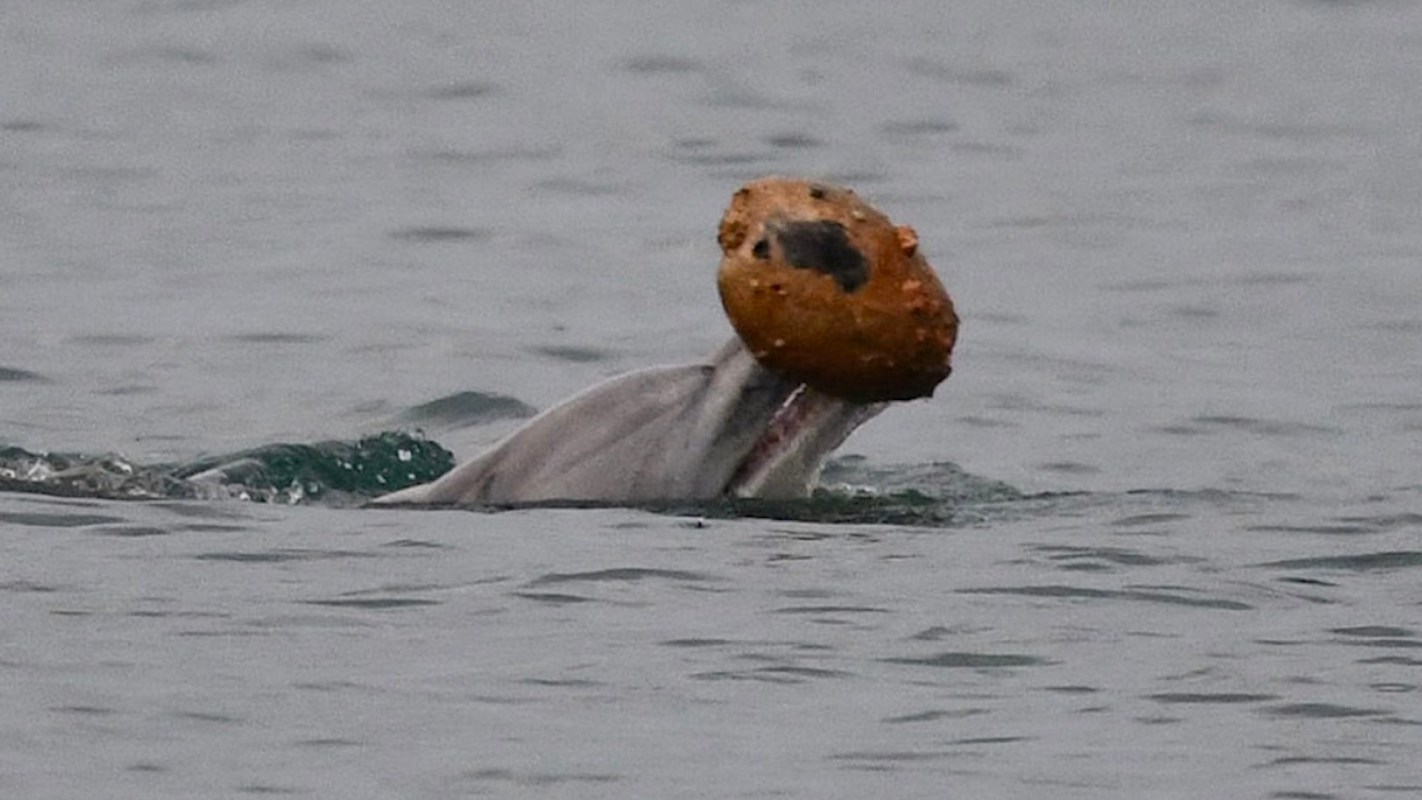
Dolphins off the coast of Australia have been filmed using shells to trap and eat fish, adding another example to show that they are among the ocean's most intelligent animals.
They have been filmed using discarded shells as hunting tools, a behavior that scientists call "shelling." The video gives researchers a rare view of what appears to be problem-solving with tools in the wild.
Here's what to know
Researchers described the behavior in a paper in the journal Marine Mammal Science after observing Pacific bottlenose dolphins near Hervey Bay using large empty seasnail shells to contain fish, according to the New York Post.
The footage shows one dolphin lifting a shell out of the water, dropping it so the fish inside spills free, and then quickly grabbing the escaping prey.
Study lead author Alexis Levengood, a marine mammal biologist at Queensland's University of the Sunshine Coast, said she recognized the behavior right away.
"The second I saw that shell in the air, I immediately knew what was happening," she told ScienceAlert.
TCD Picks » Quince Spotlight
💡These best-sellers from Quince deliver affordable, sustainable luxury for all




Scientists had reported shelling in Shark Bay, Western Australia, in 2013, but they had never captured it on video. That makes the footage stronger evidence that the technique may be more widespread than researchers thought.
Researchers also documented a mother and calf shelling in the same area, which raises the possibility that young dolphins learn the behavior directly from their mothers rather than from other dolphins.
More background
Levengood said: "We saw the mother surface with a shell, the fish inside escaped and the dolphin dropped the shell to chase the fish. Then, minutes afterwards, the dolphin calf picked up the shell and held it the same way as its mother."
If future research confirms that pattern, it would support maternal social transmission, a type of learning that helps behaviors persist across generations. Shelling may, therefore, be part of dolphin culture.
By understanding how animals find food, teach their young, and adjust to local habitats, scientists can better identify which places need protection and how human activity might disrupt those behaviors.
Research on animal tool use can also give scientists insight into intelligence, learning, and the evolutionary roots of human behavior.
What's being done?
Researchers are creating a clearer record of the rare behavior through direct visual documentation.
Video makes it possible to move beyond anecdotal sightings and lets other scientists examine body movements, timing, and learning patterns in greater detail.
Levengood told ScienceAlert that dolphins in different regions may have independently developed the same behavior, or that other populations may be using shells in ways scientists have not yet documented.
Advanced feeding behaviors may depend on healthy coastal ecosystems, stable prey populations, and minimal disturbance. Those conditions become even more important for wildlife managers and nearby communities.
"Better understanding of shelling and other tool use in non-human animals will continue to teach us more about ourselves and how and why we evolved the way we did," Levengood added.

Get TCD's free newsletters for easy tips, smart advice, and a chance to earn $5,000 toward home upgrades. To see more stories like this one, change your Google preferences here.







