


Portable power stations are undeniably convenient, but one DIY solar build suggests that simplicity may come at a premium.
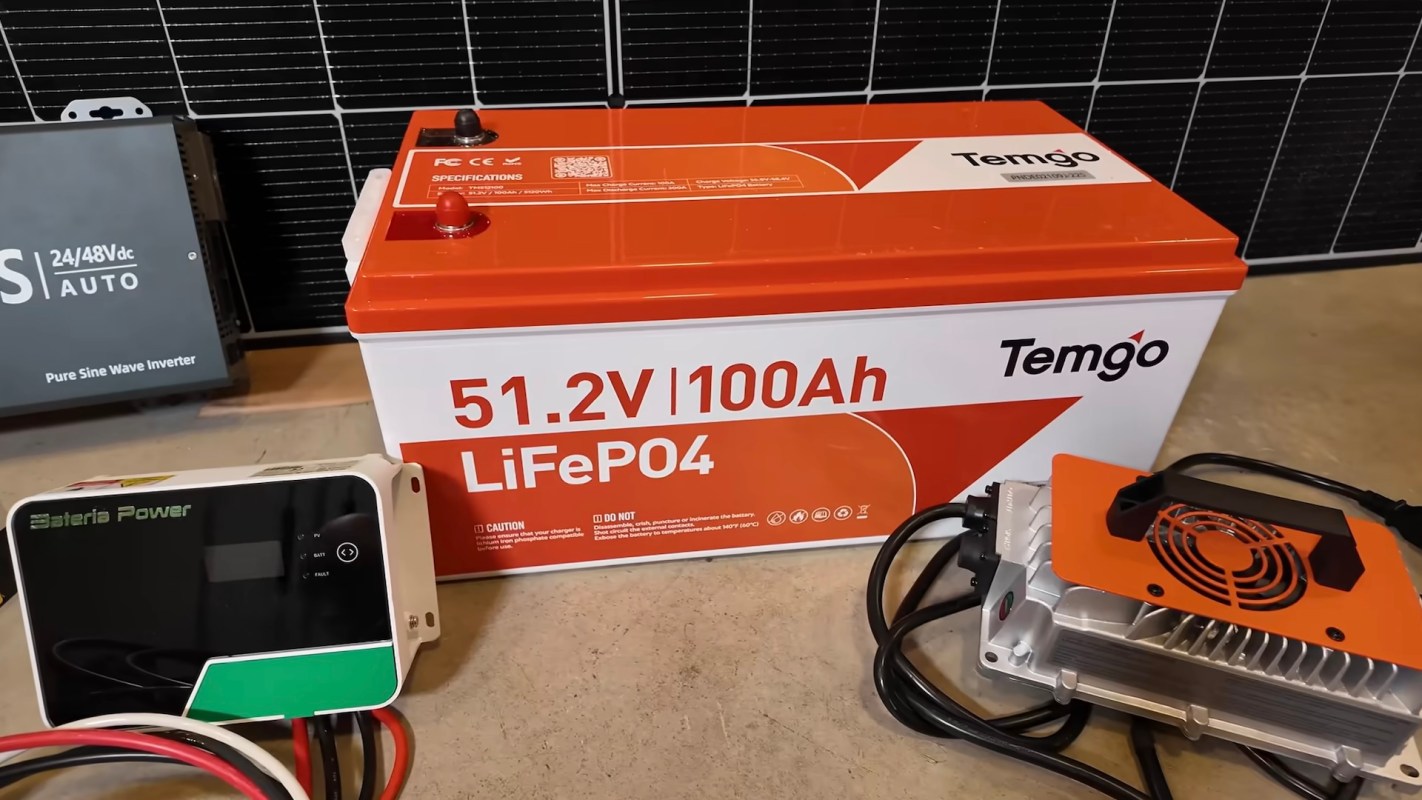
A modular setup sourced entirely from Amazon comes in at about $1,340 without solar panels, just $240 more than an EcoFlow Delta 3 Max Plus, while offering roughly 5,000 watt-hours of battery storage and 2,000 watts of output.
What's happening?
In a YouTube walkthrough from the content creator behind There's A Trick For That (@theresatrickforthat), the builder breaks down a 48-volt DIY backup power system centered on a 51.2-volt, 100-Ampere-hour lithium iron phosphate golf cart battery, along with an app-controlled MPPT charge controller, a 48V inverter, and circuit protection.
Because the EcoFlow comparison does not include panels, the creator separated that cost from the rest of the build.
With two 450-watt bifacial solar panels included, the full package reaches $2,040.11, but without them the DIY setup comes to about $1,340 versus roughly $1,100 for the portable power station.
Compared with the EcoFlow, the big draw is capacity: For about $240 more, the builder says buyers get "more than double, almost three times the battery capacity" along with triple the solar input capability.
TCD Picks » Quince Spotlight
💡These best-sellers from Quince deliver affordable, sustainable luxury for all




He also called it "the easiest, most simple, most powerful DIY solar system you can buy and put together from Amazon."
Why does it matter?
For households thinking about outage preparation, RV power, shed electricity, or reducing reliance on gas generators, battery size can make a major difference. A 5-kilowatt-hour battery can keep essential devices running far longer than a 2-kWh unit, especially when powering refrigerators, tools, fans, or other moderate loads.
Measured by storage rather than sticker price alone, the DIY option comes out ahead. Paying about $240 more for nearly triple the capacity could make a modular setup more appealing to people who care more about runtime than plug-and-play convenience.
Another practical advantage is the included weatherproof AC charger. That means the battery can be topped up not just from solar, but also from the grid or a generator, giving owners more flexibility while reducing how dependent their backup plans are on fuel-powered equipment alone.
One commenter pointed to the setup's practical value, writing, "This looks like a great setup to power my detached shed for some lighting and charging tool batteries and stuff like that."
What can I do?
A plug-and-play power station may still make sense for lighter use, but a modular system can offer better value if longer runtimes and future expansion matter more than simplicity.
The 48V layout is another reason the build may appeal to some buyers. The creator says higher-voltage systems can carry the same amount of power with smaller wires, and he presented the battery, charger, controller, and panels as parts that could later be reused in a larger home backup system.
The trade-off is an all-in-one unit for convenience versus a DIY parts list for value. Proper wiring, breakers, and battery protection are essential in a DIY setup.
As the creator put it, "You're not going to lose money by doing this and then wanting to upgrade to something, you know, larger more capable down the road," and one viewer called it "definitely one of the most budget-friendly DIYs."

Get TCD's free newsletters for easy tips, smart advice, and a chance to earn $5,000 toward home upgrades. To see more stories like this one, change your Google preferences here.






