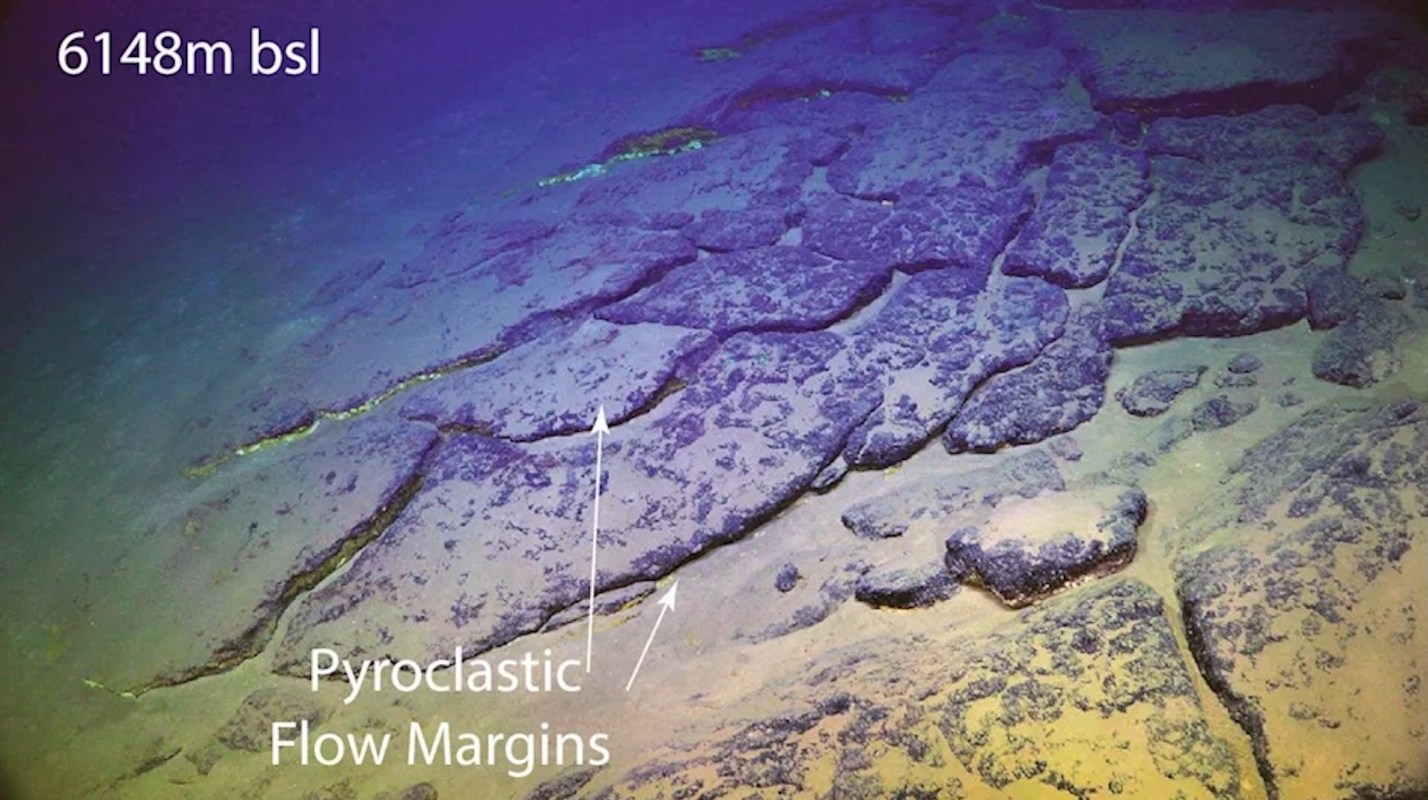
In a historical find, scientists identified evidence of an explosive volcanic flow 20,000 feet below the ocean's surface in the Mariana Trench.
Here's what to know
The remotely operated vehicle Jason/Medea spotted pancake-like rock formations during a 2014 mission, according to Live Science.
Cameras recorded the formations at three locations spanning roughly 60 miles of the trench. Samples collected from the sites contained volcanic glass and had the texture of a pyroclastic flow, which results from an explosive eruption.
Robert Stern, the study's first author and an emeritus geosciences professor at the University of Texas at Dallas, described the discovery of these flows to Live Science as a "complete surprise."
The findings, published Sunday in Frontiers in Earth Science, challenge scientists' understanding of where magma can form and how it behaves under immense pressure. Explosive eruptions are ordinarily prevented by the pressure at the discovery site, which is equivalent to about 592 Earth atmospheres.
More background
The trench's roughly 6.8-mile depth exceeds the height of Mount Everest, Live Science noted.
TCD Picks » Quince Spotlight
💡These best-sellers from Quince deliver affordable, sustainable luxury for all




The Pacific Plate slides beneath the Mariana Plate at Challenger Deep in the western Pacific. This movement is known as subduction.
Subduction commonly produces volcanic arcs, such as the one that includes Mount St. Helens and Mount Rainier in the Pacific Northwest. This stretch of Challenger Deep, however, has an ocean ridge rather than an organized volcanic arc, per Live Science.
Researchers expected the area between the ridge and the trench to lack the heat needed to generate magma.
Observations from the mission also showed two distinct forms of crustal stretching. To the east, the crust was being mechanically pulled apart, while stretching to the west was associated with volcanic eruptions, Live Science reported.
Understanding that contrast could help scientists explain how this unusually deep region formed.
What's being done?
Stern and his colleagues were dating the recovered rocks and studying their chemistry to better understand where the magma originated, according to Live Science.
Volcanic glass generally erodes quickly in seawater, so its survival offers a clue to the deposits' age. Stern suspected the eruptions occurred less than 1 million years ago.
The team was also investigating whether the plates were beginning a new subduction zone in the western part of the study area, Live Science noted. The work could help fill a gap in scientists' understanding of how these boundaries begin and shift over tens of millions of years.
How an explosive eruption occurred under such crushing water pressure remains unknown.
Stern suggested that a supercritical fluid — a state combining gas-like and liquid-like properties — may have helped drive the explosion.
"We just don't know how those magmas will behave at those water depths," Stephen Self, a volcanologist at the University of California, told Live Science.
Where can I learn more?
From shifting tectonic plates to untapped energy beneath the ocean, Earth's natural forces shape our world in surprising ways.
• In Tonga, a volcano's collapse may have supercharged a tsunami, researchers say.
• The world's first subsea geothermal power plant generated surplus power for 8.7 seconds.
• NASA spotted volcano-spun cloud swirls near South Korea's Jeju Island beside a giant Yangtze plume.
• In Italy, the crust is "unzipping," helping drive seismic activity in the Apennines.
• U.S. seabed mining bids faced Pacific pushback over bypassing a U.N.-linked regulator.

Get TCD's free newsletters for easy tips, smart advice, and a chance to earn $5,000 toward home upgrades. To see more stories like this one, change your Google preferences here.