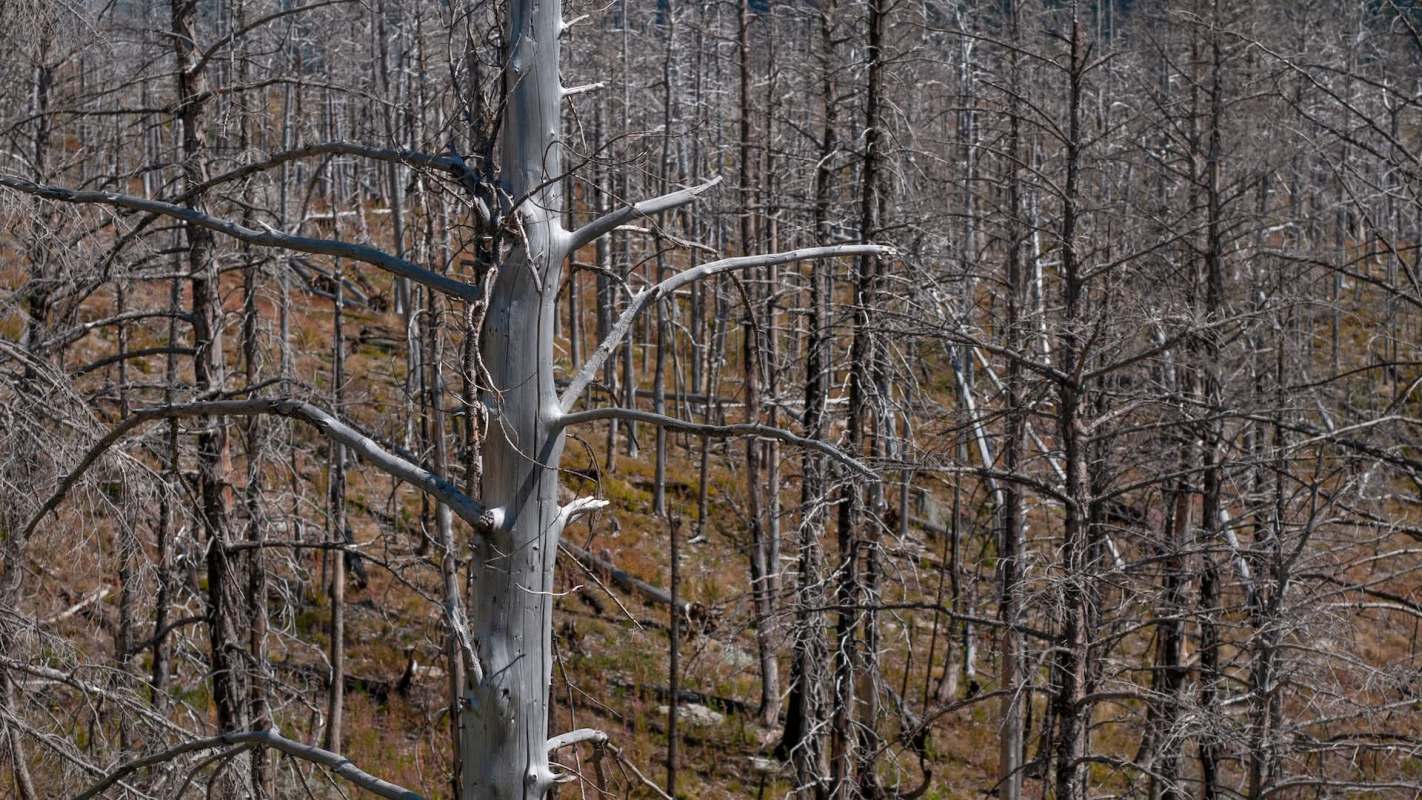
Over 10 million trees have already died along the Atlantic coast in an event that may reshape coastal woodlands.
Rising seas are driving saltwater farther inland along parts of the Atlantic coast, killing coastal forests and leaving behind ghost forests of pale, dead trees.
A new map suggests the destruction is far more widespread than scientists previously documented.
Here's what to know
Using a deep-learning system, University of Virginia doctoral researcher Henry Chi Hang Yeung and supervisor Xi Yang mapped upward of 10 million dead trees from Maine to South Carolina, as Science Blog reported. They published their findings in Nature Sustainability in December.
Building the model required extensive manual labeling. Yeung marked more than 50,000 trees by hand in aerial imagery with a resolution finer than 3.3 feet (one meter). That sharper imagery was vital to the discovery because many earlier surveys relied on Landsat satellite images with pixels about 98 feet (30 meters) wide, making individual dead trees difficult to separate from the surrounding landscape.
This resolution gap helps explain why so much forest loss went undocumented. Even with the new system, Yeung said the estimate of 10 million is likely still low because the method can miss toppled trees, trees concealed beneath living canopies, and trees with narrow crowns.
TCD Picks » Quince Spotlight
💡These best-sellers from Quince deliver affordable, sustainable luxury for all




The researchers also found that more than 6 million dead trees were concentrated in forests below 16 feet (five meters) of elevation, indicating that saltier soil and groundwater are likely major factors in the die-off.
The team published an interactive map you can use to see whether your area is affected.
More background
Coastal forests store carbon, support wildlife, and help define the landscapes that nearby communities rely on and recognize.
Affected areas will also likely be reshaped. When freshwater forests die, they are often replaced by salt marsh, which still offers benefits such as storm buffering and fish habitat, but not the same level of aboveground carbon storage. Local animals and humans may also have to adapt to the new landscape.
That transition can make it harder to maintain one of the coast's natural carbon-holding systems at a time when communities are already facing worsening climate threats. Researchers at North Carolina State University reported that, in one study area, 15% of unmanaged public land, about 64 square miles (167 square kilometers) converted from coastal forest to ghost forest between 2001 and 2014.
In a paper published in Environmental Research Letters, the team estimated that the shift led to about 143,000 US tons of aboveground carbon loss over 13 years.
Another study in Global Change Biology by Yinan Chen and Matt Kirwan of the Virginia Institute of Marine Science suggested that mid-Atlantic forest retreat trails sea-level rise by decades, meaning some of the damage from past sea-level increases may not yet have fully emerged.
What's being done?
The new mapping system gives researchers and planners a much clearer view of where coastal forests are dying, which can help communities monitor vulnerable land and prepare for change.
The study also found that in places where roads or levees stood between water and woodland, forest loss was lower by 40% and 79%, respectively. That does not mean those barriers are a permanent fix, but it does suggest that physical protections can slow the damage in certain areas.
The scale of the die-off shows that climate-driven change is already reshaping places where people live, work, and build their communities — a change that older maps did not clearly capture.
Where can I learn more?
These stories look at the same pressures from a few different angles. One follows saltwater intrusion in East Coast woodlands, while the others examine forests showing enough stress or decline to require intervention. They give a clearer sense of how quickly tree loss can reshape ecosystems and why it matters to act before the damage spreads.
• In Maryland, ghost forests creep inland as sea-level rise pushes saltwater into once-healthy woods.
• Elsewhere, warning signs show the forest lacks resilience when regeneration falters under mounting stress.
• In southwest Washington, conservationists warn they will be gone without stewardship for imperiled white oaks.
Seen side by side, the stories make clear that tree loss is not limited to one coastline or one species. They place ghost forests within the pattern of ecosystems being pushed past their limits.

Get TCD's free newsletters for easy tips, smart advice, and a chance to earn $5,000 toward home upgrades. To see more stories like this one, change your Google preferences here.