


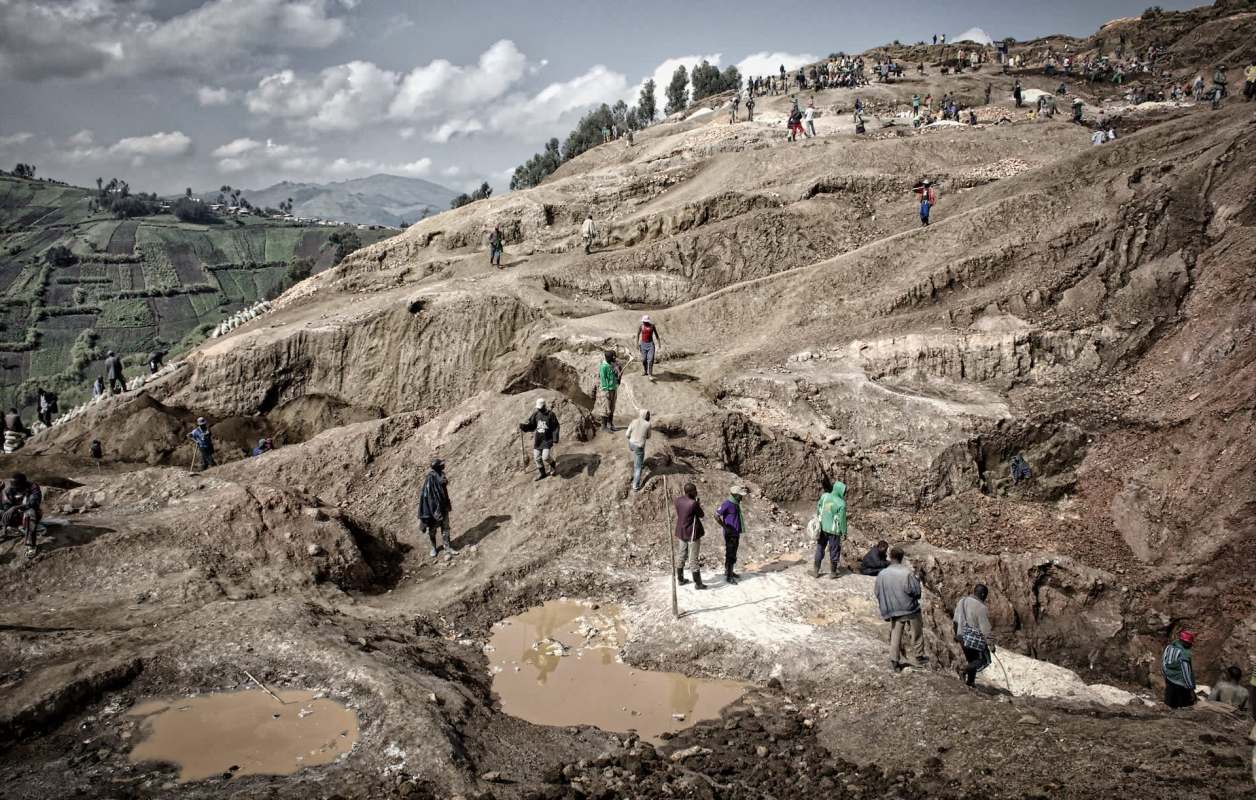
Residents near a copper and cobalt mine in the Democratic Republic of the Congo have sued the company, claiming its pollution is harming their health.
Testing at a nearby school serving around 1,500 children found fine-particle air pollution nearly triple the daily limit recommended by the World Health Organization.
Here's what to know
The 27 claimants, including eight children, are suing Compagnie Minière de Musonoie Global, or COMMUS, according to ICLG.
The lawsuit also names the Congolese government and the Congolese Environment Agency as defendants, accusing them of inadequate monitoring and enforcement. COMMUS runs the Kolwezi mine and is controlled by China's Zijin Mining Group.
Beyond the school, neighborhood air measurements averaged over five times the daily limit recommended by the WHO, according to ICLG.
Water contamination was another finding of the nonprofit Source International. Its scientists detected high metal concentrations and strong acidity in a community well beside COMMUS' tailings storage unit.
TCD Picks » Quince Spotlight
💡These best-sellers from Quince deliver affordable, sustainable luxury for all




RAID, a U.K.-based environmental and human rights NGO, announced the action, though it is only assisting the claimants and is not a party to the case.
More background
Residents have reported coughing, headaches, and nosebleeds, as well as reproductive health problems, including menstrual disorders and birth defects.
RAID described how close families' homes are to the mining infrastructure. "Homes stand close to mountains of mining waste dumps, ore stockpiles and processing facilities, with little separation between heavy industry and the places where families live and children play and study."
Congolese law requires public disclosure of COMMUS' environmental and social impact assessment, according to ICLG. The claimants say they were nevertheless "kept in the dark" about mining risks.
The lawsuit comes amid a broader government crackdown on mining activities. The Justice Ministry announced an investigation into illegal mining and mining fraud, alongside the seizure of over 500 trucks, additional machinery, and copper and cobalt totaling thousands of tons.
What's being done?
Represented by MUN Consulting Law Firm, the residents are requesting compensation of almost $1.3 million, plus $5 million for environmental restoration, according to ICLG.
They are asking the Commercial Court in Kolwezi to require COMMUS to halt harmful pollution, supply safe drinking water, and remediate polluted land and water.
In addition to the cleanup, the claimants want the company to fund an independent study of health impacts on neighboring communities. They also want tighter government oversight and public access to environmental studies and pollution-monitoring data.
The lawsuit invokes a strengthened provision of Congolese mining law that requires mining companies to demonstrate that their operations caused no environmental damage to avoid liability.
RAID called the action "an important test case of the DRC's strengthened mining law."
The organization's executive director, Anneke Van Woudenberg, said, "The clean energy transition cannot be built on polluted communities." Van Woudenberg continued, "As the world races for Congo's copper and cobalt, the people living alongside these mines are demanding that their rights matter too. Rather than waiting for companies and governments to protect them, they are taking their fight for justice into the courtroom."
Where can I learn more?
Mining and industrial pollution have raised similar health and environmental concerns in communities worldwide.
• In India, thousands developed cancer and lung disease after a British company's asbestos dumping.
• In Canada, a proposed U.S. mine puts a border town's drinking water at risk.
• In Brazil, Indigenous communities are protesting a planned gold mine over fears of irreversible harm.
• In China, miners cut through the Great Wall to dump waste despite whistleblowers' warnings.
• In Minnesota, neighbors are suing Owens Corning over shingle-factory emissions they say hurt their lungs.

Get TCD's free newsletters for easy tips, smart advice, and a chance to earn $5,000 toward home upgrades. To see more stories like this one, change your Google preferences here.






