


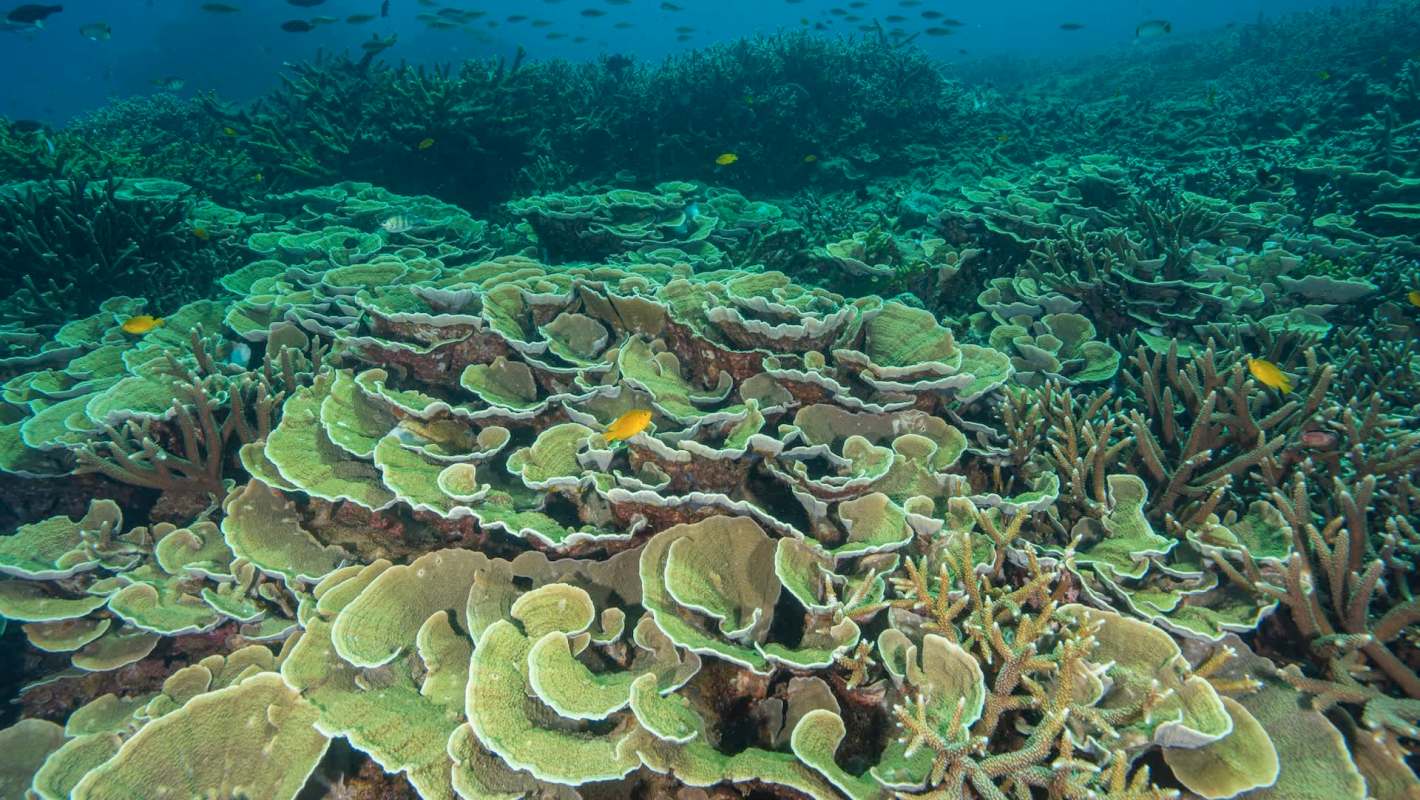
A marine biologist needed 12 dives to map a sprawling coral colony off Australia's Cocos Islands that stretches nearly a mile (1.5 kilometers) along the reef.
Here's what to know
ScienceAlert reported that PJ Hobbs secured funding to survey the colony, roughly 30 years after Cocos Islands dive operator Dieter Gerhard first noticed it.
The enormous formation may have lived for centuries or even millennia if it is one organism, marine genomicist Peter Cowman said, offering researchers an opportunity to understand how it has thrived for so long.
Pachyseris, the genus that includes this rose coral, typically forms colonies about 6.6 feet (2 meters) in diameter.
Hobbs could not reach the coral's boundary within his dive time as he repeatedly followed it along the atoll's outer slope.
"I was just waiting for the end, and the end never came," he told ScienceAlert.
TCD Picks » Quince Spotlight
💡These best-sellers from Quince deliver affordable, sustainable luxury for all




Hobbs said the colony may once have stretched more than 1.2 miles (2 kilometers). He saw more Pachyseris extending into the distance across a 33-foot (10-meter) break left by a collapsed section of reef.
Researchers will use specimens Hobbs gathered at 50 points during the survey to investigate the colony's identity and origins.
More background
The colony extends from 46 to 213 feet (14 to 65 meters) deep, reaching the mesophotic, or "twilight," zone where sunlight fades.
That depth range exposes different parts of the coral to varying light and temperature conditions, allowing researchers to investigate what has supported its extraordinary growth, Hobbs said.
Shallow reefs near the Cocos Islands have suffered damage from bleaching and disease as well as crown-of-thorns starfish. The deeper reef may shelter marine life when shallow-water conditions become stressful.
"Down deep, it seems like the conditions have been favorable for really long periods of time," Hobbs said.
The coral's plate-like ridges may also help explain its impressive size, according to Cowman. Broken fragments could settle farther down the slope, grow, and eventually reconnect with the original colony.
What's being done?
Cowman plans to study the specimens at Queensland Museum to determine whether the colony belongs to a known Pachyseris species or an unidentified one. Cowman said genetic testing could also reveal whether it grew from a single larva or formed when separate, potentially related colonies fused together.
Researchers kept the tissue samples' DNA available for sequencing by preserving them in ethanol and cold storage. Bleaching and drying, the traditional approach, leaves coral skeletons suitable for physical comparisons but destroys their DNA.
If the colony is one individual, Cowman hopes to map mutations that have accumulated over time and use a molecular clock to estimate its age.
The completed survey gives scientists a starting point for tracking changes after bleaching, heatwaves, and other climate events. Researchers also hope to learn whether the colony's immense size could help it withstand future climate pressures.
"I think it's good now that we have a map of its size and of its range and that can be our baseline for surveying it in years to come," Cowman stated.
Where can I learn more?
Researchers elsewhere are also studying how corals survive and recover from damage.
• In Palau, scientists are growing heat-tolerant coral after local reefs escaped mass bleaching.
• In California, bleached corals recovered within weeks, but only when touching their healthy twins.
• The IUCN warns that 96% of coral reefs worldwide could collapse by 2075.
• On Japan's Okinawa beaches, researchers found plastic fused with coral, a material dubbed "plasticoral."
• Florida plans to sink a 990-foot liner to create an artificial reef.

Get TCD's free newsletters for easy tips, smart advice, and a chance to earn $5,000 toward home upgrades. To see more stories like this one, change your Google preferences here.






