


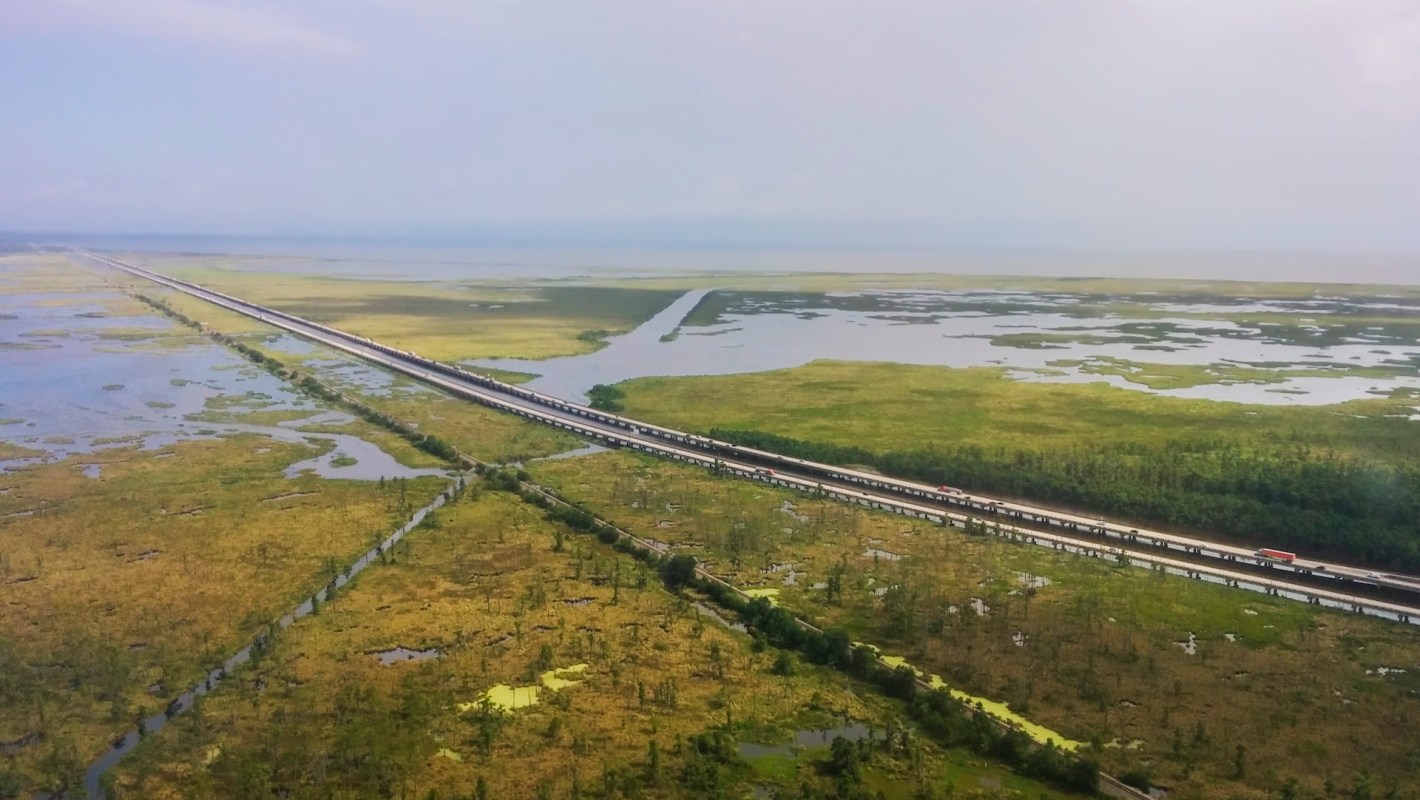
Louisiana's shoreline has never been fixed, but a new study says human-caused warming is speeding up that movement — and the state may have only a narrowing window to prepare before more residents are forced to leave.
Researchers say the coast could one day shift more than 30 miles inland, making Louisiana a real-time example of what climate adaptation can look like as conditions continue to change.
What's happening?
A new study published in Nature Sustainability says coastal Louisiana should be understood as "ground zero" for coastal climate adaptation — not because the coast is only now disappearing, but because it has always been in motion, and communities need to plan around that reality.
The researchers point to a dangerous mix of sea-level rise, land subsidence, wetland erosion, and stronger storms, much of it worsened by decades of oil and gas development that carved canals through fragile coastal ecosystems. The study says the state contains what the IPCC describes as the planet's most exposed coastal zone.
Using a comparison to the last interglacial period around 125,000 years ago, when seas stood much higher, the study says southern Louisiana could ultimately experience three to seven meters of sea-level rise and lose up to three-quarters of its remaining coastal wetlands.
Why does it matter?
The consequences go far beyond shifting maps. As wetlands disappear and storms reach farther inland, extreme weather disasters can grow more dangerous and more costly, putting lives, homes, jobs, schools, and critical infrastructure at greater risk. Flooding and storm surge can also contaminate drinking water, increase respiratory illness through mold exposure, interrupt medical care, and destabilize local economies built around ports, fisheries, tourism, and energy.
TCD Picks » Quince Spotlight
💡These best-sellers from Quince deliver affordable, sustainable luxury for all




In many places, displacement is already underway. Nearly all of Louisiana's coastal zone has lost population since 2000. Since Hurricane Katrina in 2005, roughly a quarter of Orleans Parish residents have left, while more than half of rural Cameron Parish residents have relocated.
The authors say any serious adaptation strategy has to account for who is actually able to move safely. Telling people to leave flood-prone areas is not enough if higher ground does not offer affordable housing, reliable jobs, and strong public services.
What's being done?
The researchers say the focus needs to shift from disaster response to planning ahead. That includes investing not only in buyouts of flood-prone homes, but also in creating opportunity elsewhere — including affordable housing, schools, and industries in safer places so people can relocate with dignity rather than being displaced by crisis.
They also point to large-scale restoration efforts that could help slow land loss. One example is the canceled Mid-Barataria Sediment Diversion, a multibillion-dollar project meant to reconnect the Mississippi River with disappearing wetlands south of New Orleans. Another is the Breton diversion on the river's opposite side.
Unlike one-time dredging projects, sediment diversions are designed to mimic the natural river systems that built the delta in the first place, creating a steadier supply of sediment to nearby wetlands. Portland State University professor Vivek Shandas, who was not involved in the paper, said Louisiana could become a bellwether for the rest of the country. Keenan said the paper urges collaboration among public, private, and civic groups on adaptation policy, planning, and practice.
"We're not going to 'lose' New Orleans," co-author Brianna Castro said. "New Orleans has an incredibly rich local culture, and that will carry across the lake."
As fellow co-author Jesse Keenan put it: "We've got a big challenge here, but this isn't about the challenge. This is about the opportunity."

Get TCD's free newsletters for easy tips, smart advice, and a chance to earn $5,000 toward home upgrades. To see more stories like this one, change your Google preferences here.






