


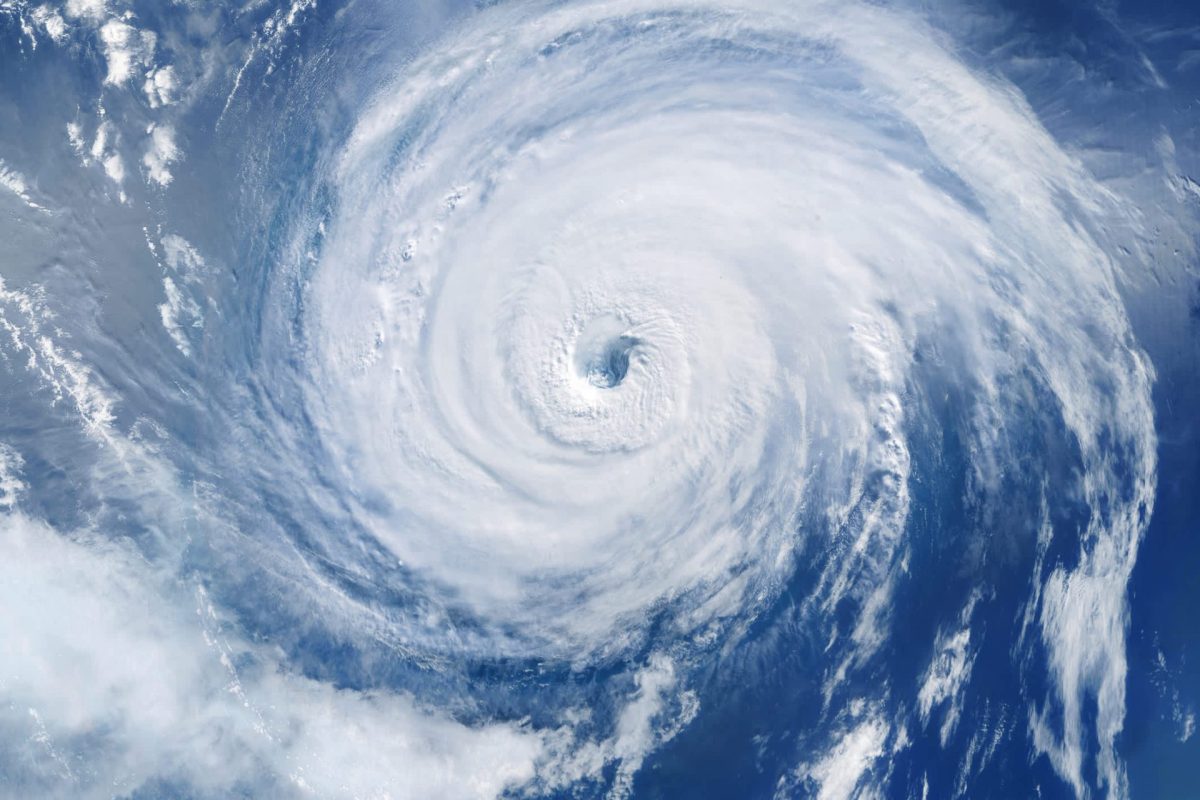
New peer-reviewed research takes up a much bigger idea than simply squeezing extra rain from clouds: whether intentional changes in the atmosphere could eventually influence the path or strength of extreme weather.
The authors say that if scientists ever have enough real-time observations, computing capacity, and precise delivery methods, small interventions might help shift threatening storms away from densely populated places.
What's happening?
The PLOS Water paper suggests that carefully timed atmospheric "nudges" might theoretically change how major weather events develop before they reach maximum intensity, USA Today reported.
In modeled scenarios, the study's authors said interventions could have pushed Superstorm Sandy roughly 300 miles off its course toward New York City, raised the 2021 Texas freeze's low by about 18 degrees Fahrenheit, or cut precipitation during a 2022 California atmospheric river by about 5%.
The paper builds on cloud seeding, a decades-old technique that the National Oceanic and Atmospheric Administration says is generally used to increase precipitation or suppress hail, often with particles such as silver iodide. The Government Accountability Office has said nine U.S. states use cloud seeding, while other states have restricted or debated the practice.
Even so, moving from modest local precipitation effects to steering hurricanes would be an enormous jump.
TCD Picks » Quince Spotlight
💡These best-sellers from Quince deliver affordable, sustainable luxury for all




Katja Friedrich, an assistant professor in the Department of Atmospheric and Oceanic Science at the University of Colorado, told USA Today that "there is currently NO scientific evidence" that existing cloud-seeding technologies "can modify large-scale weather systems, in particular severe weather systems like hurricanes and thunderstorms, that are driven by large dynamic forcing."
For now, the study is a proposal for future investigation rather than a demonstrated technology.
Why does it matter?
If a technology could safely and reliably weaken floods, freezes, or landfalling storms, it could have enormous real-world value.
But the paper does not show that such control is currently possible. Decades of research suggest cloud seeding may sometimes have limited effects on precipitation when conditions are favorable, which is very different from rerouting a hurricane or changing a freeze across a vast area.
The study presents modeled outcomes, not proof from real-world use.
The concept also raises major ethical and legal concerns. Shifting a storm away from one city could push risk onto another region.
Robert Rauber, a director emeritus in the Department of Climate, Meteorology and Atmospheric Sciences at the University of Illinois, warned that "even if humans could move storms, the political, international and legal fallout would be so great that it would never happen."
Online claims after the 2025 Texas floods blamed cloud seeding for the disaster, but CBS News reported that meteorologists found no evidence supporting that accusation. Cloud seeding is not known to create catastrophic floods.
What's being done?
The researchers said any future system would require far more than the cloud-seeding programs used today.
Study coauthor Upmanu Lall of Arizona State University said such an effort would need dense atmospheric observations, near-real-time analysis, artificial intelligence, and a way to deliver a precisely targeted "nudge."
Lall also emphasized that scientists do not yet know the best way to do that.
"We are still working on the best technology for delivering the nudge. A very large-scale cloud seeding effort at the right time and place is a possible mechanism, but not necessarily the definitive one," Lall said.
Even the study's authors are cautious for now.
"We are focused for now on developing the science and engineering capacity, and are cognizant of the ethical and control issues, but not focused on them at this point," Lall said.

Get TCD's free newsletters for easy tips, smart advice, and a chance to earn $5,000 toward home upgrades. To see more stories like this one, change your Google preferences here.






