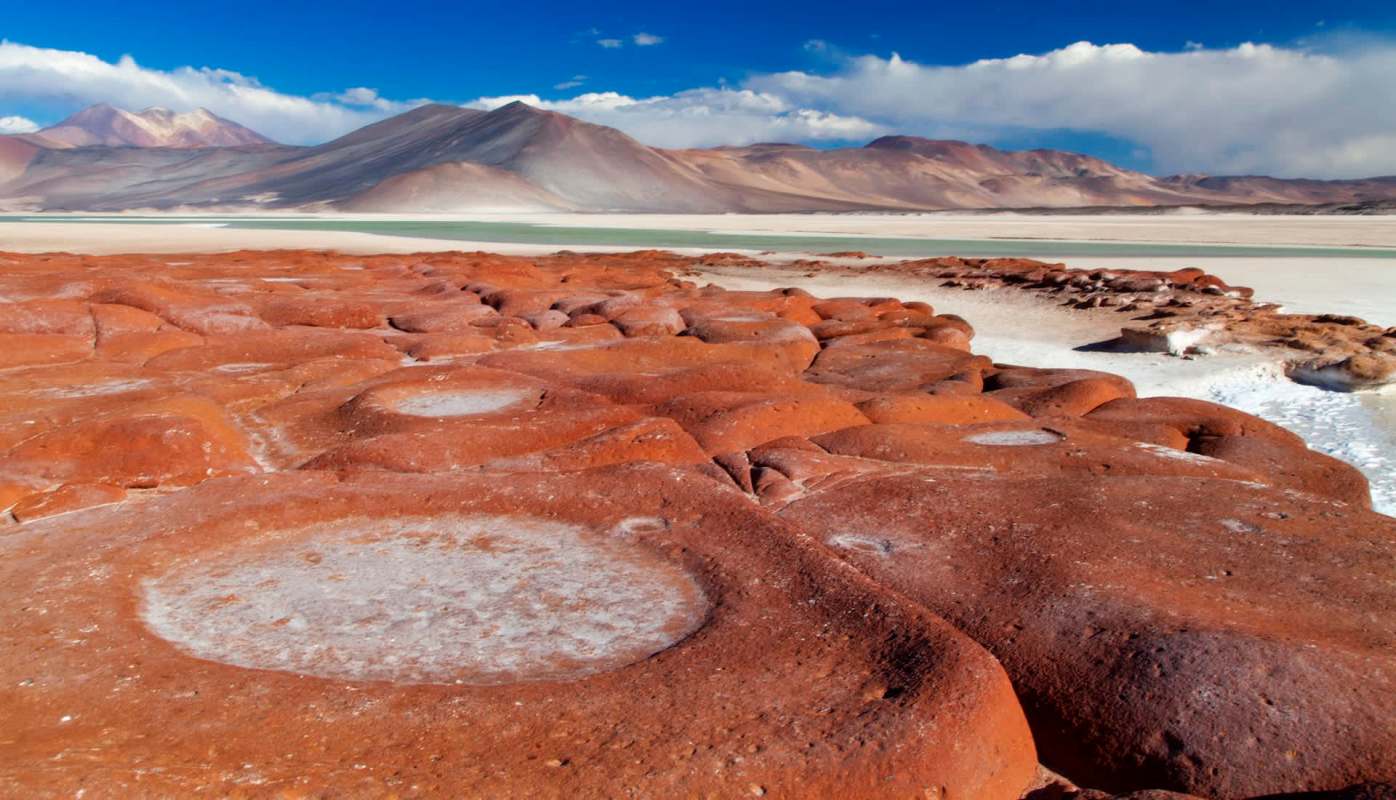
South America has its first officially recognized lunar meteorite: a tiny rock from Chile's Atacama Desert offering evidence of the collisions that reshaped the moon's surface.
Calama 957 consists of lunar fragments fused by powerful impacts and weighs just 0.42 ounces (12 grams), The Daily Galaxy reported.
Here's what to know
Russian meteorite hunters Mikhail Nepomiluev and Ilya Kriachko discovered the specimen near Calama on May 19.
Researchers at Russia's Vernadsky Institute traced the rock to the moon. Chile's Center for Astrophysics and Associated Technologies, or CATA, reported that the Meteoritical Bulletin approved the classification on Nov. 3.
The rock's feldspar-rich composition links it to the moon's ancient highlands, which cover much of its bright surface.
According to The Daily Galaxy, researchers classified Calama 957 as a feldspathic impact-melt breccia — broken rock fragments bound together by material melted during impacts.
TCD Picks » Quince Spotlight
💡These best-sellers from Quince deliver affordable, sustainable luxury for all




Washington University in St. Louis attributes the prevalence of breccias among lunar highland meteorites to repeated collisions that fractured and reshaped the highlands.
Scientists can use older material preserved within these rocks to investigate geological events that predate the impacts that fused the fragments together.
More background
Calama 957's journey began with an asteroid or comet impact that propelled lunar rock beyond the moon's gravitational reach.
Fragments that eventually cross Earth's path and survive the trip through its atmosphere can reach the ground as meteorites. These natural arrivals allow scientists to study lunar material from beyond the landing sites explored by Apollo astronauts.
Millarca Valenzuela, a geologist associated with CATA and Universidad Católica del Norte, says fewer than 1% of meteorites recovered on Earth come from the moon.
The Atacama's extreme dryness and stable surfaces help preserve these specimens, allowing some to remain for millions of years.
Research published in March 2026 in Meteoritics & Planetary Science found that meteorites in the desert collections examined had spent an average of approximately 820,000 years on Earth.
The oldest approached three million years.
What's being done?
Juan Pablo Pizarro, director of Atacama Petrolab, and Timur Kriachko organized the expedition that recovered Calama 957.
Valenzuela is calling for stronger conservation measures, scientific partnerships, and research facilities. She estimates that more than 4.4 U.S. tons (four metric tons) of meteorites recovered in Chile have gone abroad, limiting opportunities for scientists in the country to study them.
Inadequate laboratory infrastructure and a shortage of specialists also hinder domestic research, Valenzuela explained.
Chile had registered 4,585 meteorites when Calama 957 was announced, according to Valenzuela — yet it took more than 30 years of searching to identify its first lunar specimen.
In 2028, Antofagasta will host the 90th Meteoritical Society Meeting, bringing an international gathering of meteorite researchers to the Chilean region where the continent's first formally recognized Moon meteorite was discovered.
Where can I learn more?
Chile's contributions to space research reach from meteorites on the desert floor to telescope observations of distant galaxies. These stories explore satellite fragments, falling rocket debris, and fossils found in unexpected places.
• A Chinese satellite broke apart, leaving 43 fragments in orbit that may persist for centuries.
• Suspected rocket debris struck a Minnesota cornfield and an Indonesian plantation just days apart.
• In Saskatchewan, siblings spotted 450-million-year-old sea creature fossils in a neighborhood rock pile.

Get TCD's free newsletters for easy tips, smart advice, and a chance to earn $5,000 toward home upgrades. To see more stories like this one, change your Google preferences here.
Cool Picks