


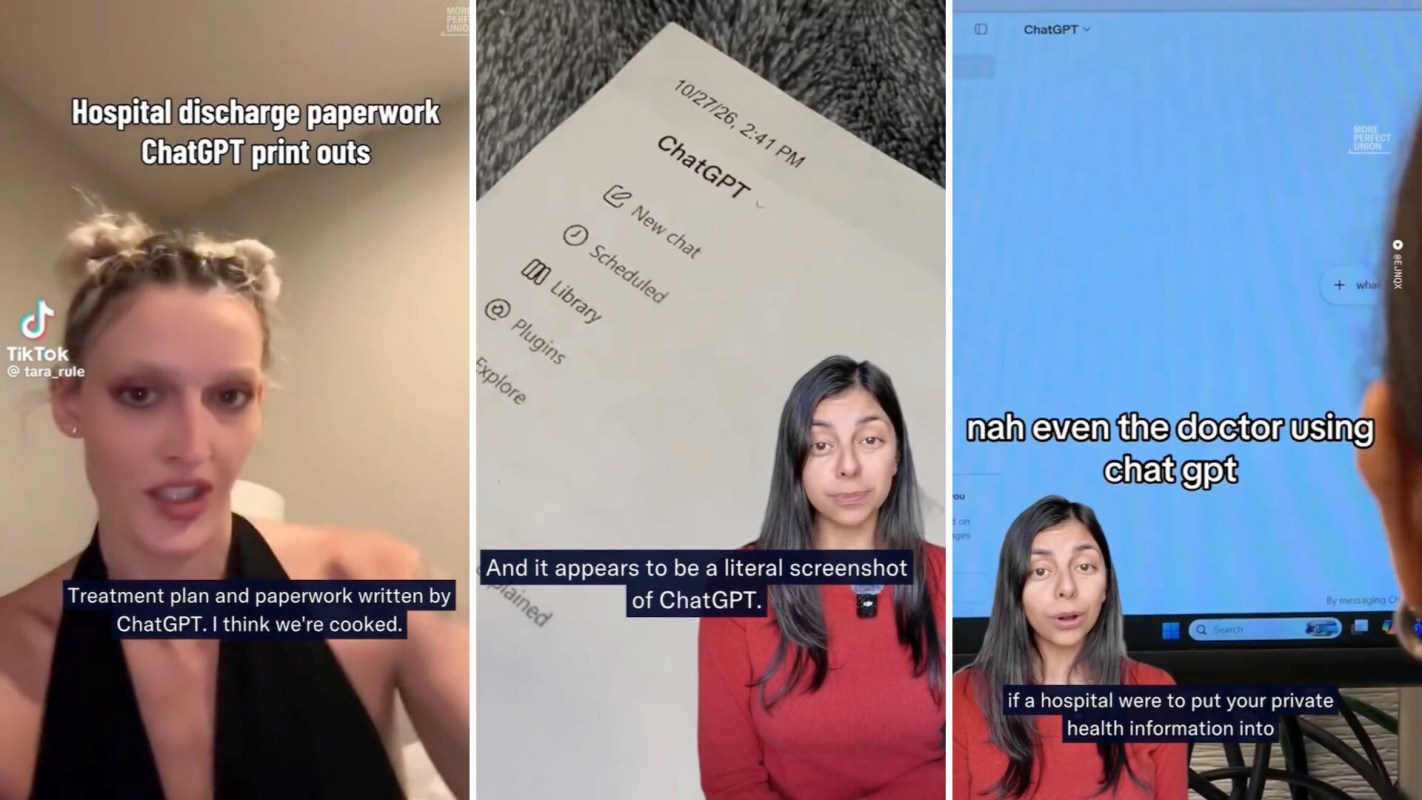
A patient said she was sent home from the hospital with an at-home treatment plan that appeared to be copied from ChatGPT.
Her account has drawn attention to the growing use of artificial intelligence in hospitals, raising concerns about medical guidance and the handling of sensitive patient information.
Here's what to know
Last week, actor, model, and content creator Tara Rule (@tara_rule_) shared a short video describing her experience after consulting with health care providers at a hospital.
@tara_rule Replying to @MaryAnn John Rosenbaum ♬ original sound - Tara Rule
Rule said her symptoms had gotten "to emergency status" and also explained that she has Ehlers-Danlos Syndrome, a connective tissue disorder.
Rule said she was later sent home from the hospital with paper printouts that seemed to feature content drawn from ChatGPT.
The paperwork she referenced in the video appeared to read "ChatGPT" at the top as well as entries that seemed to reflect a user's search history, including "Emergency Consultation Format," "Medical Spanish Interpreter," "Aftercare Instruction Request," and "Verb to Go Conjunction."
TCD Picks » Quince Spotlight
💡These best-sellers from Quince deliver affordable, sustainable luxury for all




Rule raised concerns that the treatment plan for constipation could conflict with her Ehlers-Danlos diagnosis and said she later consulted with physician friends who advised a modified plan.
"This is concerning to me," she said in the video. "What if I didn't know so much about ChatGPT and then I [followed the original plan] and my intestines exploded or something."
Rule also said that she could have searched online for advice at home herself but went to a hospital specifically to consult with medical experts.
"The reason I went to see a doctor is because I'm not one," she said, pointing to a desire for credible health information.
More background
The news organization More Perfect Union shared its own video on Rule's experience.
"Hospitals are increasingly using AI tools to provide patient care," its caption read.
Referencing other examples of AI becoming a part of medical experiences, the news outlet pointed to a lawsuit alleging that use of ChatGPT encouraged a young woman to stop taking anti-seizure medication before her death. In another example, More Perfect Union said a Florida pastor alleged that the chatbot steered him away from seeking treatment for a pulmonary embolism.
In addition to concerns over accurate medical information and appropriate patient care, the outlet highlighted privacy violations as another potential concern, specifically if staff ever use consumer ChatGPT products rather than the ostensibly more protected enterprise models owned by hospitals.
According to More Perfect Union, OpenAI says its enterprise version offers compliance with HIPAA, the federal law protecting health information. Some physicians responding to the news outlet's video also shared that they use AI tools but ensure that their outputs are reviewed and approved by human medical professionals for accuracy.
Meanwhile, community members across the U.S. have shared concerns that the expansion of AI infrastructure could impact human well-being in other ways. Although the technology may be used to help optimize clean energy systems, the data centers that power AI also demand huge amounts of energy to run and water to cool servers, potentially increasing pollution and straining resources.
What can be done?
Rule appeared to respond to More Perfect Union's video herself, noting that Medicare would be looking into her case.
"That's me," she commented. "My insurance company is investigating (Medicare)."
Meanwhile, some people may be drawn to use AI tools to explore their own medical questions at home. It's a concern for those who worry this could lead to improper or delayed treatment.
According to 2025 data cited by the Associated Press, nearly a quarter of Americans used ChatGPT to seek medical advice in a 30-day period, sometimes because of the high costs of professional health care and insurance.
One commenter wrote in response to More Perfect Union's video, "Please fight back. We as health care workers are being forced into using AI and I promise that many of us HATE it."
Where can I learn more?
AI is also playing a role in hospital billing, staffing, and treatment decisions.
• After a patient disputed an $85,000 hospital bill, an AI sweep found $20,000 more.
• Blue Cross says hospitals' AI billing tools increased costs by $942 million without more care.
• In Utah, a $4.99 AI acne app can issue prescriptions as doctors review fewer cases.
• Palantir reaches one-fifth of U.S. hospital beds as nurses warn AI is worsening shortages.

Get TCD's free newsletters for easy tips, smart advice, and a chance to earn $5,000 toward home upgrades. To see more stories like this one, change your Google preferences here.






