


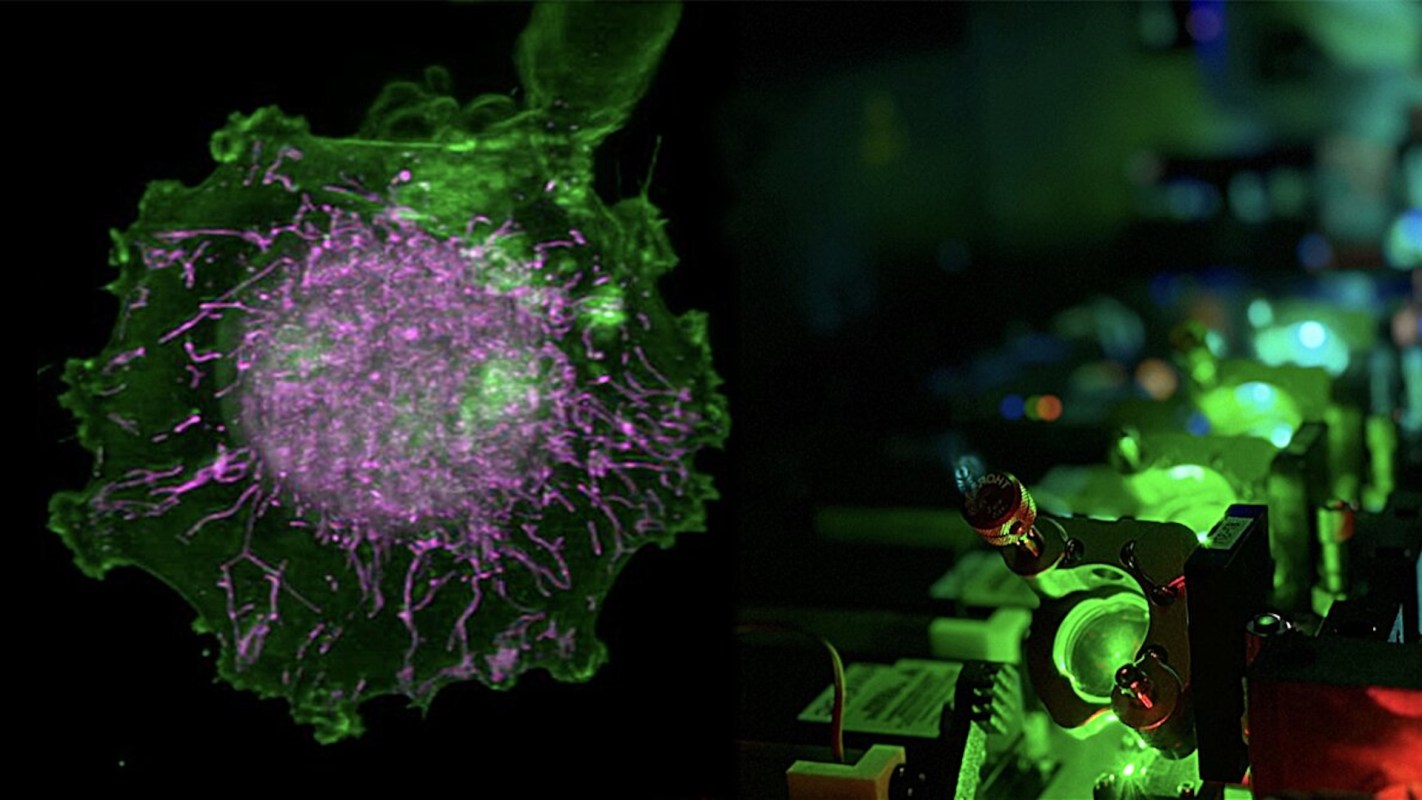
Mitochondria are often portrayed in textbooks as tiny, bean-shaped structures floating inside cells, but in reality they function more like a shifting power grid, constantly merging, splitting, and moving to wherever energy is needed.
That nonstop activity has made them difficult to study at scale, but researchers at the University of California San Diego now say artificial intelligence and "digital twins" of living cells could help change that.
Here's what to know
At the center of the work were two virtual systems built by researchers at the University of California San Diego to measure how mitochondrial networks change.
They relied on 4D lattice light-sheet microscopy, which tracks mitochondria and other cellular structures as they move through 3D space over time.
They used those measurements to build one AI model to predict cell health from mitochondrial shape and a separate physics-based model that functioned as a digital twin of a living cell.
To create MitoSpace, the team assembled 40,000 single-cell 4D movies after treating cancer cells with 25 compounds that disrupt mitochondria in different ways.
TCD Picks » Quince Spotlight
💡These best-sellers from Quince deliver affordable, sustainable luxury for all




Instead of relying on people to manually sort and label each image, the system detected patterns on its own. The researchers said it could still group cells by drug response without being told which treatment any individual cell received.
Published in the journal Cell, the two studies together suggested a quicker way to assess how drugs influence cell function.
More background
Mitochondria matter for more than energy production.
As their shapes shift, they can signal whether a cell is healthy, stressed, or damaged, which is why researchers use them as markers when studying conditions such as cancer, diabetes, Alzheimer's, and mitochondrial disorders in children.
A big limitation of older lab imaging is that it often captures only a single flat frame.
That kind of still image can miss the continual remodeling of mitochondrial networks, even though those changes may contain key information about cell function and treatment response.
By turning those moving structures into virtual models, researchers may be able to test ideas more efficiently before committing to slower, more costly laboratory work.
The research is still in its early stages, focused on identifying promising compounds and understanding what they do inside cells.
What's being done?
The researchers built two tools: MitoSpace, a deep-learning system that interprets mitochondrial form as a readout of cell health, and a separate rules-based digital twin that models how organelles behave inside a real cell.
When the team tested drugs in the digital twin experiments, the simulated mitochondrial networks reacted much like those in living cells.
That suggested some early-stage work could eventually be done in silico before researchers move to the lab bench.
If the method proves reliable over time, it could ease some of the most labor-intensive parts of drug screening. That could be especially valuable for diseases driven in part by mitochondrial dysfunction, where many possible compounds may need to be compared quickly.
The advance is a research tool, not a consumer technology.
Methods like this can help scientists sort through potential drug candidates faster and with more biological detail than static images alone can provide.
Using 40,000 cell movies, the team created a map that groups cells with similar drug-response patterns, offering another way to examine what is happening inside cells.
Where can I learn more?
These articles explore AI in virtual animal testing, protein research, and flu vaccine forecasting.
• In Switzerland, scientists built an AI virtual mouse to reduce nanomedicine animal testing.
• Biomedical researchers are using protein language models to speed searches for new treatments.
• At Johns Hopkins, scientists use AI to forecast which flu strains vaccines should target.

Get TCD's free newsletters for easy tips, smart advice, and a chance to earn $5,000 toward home upgrades. To see more stories like this one, change your Google preferences here.






