


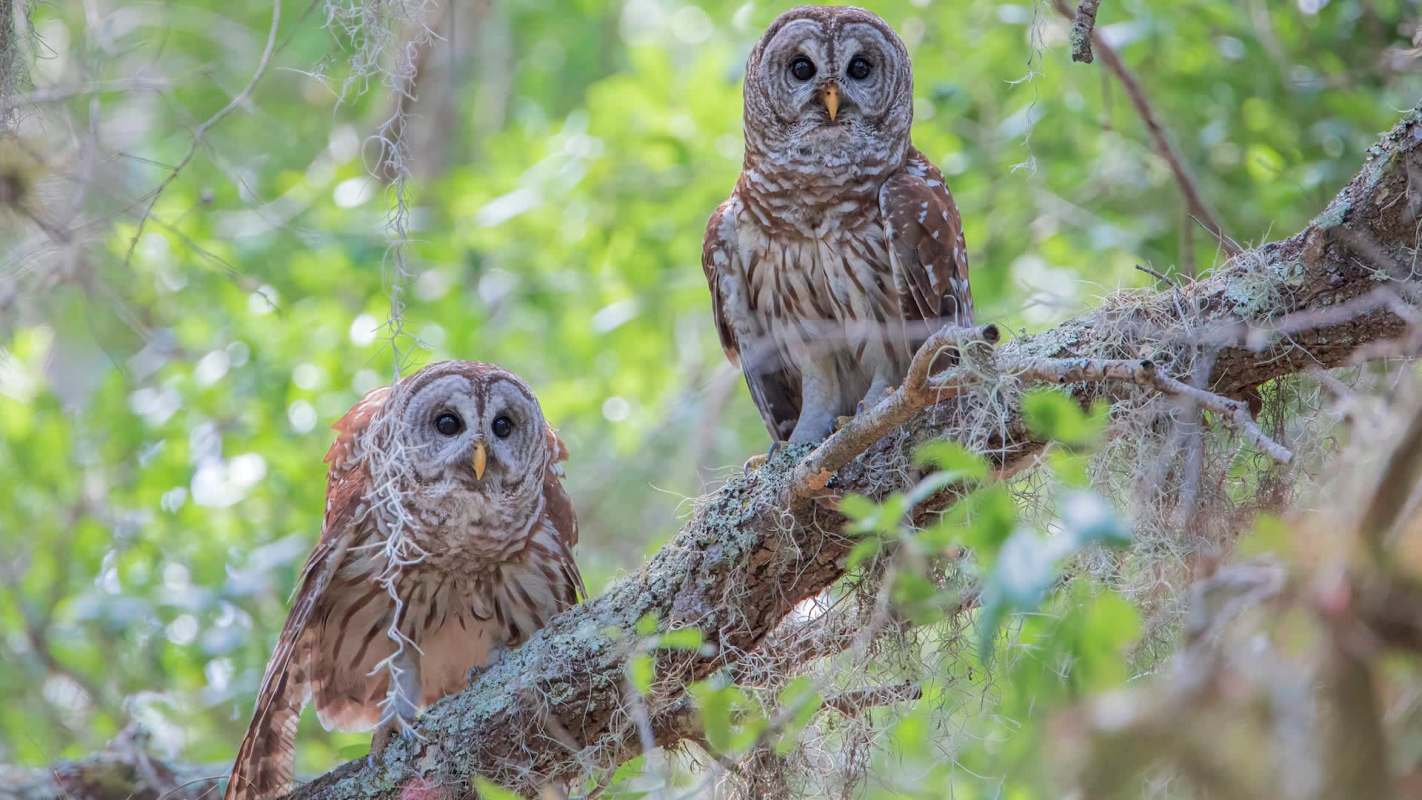
New research from California suggests northern spotted owls are continuing to lose territory in a battle between barred owls moving into the same old-growth forests.
After fitting barred owls with GPS trackers, scientists found the invasive birds repeatedly using the large, mature forest habitat spotted owls depend on, a result that could affect how we think about forest protection and the wildlife tied to it.
Here's what to know
On Aug. 12, the Integral Ecology Research Center reported findings showing that barred owls in northwestern California consistently favored the region's tallest, oldest, and most structurally complex forest stands. The same places northern spotted owls use for nesting and roosting.
The study tracked 56 barred owls across 1,571 square miles (4,070 square kilometers) of forest, according to Lost Coast Outpost.
On average, 64% of a barred owl's home range overlapped habitat already mapped for spotted owls, and 38% of that range lay within the landscape's best nesting and roosting forest.
The researchers found an average home range of 2.6 square miles (6.7 square kilometers) for each barred owl, roughly 28 times larger than the home-range size they had recorded in Louisiana, within the species' native range.
TCD Picks » Quince Spotlight
💡These best-sellers from Quince deliver affordable, sustainable luxury for all




More background
Barred owls and spotted owls compete for prey such as flying squirrels and tree voles. Barred owls also feed on a wider range of animals, including salamanders, reptiles, and small carnivores such as the western spotted skunk.
As a result, habitat can still look intact on a map while no longer functioning as available living space for the native species that relies on it.
Dr. Vitek Jirinec, research scientist at IERC and lead author of the study, summed it up this way: "Every stand of that forest still shows up as spotted owl habitat on our maps. But habitat isn't just trees, it's trees a spotted owl can actually live in, and barred owls have taken that off the table across much of the landscape."
What's being done?
Because the forest structure remains intact, researchers said removing barred owls from an area can make that habitat usable again for spotted owls relatively quickly.
Based on data from 1,171 barred owls removed through an ongoing permitted regional research and management program, the study estimated that more than 695 square miles (1,800 square kilometers) of spotted owl habitat have become available again for recolonization. Nearly 444 square miles (1,150 square kilometers) of that total is top nesting and roosting forest.
The effort includes partners from the University of Wisconsin-Madison, the U.S. Department of Agriculture, the Hoopa Valley Tribe, the U.S. Forest Service, the California Department of Fish and Wildlife, and other regional collaborators. Most of the funding came through CDFW's Cannabis Restoration Grant Program.
"Spotted owls are the reason this study exists, but they're part of a much larger old-growth food web, one where every species plays a role in keeping the system intact," said Dr. Greta Wengert, who co-leads IERC and served as principal investigator on the study. "This means protection of the old growth biological community requires staying committed to managing this invader for the long haul."

Get TCD's free newsletters for easy tips, smart advice, and a chance to earn $5,000 toward home upgrades. To see more stories like this one, change your Google preferences here.






