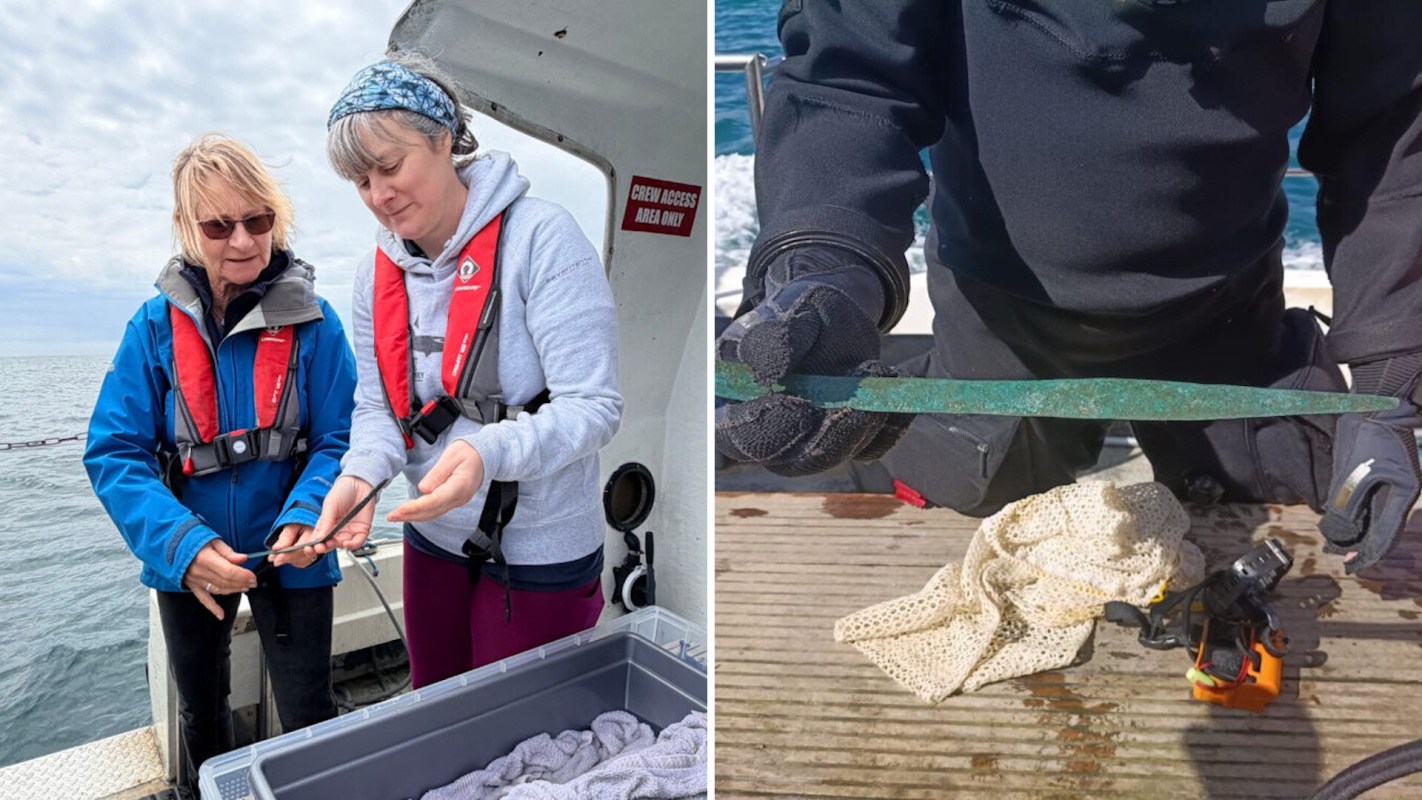
A dive off England's southwest coast has uncovered a rare Bronze Age sword that spent roughly 3,000 years underwater near Salcombe. A find far older than the shipwrecks the archaeologists set out to study.
What happened?
Earlier this year, the South West Maritime Archaeological Group, or SWMAG, found the sword while investigating a site that had already produced evidence from 17th-century wrecks as well as much older prehistoric material, according to Fox 5 New York.
The weapon was recovered by archaeologists Becky Gill and Catherine Gill in the Salcombe area, which is recognized internationally as an important prehistoric maritime site. Previous discoveries there have connected the waters to Bronze Age trade and seafaring, and the latest artifact offers another hint about how people traveled, exchanged goods, and used the sea in ancient Britain.
Specialists believe the sword comes from the middle or late Bronze Age. Its long burial underwater and the erosion it suffered over time make a more exact date difficult to determine.
"A kid at Christmas does not come close to the excitement of finding this sword," Catherine Gill said.
Why does it matter?
Finds like this can reshape experts' understanding of life thousands of years ago, especially in places where the sea served as a major route for travel and trade.
TCD Picks » Good Store Spotlight
Get 10% off your next purchase with code TCD10




Swords like the one found here offer clues about craftsmanship, status, technology, and the movement of people and materials across regions.
The Salcombe area is already considered a major prehistoric maritime site, so another rare artifact strengthens the case that this stretch of coast played an important role long before the better-known shipwrecks of later centuries. Each discovery helps fill gaps in a period that can be difficult to reconstruct from fragmentary evidence alone.
The sword's erosion also shows how vulnerable underwater history can be. Coastal sites can lose detail over time, which means careful archaeological work is needed if researchers hope to learn from objects before damage from water, shifting sediment, or disturbance makes that impossible.
What's being done?
Recovering an artifact like this typically requires careful surveying, identification, and conservation so the object's context is not lost.
The sword is expected to be donated to the British Museum, where it can be studied more closely and used to support further research. Analysis may reveal more about how it was made, where it came from, and how it ended up on the seabed off southwest England.
"I wonder where and who made it, who was planning to use it, and who was the last person to touch it, before us, around 3000 years ago," she said.

Get TCD's free newsletters for easy tips, smart advice, and a chance to earn $5,000 toward home upgrades. To see more stories like this one, change your Google preferences here.