


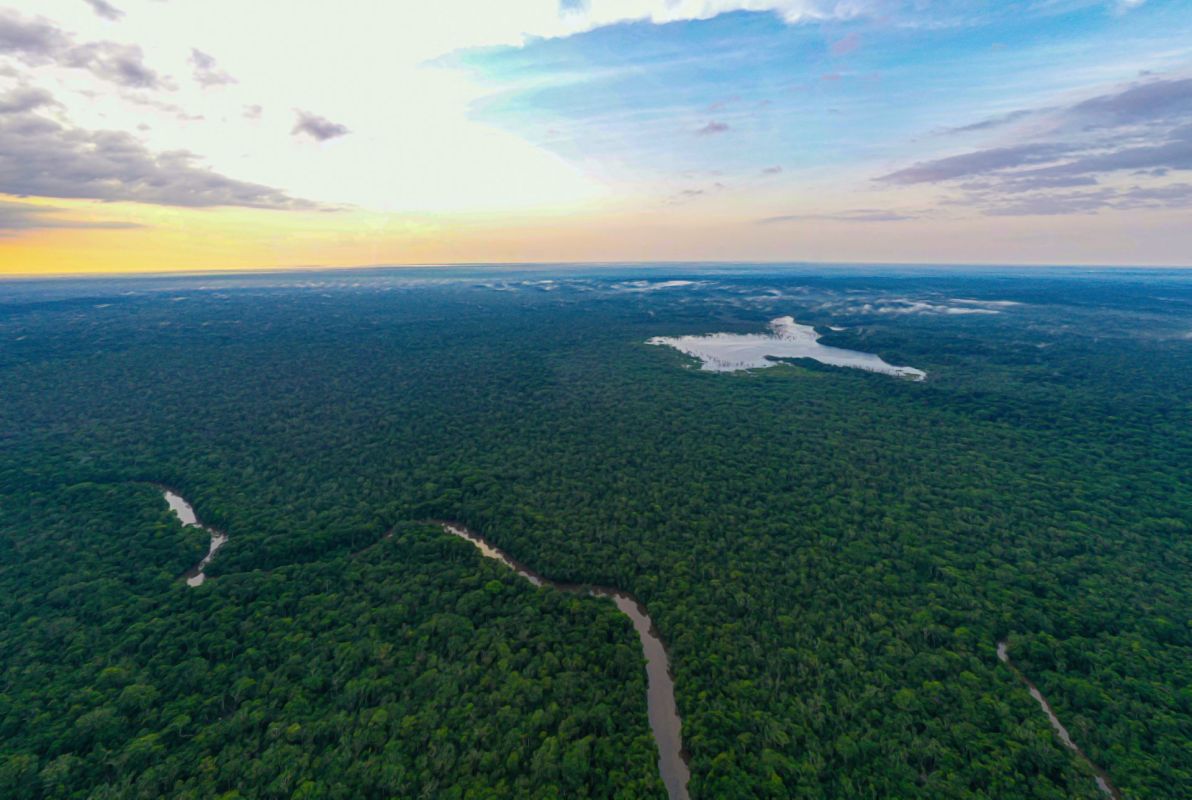
The central-northern Amazon's hottest temperatures have risen by more than 5.8 degrees Fahrenheit (3.22 degrees Celsius) over 43 years as extreme heat intensifies in a largely protected stretch of Brazil's rainforest.
Here's what to know
Across Amazonia, the most extreme dry conditions worsened faster than average conditions, and temperature extremes rose at more than twice the rate of annual averages, Mongabay reported. Researchers based their analysis on observations gathered from 1981 through 2023 by satellites, aircraft, and observation stations.
The highest 5% of temperatures in the hardest-hit area rose by about 1.35 degrees Fahrenheit per decade — more than 3.5 times the average regional warming rate. The sharpest changes were concentrated across roughly 270,000 square miles, mostly in Roraima, Brazil's northernmost state.
The affected area lies outside the Amazon's main deforestation zone and overlaps numerous protected areas and Indigenous territories.
"It was a big surprise," Nathália S. Carvalho, a Lancaster University postdoctoral researcher who oversaw mapping for the study, told Mongabay. "When we think about the impact of climate change in the Amazon, the first region that comes to mind is the south. But these results for extremes are very clear."
More background
After fire season began in October 2023, dead sloths turned up throughout the forest researchers were surveying near Manaus, with some still hanging from branches.
TCD Picks » Quince Spotlight
💡These best-sellers from Quince deliver affordable, sustainable luxury for all




"Animals just kept showing up dead," biologist Aretha Guimarães, who works for Brazil's National Institute of Amazonian Research, told Mongabay. "I've never seen such mortality. We were shocked."
While the phenomenon is still unexplained, the assumption is that the slow-moving animals could not get to water fast enough when temperatures started to rise.
The study's authors noted that the findings could help explain wildlife deaths, severe droughts, forest fires, and a rise in hospital admissions related to heat and smoke in Manaus.
Researchers have not determined exactly what is driving the worsening extremes in the central-northern Amazon. Possible influences include El Niño and changes in cloud cover around the equator. They also cited modeling suggesting that a collapse of circulation in the Atlantic Ocean could worsen drought in the northern Amazon.
What's being done?
Brazil's government has expanded its firefighting personnel and experimented with artificial intelligence to detect fires and send drones to extinguish them. However, much of that preparation has focused on the southeastern Amazon.
Advocating for more support, Guimarães said, "We don't have enough people doing real-time field work, and we can't monitor something that we are not seeing."
Study co-author Jos Barlow, who teaches conservation science at Lancaster University, said, per Mongabay: "If [the extremes] are not linked to local deforestation effects, then the first message is to reduce greenhouse gas emissions. The policies that have to change are for the whole world. It makes you feel powerless to think that the region's future depends on humanity's capacity to resolve global climate change, because at the moment it doesn't feel like we're going in the right direction."

Get TCD's free newsletters for easy tips, smart advice, and a chance to earn $5,000 toward home upgrades. To see more stories like this one, change your Google preferences here.






