


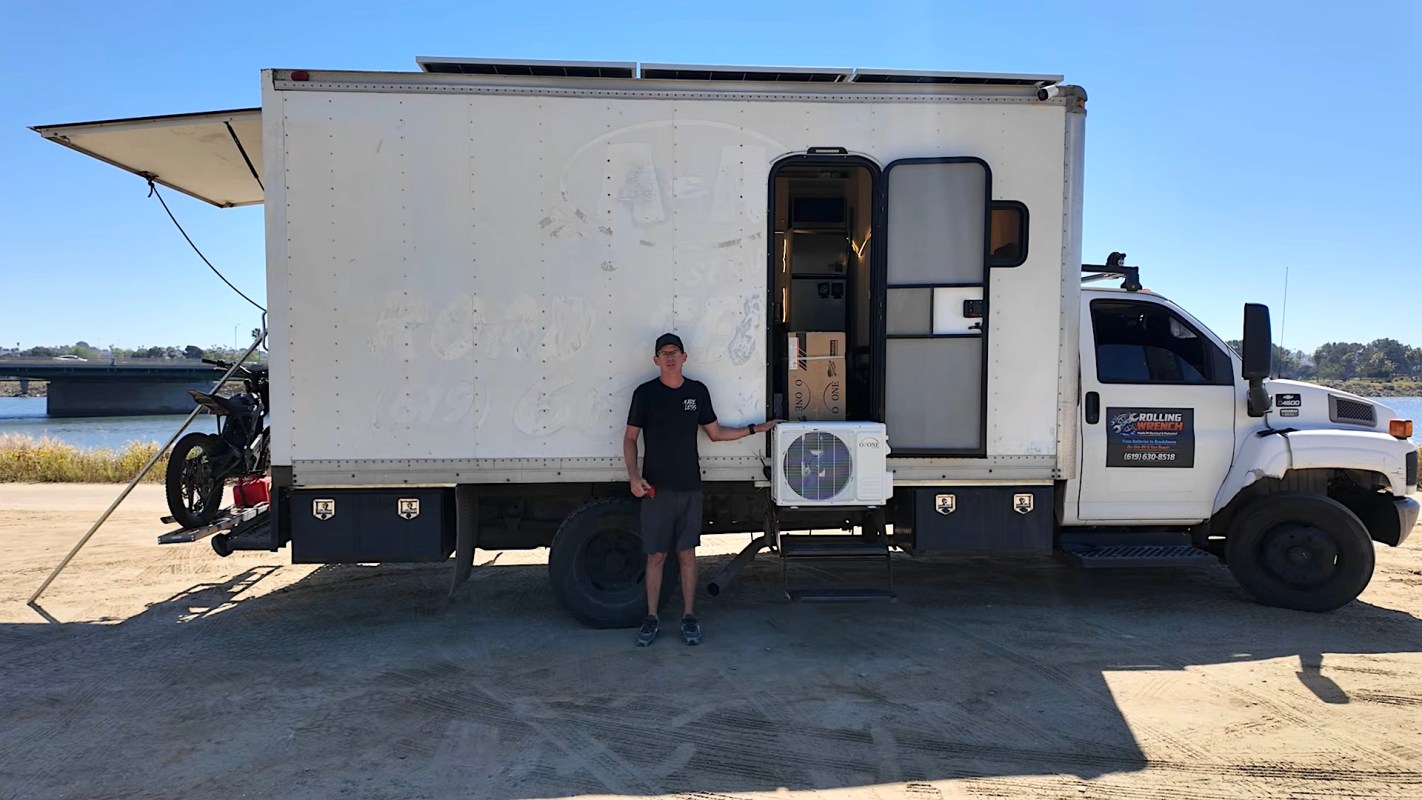
To see whether life in a converted box truck could stay comfortable in the California and Arizona desert once temperatures topped 100 degrees Fahrenheit, one owner relied entirely on rooftop solar, battery storage, and an efficient mini-split instead of plugging in.
Here's what to know
A YouTube video by Dave from Ebike VanLife (@EbikeVanlife) showed a converted 2003 Chevy Kodiak C4500 tiny home traveling through hot parts of California and Arizona while keeping its air conditioning running off-grid.
For the test, there were no campground electrical hookups, no shore power connection, and no generator operating during the day.
Cooling came from a 12,000-BTU mini-split that runs on 110 volts, supported by a 3,000-watt Sungold inverter/charger, roughly 10 kilowatt-hours of 24-volt lithium batteries, and three 650-watt solar panels for 1,950 watts total.
Dave said they bought the mini-split on Facebook Marketplace for about $500. They added that the system was meant to do more than provide a little temporary relief from the heat.
"I don't want to find a campground with hookups. I want to be able to park somewhere like this," they said, describing a setup that could also support cooking, refrigeration, work, and device charging.
Going solar is also one of the best ways to save money on home energy, especially if you're trying to offset heavy summer cooling costs. Homeowners who want to explore it can try EnergySage to get free solar installation estimates and compare quotes.
More background
Dave's test suggested that a converted box truck could stay comfortable in high heat, partly because a mini-split is more efficient than a standard rooftop RV air conditioner.
Save $10,000 on solar panels without even sharing your phone number Want to go solar but not sure who to trust? EnergySage has your back with free and transparent quotes from fully vetted providers that can help you save as much as $10k on installation. To get started, just answer a few questions about your home — no phone number required. Within a day or two, EnergySage will email you the best local options for your needs, and their expert advisers can help you compare quotes and pick a winner. |

In the video, Dave noted that an inverter mini-split can ramp its performance up or down to match demand instead of repeatedly switching fully on and off like a typical rooftop unit. That flexibility matters in an off-grid setup where the same solar production and battery capacity also have to cover the rest of daily life.
The rig was built to function as a genuine off-grid home, Dave said, with a sleeping space, a kitchen, a bathroom, and 75 gallons of fresh water on board.
"Excellent explanation of how solar is used to power your mini split and comparative efficiency of traditional rooftop AC units v mini split," one commenter wrote. "The best part was the drone footage that showed just how isolated you were from ppl and shore power."
What can be done?
If this test has you thinking about your own home, EnergySage offers free tools that let you compare competitive bids from local installers without them getting your contact information unless you choose to work with one further.
More From EnergySage
💡Go deep on the latest news and trends shaping the residential solar landscape

That kind of comparison shopping can make a major financial difference. With EnergySage's help, the average person can save up to $10,000 on solar purchases and installations. Tools such as EnergySage's solar map show the average cost of a home solar panel system by state, along with details on solar panel incentives for each state, helping homeowners find the best price for rooftop solar panels and access available incentives.
Adding battery storage to a solar setup is also one of the best ways to protect your home during outages, save money on energy, and reduce reliance on an unpredictable grid. Homeowners interested in that option can explore EnergySage for information about home battery storage options, including competitive installation estimates.
"And there's something pretty funny about using the brutal desert sun to generate the electricity that keeps me cool enough to survive the brutal desert sun," Dave said.
Where can I learn more?
These stories explore how far solar power can go in real-world conditions. They cover homes and off-grid setups using rooftop panels and batteries to handle heavy energy demands.
• One homeowner kept whole-house AC and two EVs running through 90-degree summer heat.
• In the Rocky Mountains, a family of five showed how 1,000 watts of solar powered daily off-grid life.
• In snowy conditions, one off-grid homeowner showed that solar panels still generated power when many assumed they wouldn't.

Get TCD's free newsletters for easy tips, smart advice, and a chance to earn $5,000 toward home upgrades. To see more stories like this one, change your Google preferences here.






