


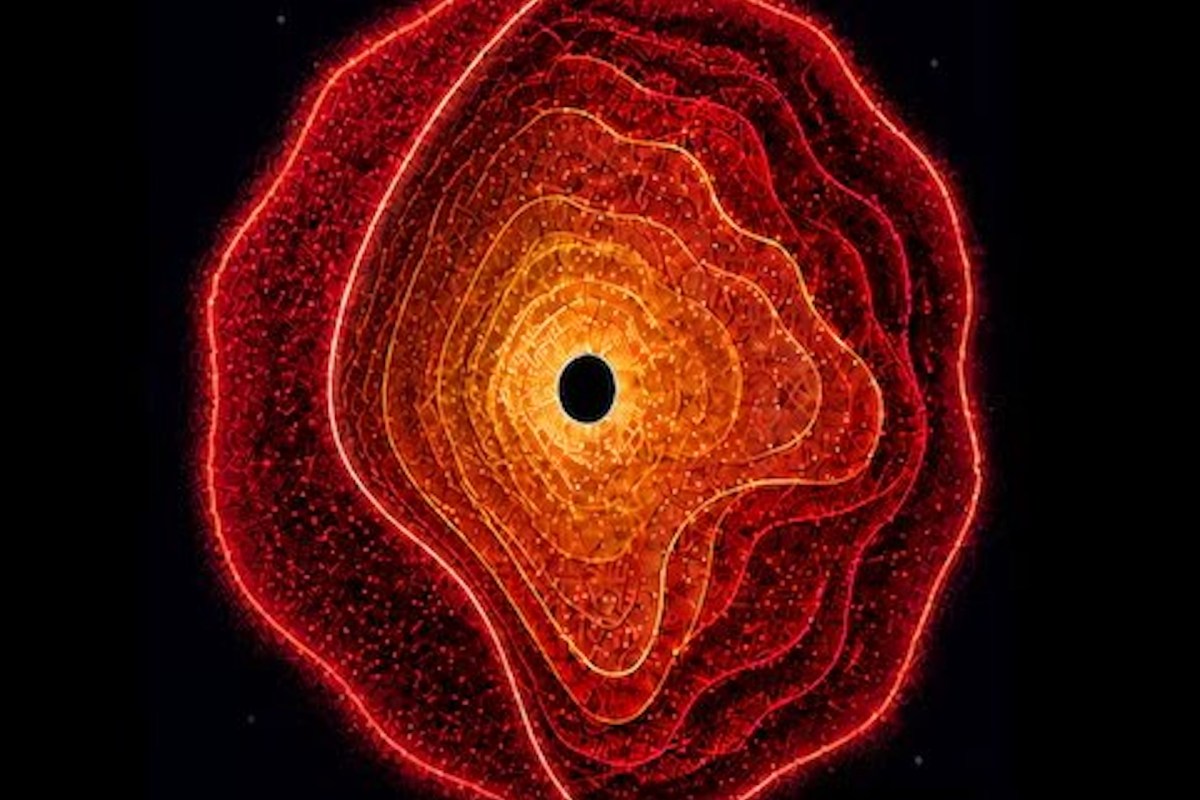
Astronomers analyzing data from the James Webb Space Telescope may have found a "black hole star." According to Futurism, it's a bright, star-like body whose light is driven by a black hole consuming material at its center rather than by fusion.
Researchers have labeled the object MoM-BH*-1, and they said it does not match any category they have previously confirmed.
NEWS 🚨: Astronomers have discovered an entirely new type of cosmic object called a "black hole star"
— Latest in space (@latestinspace) August 13, 2026
It's the size of our solar system, emits 100 billion times more energy than any star, and may finally explain JWST's mysterious "little red dots" pic.twitter.com/uBILVcoGdF
Here's what to know
In a study published in the journal Nature, scientists described a red object with a mass of about 100,000 suns, enclosed by gas so thick that on solar-system scales it can look like a star, Futurism detailed.
Its energy source, though, appears to be very different from that of a normal star. Instead of nuclear fusion, the glow is thought to come from a central black hole as it pulls in matter and releases enormous energy.
Futurism noted that researchers said the black hole at the center is emitting about 100 billion times more energy than any known star, and that the object formed within 700 million years of the Big Bang.
Speaking to Gizmodo, study lead and University of Hawai'i astronomer Rohan Naidu said, "It is a very special thing to find an object with no comparison given the vast stores of data on billions of stars, galaxies, and black holes that we have in our archival databases."
TCD Picks » Quince Spotlight
💡These best-sellers from Quince deliver affordable, sustainable luxury for all




More background
Futurism noted that scientists initially proposed the idea of black hole stars nearly two decades ago. However, it wasn't until the launch of the James Webb Space Telescope that black hole stars, also known as quasi-stars, gained renewed attention after it revealed strange red dots were littering the universe.
Those little red dots baffled astronomers because they seemed too large to be stars yet too compact to qualify as galaxies.
One leading explanation was that supermassive black holes were hidden inside them. But researchers were not finding the X-ray signatures they would normally expect from such black holes.
Scientists proposed that an extremely dense shell of gas could cloak the X-rays. In May, another research team detected X-rays from one of the little red dots, adding support to the idea that black holes may sit at their centers, Futurism reported.
Naidu's team focused on one object after spotting an unusual dip in brightness at certain wavelengths. That kind of signal is often associated with young stars whose light appears dust-filtered, but in this case there was no evidence of dust.
Instead, simulations indicated that a hydrogen-rich shell could mimic that effect, and the central black hole would explain the object's exceptional brightness.
What's being done?
If that interpretation proves correct, many of the little red dots Webb identified could also turn out to be black hole stars.
That could help answer one of astronomy's biggest outstanding questions: how enormous black holes formed so early in cosmic history. It could significantly reshape scientists' understanding of how the first galaxies and black holes came to be.
The finding shows how next-generation observatories can reveal phenomena older instruments failed to detect. As researchers continue combing through Webb's growing archive, more of these unusual objects could emerge.

Get TCD's free newsletters for easy tips, smart advice, and a chance to earn $5,000 toward home upgrades. To see more stories like this one, change your Google preferences here.







