


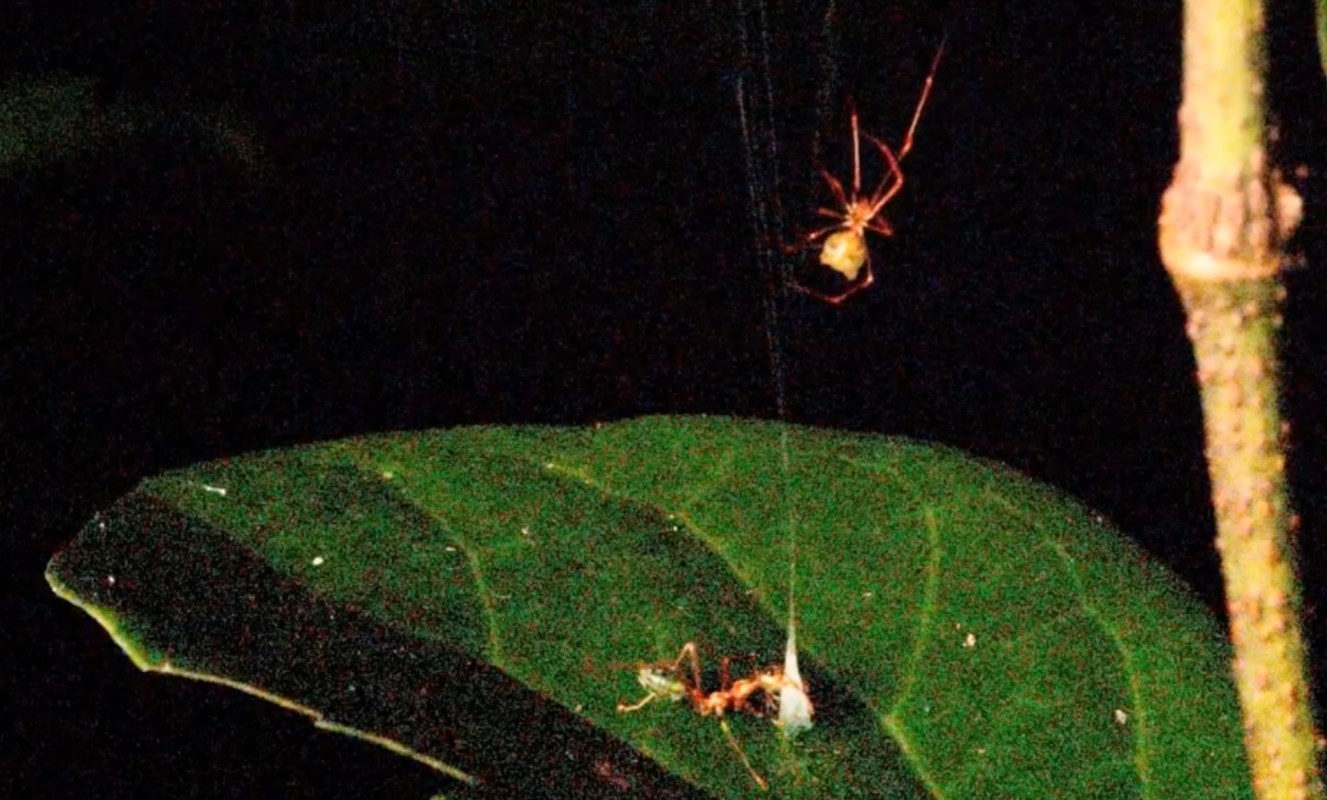
A tiny newly discovered spider in Australia is drawing attention online for a hunting strategy that looks more like a medieval siege weapon than something found in a rainforest canopy.
New research footage shows why researchers have nicknamed it the "ballista spider": after apparently drawing an ant into striking, it uses a tensioned silk snare to fire the insect into a waiting web.
What happened?
In the rainforests of northern Queensland, scientists found an unnamed spider in the genus Propostira that seems to target green tree ants, prey that can be as large as the spider itself.
The unusual predator has been dubbed the "ballista spider," and its trap-building behavior is now reaching a wider audience online, as A-Z Animals reported.
Each night, the spider can spend as long as four hours creating a cone-shaped trap of tensioned silk on a leaf.
The moment a worker green tree ant bites the structure, that stored energy is unleashed, hurling the ant upward into the spider's web at an acceleration of 4,485 feet per second squared (1,367 meters per second squared).
TCD Picks » Quince Spotlight
💡These best-sellers from Quince deliver affordable, sustainable luxury for all




Lead researcher Professor Ajay Narendra said the trap may even be chemically baited.
"We suspect during the final construction stage the spider adds a pheromone that specifically lures worker ants and induces an aggressive attack, triggering the snare," he said, per A-Z Animals.
Why does it matter?
Ants are notoriously risky prey, equipped with strong mandibles, chemical defenses, and the ability to call in reinforcements.
Instead of confronting an ant directly, the spider appears to exploit the insect's aggression so the attack itself triggers the capture.
But much remains hidden in biodiverse rainforests.
Green tree ants play an important role in tropical ecosystems by preying on plant-eating insects, and the ballista spider's highly specialized hunting strategy shows how closely linked species can become over time.
What are people saying?
Narendra described the behavior as unusual.
"It's very unusual for a spider to feed on ants, because they're notoriously dangerous, and even more bizarre to find a spider that eats only one particular ant species," he said.
He also said the trap appears to help the spider manage dangerous prey from a safer distance.
"The snare mechanism seems to have evolved as a highly specialised way of allowing the spider to 'pick off' potentially hazardous prey one at a time and transport them a safe distance away from ant trails and nests," he said, per A-Z Animals.
Narendra added, "The ballista spider's snare is bioengineered to store elastic energy in the silk and rapidly release it, giving it incredible instantaneous power density – greater than any other specialised silk-based biological catapults."

Get TCD's free newsletters for easy tips, smart advice, and a chance to earn $5,000 toward home upgrades. To see more stories like this one, change your Google preferences here.







