


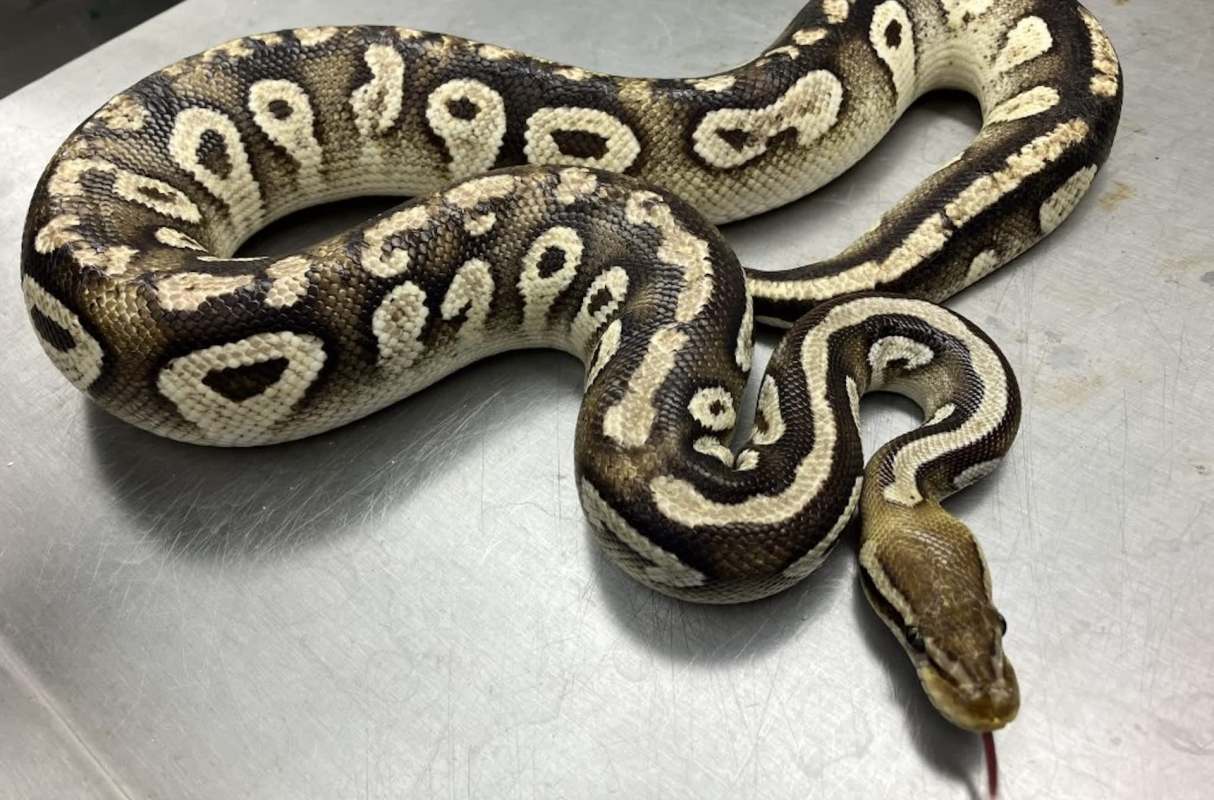
A ball python showed up in one of the last places a snake should be: O'ahu, where snakes are illegal and even a single sighting can trigger a multi-agency response.
State biosecurity officers were called after a 45-inch ball python was discovered in Wai'anae, on O'ahu's leeward side.
Here's what to know
After Honolulu police responded to the snake sighting at Camp Wai'anae, the case moved to the Hawaiian Humane Society and then to the Department of Agriculture and Biosecurity, whose officers took custody of the nonvenomous python near 85-1508 Haleahi Road.
According to Maui Now, the department's Plant Quarantine Branch is holding the snake while it tests to determine its sex. Even though ball pythons are not venomous, Hawai'i still treats their presence as a serious concern.
Hawai'i law prohibits snakes, and possessing one can lead to fines of up to $200,000 and three years in prison. Because the islands evolved without snakes, even one pet trade animal on the loose can raise both environmental and public safety concerns.
More background
Hawai'i has no native snake populations, and the state says an introduced snake would have no natural predators on the islands. Officials warn that snakes could harm the environment by competing with native wildlife for food and habitat.
TCD Picks » Quince Spotlight
💡These best-sellers from Quince deliver affordable, sustainable luxury for all




Officials say snakes such as ball pythons may feed on birds and eggs, increasing the pressure on Hawai'i's endangered native bird species.
The state also warns that large snakes can threaten pets and other domestic animals and may pose risks to human health and safety. Ball pythons are widely sold in the continental pet trade. More broadly, human-wildlife encounters often reflect human activity, including moving animals beyond their native ranges.
What can be done?
The capture followed Hawai'i's multiagency response system for cases like this. Honolulu police, the Hawaiian Humane Society, and the Department of Agriculture and Biosecurity helped remove the snake and place it in quarantine.
The state is reminding residents that they can report illegal animals through the toll-free PEST HOTLINE at 643-PEST (7378).
People who already have prohibited animals can also turn them in through Hawai'i's Amnesty Program. The state is trying to prevent one illegally kept animal from becoming a broader problem for wildlife, neighborhoods, and pet owners.
Ball pythons can grow up to six feet long, which helps explain why Hawai'i treats even a single pet trade python as a serious biosecurity threat.
Where can I learn more?
Elsewhere, officials have learned how quickly nonnative snakes can become a long-term ecological problem. The following articles cover snake hunts on islands and urban settlements, along with the damage officials are trying to stop.
• In Florida, officials removed 294 pythons in 10 days while the Everglades invasion kept spreading.
• In Guam, residents joined a hunt for brown tree snakes blamed for bird losses and blackouts.
• On the Balearic Islands, horseshoe snakes spread across habitat and threatened vulnerable local wildlife.
• In Dhaka, Bangladesh, rescuers say snakes sneak into human settlements as urbanization squeezes habitat.






