


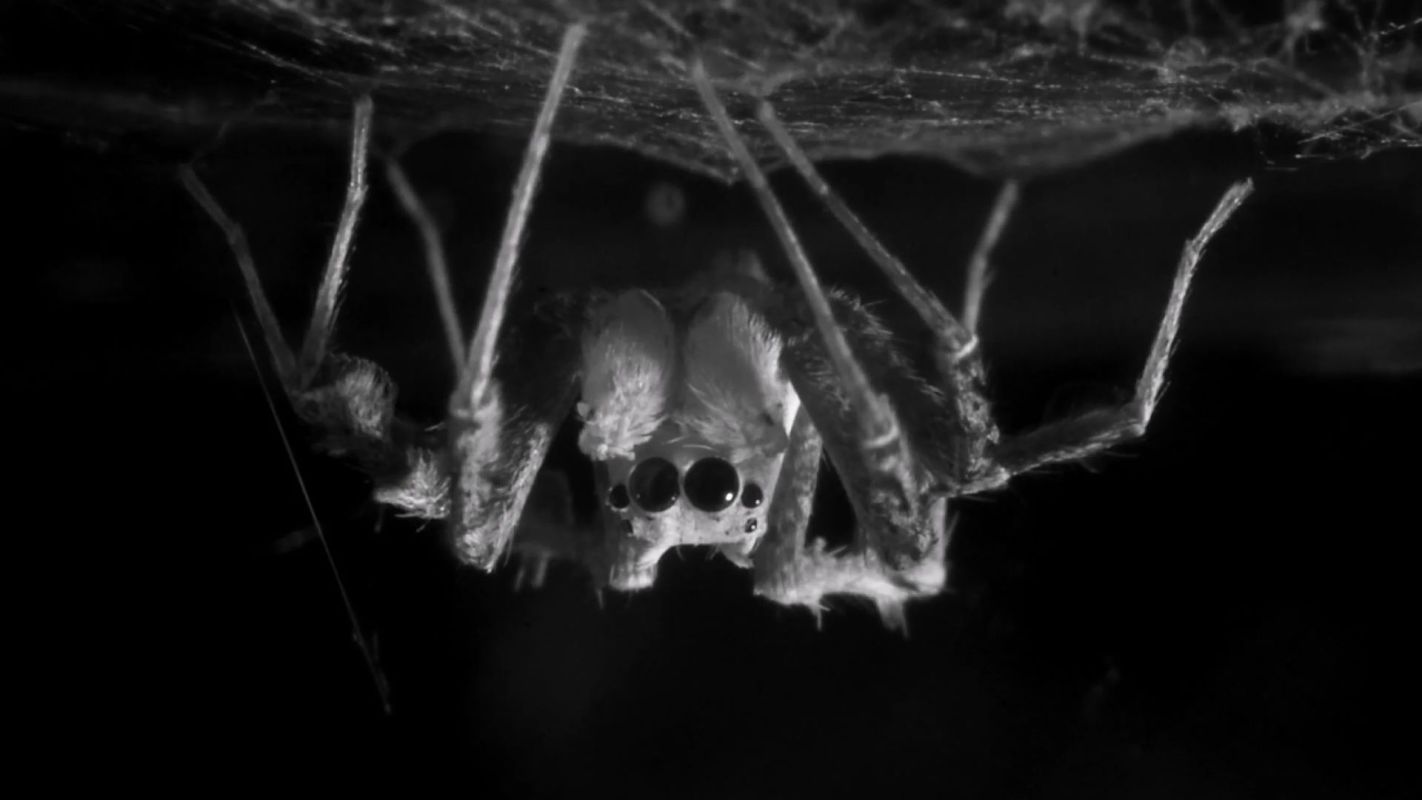
Video footage suggests a small Australian jumping spider's nighttime routine is more elaborate than expected: it hangs upside down in a silk retreat and later shows eye flickers, twitching limbs, and curled legs during a REM-like state.
The recordings suggest that even spiders may follow a more organized sleep cycle than scientists had assumed.
Here's what to know
In a new study published in Proceedings of the National Academy of Sciences, researchers reported that Portia fimbriata — a jumping spider found across Northern Australia — moves through at least two separate sleep stages.
According to the Australian Broadcasting Corporation (ABC), the team documented both a quiescent period and a REM-like period, adding to evidence that sleep may be a deeply rooted feature of animal life.
For study co-author Daniela Rößler, a behavioral ecologist at the University of Bonn, the finding points to more than an unusual spider behavior.
"Spiders have distinct sleep stages, and that the architecture of their sleep mirrors key features of vertebrate sleep far more closely than anyone expected," she said.
TCD Picks » Quince Spotlight
💡These best-sellers from Quince deliver affordable, sustainable luxury for all




Study co-author Nadja Geiger said the species was especially well suited to the project, calling Portia fimbriata a "dream species" for the research because "She also has a very clear nighttime resting posture, sleeping upside down in a little web … this makes sleep easier to identify and study."
To determine whether the spiders were truly asleep, the researchers also woke them with a loud noise during both sleep phases and while the animals were visibly awake. The spiders responded more slowly during sleep.
"Responses were significantly delayed, and some spiders did not respond at all," Geiger said.
More background
Thomas White, a University of Sydney entomologist who studies invertebrate behavior, told ABC that spiders and vertebrates diverged roughly 500 million years ago, which can make comparisons between them seem surprising at first.
But White said unfamiliarity with the animals should not be a reason to dismiss the idea.
"We readily see our dog lying down and its eyes are twitching and it's kicking its little paws. Essentially what [the researchers] are showing here is that something similar," he said.
White said the study extends the team's earlier research, which suggested that jumping spiders might undergo REM-like sleep.
"This paper is far and away the most complete behavioral case for sleep in any arachnid," White said.
Across the animal kingdom, sleep can happen while moving, standing upright, in trees, or underwater, and some species have no eyelids at all.
That makes spider sleep a potentially useful window into why sleep exists, not just how humans experience it.
What's being done?
The researchers built their case by filming the spiders overnight and closely reviewing the footage.
From those recordings, they identified a quiescent stage in which the spiders gradually drooped and sometimes groomed themselves while resting, followed by a REM-like stage marked by eye movements, twitching, and leg curls.
They then used a standard sleep test by trying to wake the spiders. Geiger said, "A hallmark sign of sleep is … [responding] slower or not at all to external stimuli." ABC News reported that the effect was especially strong during the REM-like phase.
The researchers plan to examine spider sleep in the wild, including fieldwork in northern Queensland and Western Australia.
That work could also clarify how human activity alters animal behavior. Rößler said the field studies will examine "how natural conditions and anthropogenic changes, such as artificial light and habitat disturbance, influence sleep outside the laboratory."
The researchers also hope the findings shift how people think about arachnids.
As Rößler put it, "We'd love for this kind of research to help spread a little more curiosity and appreciation for these charismatic animals."
Where can I learn more?
Curious about what else spiders have been up to? These stories cover other surprising encounters and discoveries, from a bedroom huntsman that stopped hunting to newly recorded or recovering species in Idaho, Norfolk, Cheshire, and Connecticut.
• A bedroom huntsman stayed on pest patrol but refused to take down a roach.
• At the University of Idaho, researchers named a new spider after the Vandals.
• In Norfolk, U.K., conservation work has brought fen raft spiders back from the brink.
• In Cheshire, U.K., officials recorded a wasp spider for the first time.
• In Connecticut, experts confirmed the state's first recluse spider after a pest pro noticed it.

Get TCD's free newsletters for easy tips, smart advice, and a chance to earn $5,000 toward home upgrades. To see more stories like this one, change your Google preferences here.






