


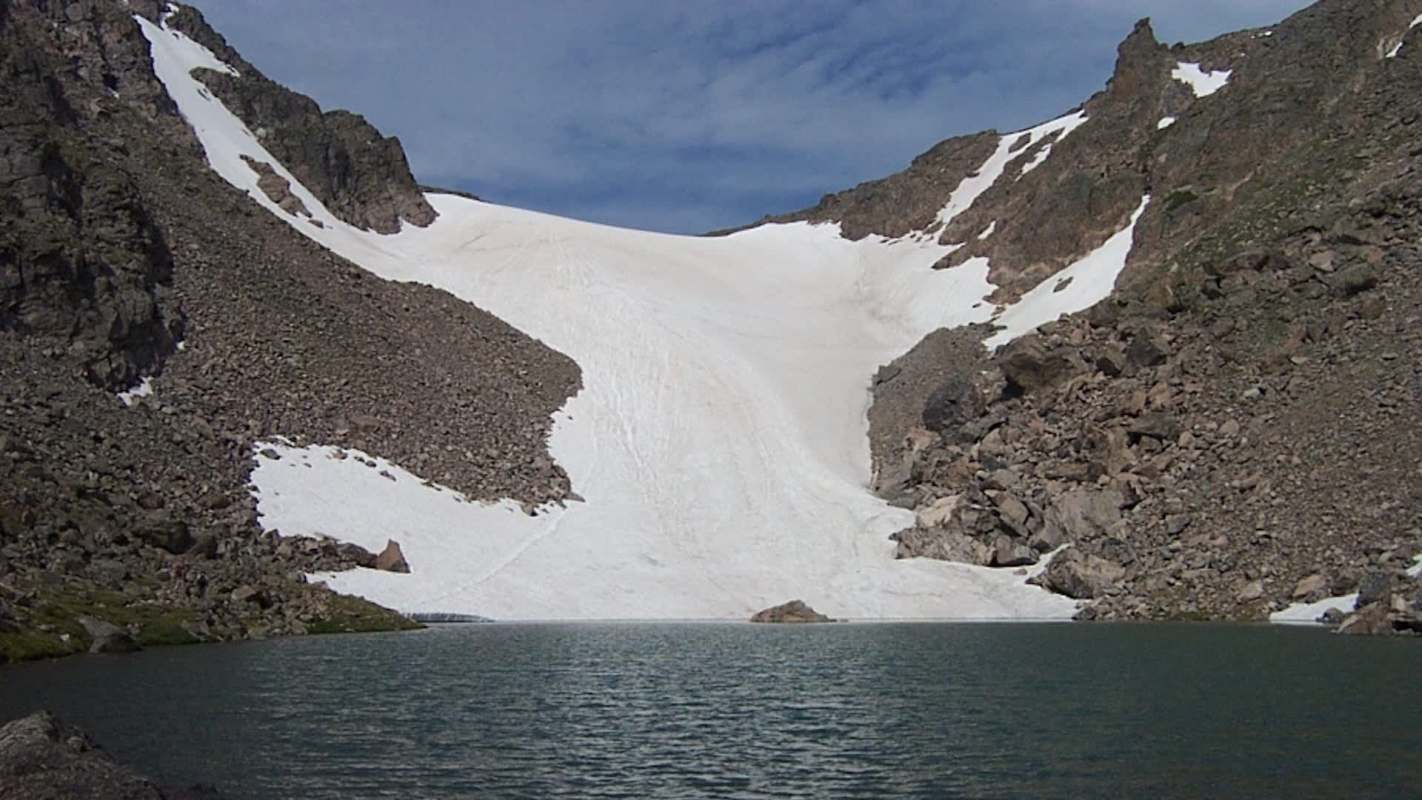
Colorado's Andrews Glacier lost more than 12 feet of thickness in 2026 as record-low snowpack and record summer heat left its year-round ice exposed.
Here's what to know
Scientists generally assess glacial changes across longer stretches of time, but Colorado's unusual conditions prompted an investigation focused on a single year. Glaciologist Dan McGrath of Colorado State University measured the losses following Colorado's exceptionally warm, dry year, according to The Associated Press.
Arapaho Glacier lost almost 10 feet of thickness, and Isabelle Glacier lost approximately 6.5 feet. Across the three glaciers, the thinning rate doubled compared with the preceding five years, McGrath said. During the earlier decade, yearly ice loss was no greater than a foot.
By September 2026, St. Mary's Glacier had completely melted. The hiking and skiing destination is a persistent snowfield rather than a glacier. Andrews Glacier has shed 50% of its ice since 2017, McGrath said.
"This past decade has showed us that these glaciers are out of balance with the climate here in Colorado, in the western U.S., and they're thinning at a rate that could lead to their demise in the next 20 years," he said, per AP.
More background
Glacier runoff supplies ecosystems downstream and at high elevations throughout the western United States, according to Brian Menounos, who teaches earth sciences at Canada's University of Northern British Columbia. As the ice disappears, severe drought could become a greater threat to those areas.
TCD Picks » Quince Spotlight
💡These best-sellers from Quince deliver affordable, sustainable luxury for all




A study co-authored by Menounos found that about one-quarter of mountain glaciers in the contiguous U.S. have disappeared since the mid-1900s. Those that remain have shrunk by approximately a third in both volume and area.
Wildfires can worsen the damage by depositing soot and dust on glacier surfaces, Menounos explained. The darker surfaces absorb more sunlight, causing further melting.
AP noted that Switzerland's glaciers lost 5.5% of their ice volume in 2026, marking their second-worst proportional loss on record, according to the Swiss Academy of Sciences and the GLAMOS Swiss glacier monitoring service.
What's being done?
Harlan Ulmer, a 20-year-old Colorado State University student who volunteers with McGrath's research project, has taken yearly photographs of the glaciers since 2022, creating a visual record of their decline, AP reported.
In Washington, researchers with the North Cascade Glacier Climate Project visit each summer to measure six of Mount Baker's glaciers. The project's director, Mauri Pelto, said the 2026 survey found that the average rate of retreat had reached its highest level since 1950. Several large ice caves had also collapsed.
Reversing these losses would require substantially lower carbon pollution and temperatures cool enough for snow to accumulate year-round, Menounos said.
That snow could eventually compress into glacial ice again, but rebuilding glaciers may take several hundred years, leaving no quick replacement for the ice that Colorado is losing.
"What we're witnessing is the loss of that part of Colorado's identity," McGrath said, according to AP. "And it's not just Colorado. Obviously we see it in the Alps and we're seeing it in other mountain ranges in the western U.S., the European Alps and globally. There are very clear, consistent patterns across these ranges."
Where can I learn more?
Glaciers are shrinking far beyond Colorado, as these stories cover.
• A global map shows when glaciers may disappear as Switzerland loses two more.
• West Antarctica's Thwaites Glacier could raise sea levels 1.2 inches by the year 2100 without further warming.
• Norway's Svalbard glaciers are releasing ancient methane, opening a hidden Arctic climate feedback loop.

Get TCD's free newsletters for easy tips, smart advice, and a chance to earn $5,000 toward home upgrades. To see more stories like this one, change your Google preferences here.







