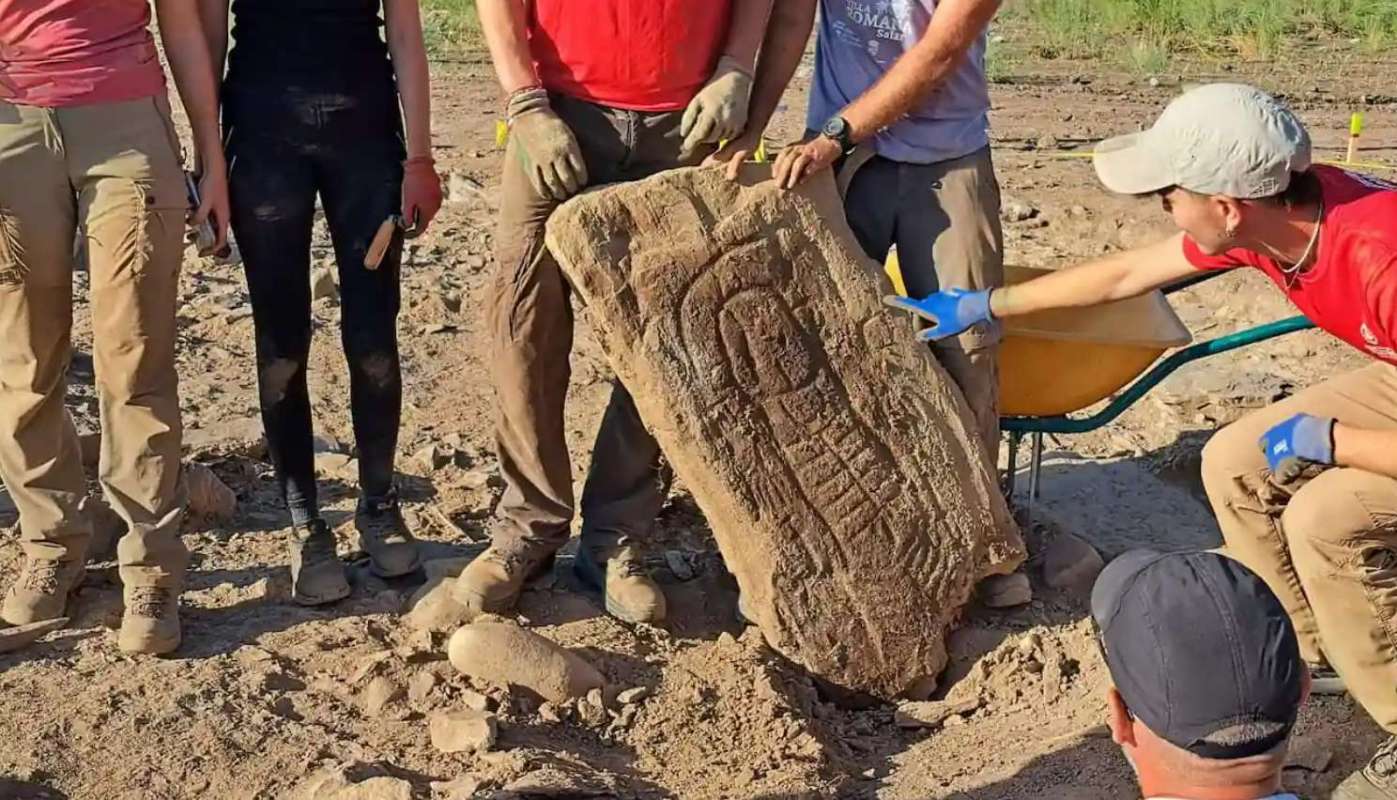
Three carved stone monuments uncovered in southwestern Spain may finally help answer a question that has puzzled archaeologists for more than a century: What exactly were ancient Iberian stelae used for?
A newly studied funerary complex suggests the answer may not be limited to a single purpose. Instead, the stones may have served simultaneously as grave markers, territorial signs, and route markers.
What happened?
At Las Capellanías in Huelva, archaeologists working with the University of Seville documented three stelae in the same setting as graves and a former roadway. According to La Brújula Verde, that kind of direct context has been missing from long-running arguments about what these decorated stones were for.
Work at the site began after a chance 2018 find, when a stela turned up at the edge of a road. From 2019 to 2023, researchers examined roughly 3.1 miles (5 kilometers) around that point and recorded 18 funerary structures, eight of which were fully excavated.
The tombs span an unusually long period, from the second millennium B.C. to the mid-first millennium B.C., with especially heavy use between the eighth and sixth centuries B.C.
Their placement suggests the monuments had more than one role in the landscape. Two are "warrior" stelae, one is a "diadem" stela, and all three were positioned near graves as well as the path, indicating they may have identified burial areas while also marking movement along the route.
TCD Picks » EDF Spotlight
💡EDF's Vital Signs newsletter delivers stories about game-changing solutions close to home and around the world



Why does it matter?
The discovery offers a clearer picture of how people in ancient Iberia lived, traveled, traded, and commemorated their dead.
The graves contained cremated remains, ceramic urns, bronze objects, glass beads, a silver earring, and evidence of outside influence from Phoenician and Greek-connected exchange networks. One wheel-made urn appears linked to Phoenician traditions, while other vessels and metal goods reflect local customs.
Taken together, the findings suggest that communities in the region were blending imported ideas with older regional practices.
Researchers also found stable isotope evidence pointing to marine fish in the diet, even though the coast lay more than 62 miles away. That detail suggests long-distance exchange routes were part of everyday life, shaping foodways and funerary rituals.
This formed part of a broader network of mobility, commerce, and cultural exchange during a major transitional period in southwestern Iberia.
What's being done?
Researchers are now using Las Capellanías as an important reference point for understanding prehistoric stelae across the Iberian Peninsula. Because the stones were found in place near graves and along a route that may have remained in use for centuries, the site gives archaeologists a rare framework for comparing similar discoveries elsewhere.
The excavation also underscores the importance of protecting landscapes that may seem ordinary today but rest atop ancient infrastructure and burial grounds. In this case, a modern path appears to preserve the line of a much older communication route, possibly one used long before it was recorded in the medieval period.
As the researchers concluded, the excavations revealed "temporal persistence, geographic connectivity, and cultural hybridization in funerary architecture and objects" and offer "valuable and novel data to understand the social and cultural context of the use of prehistoric stelae in Iberia like never before."

Get TCD's free newsletters for easy tips, smart advice, and a chance to earn $5,000 toward home upgrades. To see more stories like this one, change your Google preferences here.