


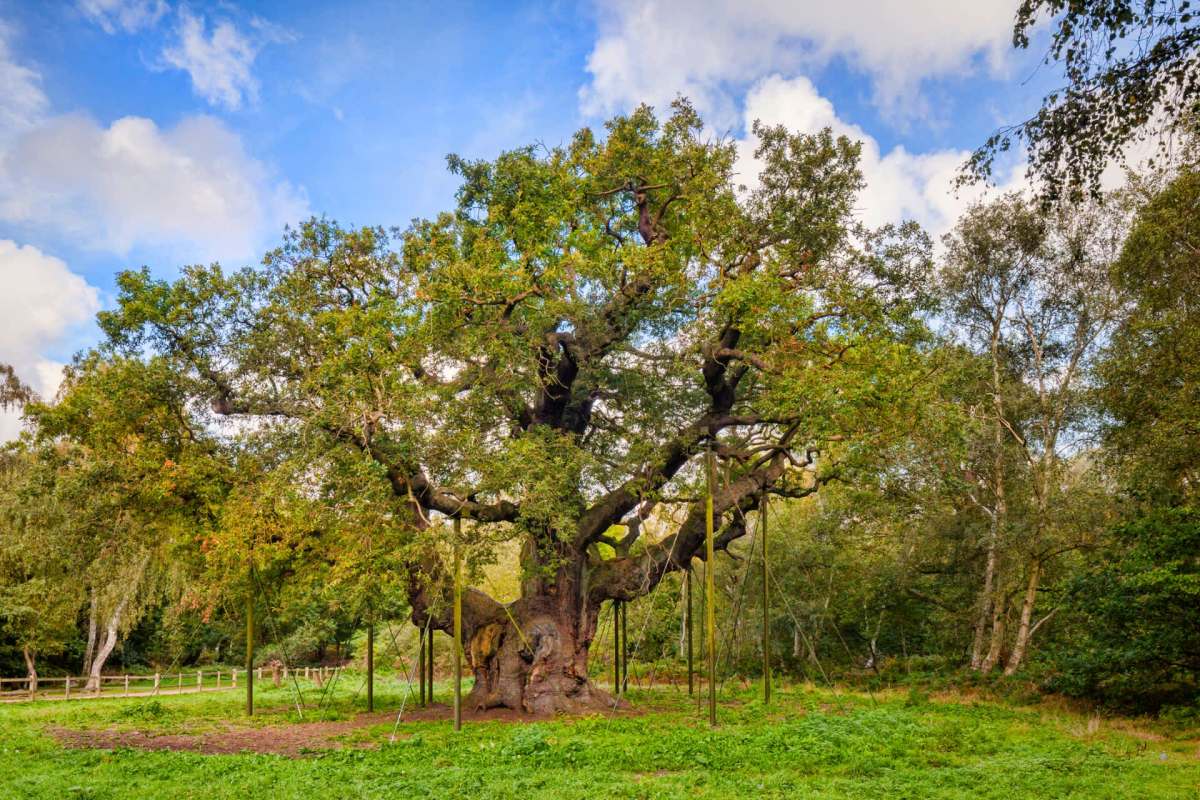
England's ancient oak trees are beginning to show signs of "early autumn" in the middle of summer, shedding leaves and wilting as heat and drought push them beyond what they can withstand.
For the communities that have lived alongside these trees for generations, the damage is another sign that ecosystems are changing faster than nature can comfortably adapt.
Here's what to know
According to The Guardian, prolonged heat and very little rain are taking a particularly heavy toll on some of England's oldest trees. Experts say severe drought stress can force trees to scale back normal functions, resulting in premature leaf loss that is giving parts of Europe an "early autumn" look.
Woodland Trust senior conservation adviser Ed Pyne said a tree's health depends on water, minerals, and nutrients moving upward from the roots to the leaves.
"When the trees are losing too much water, it stops this process and that's when we start seeing the leaves wilting and dying, which can give rise to this early autumn phenomenon where the trees are losing their leaves early," he said.
Among the trees suffering most, Pyne said, are ancient and veteran oaks. "These really old trees, they're survivors," he said, "but, like us, when they get old they get a bit less resilient."
TCD Picks » Quince Spotlight
💡These best-sellers from Quince deliver affordable, sustainable luxury for all




Losses have sharpened concern. Sherwood Forest lost eight ancient oaks in 2024 and 2025, Pyne has identified seven more trees in England and Wales that are in critical condition, and the Major oak — one of Europe's oldest, largest, and most celebrated ancient trees — died in June.
More background
The benchmark for classifying an oak as ancient is 400 years old. England has about 3,300 with trunks wider than 19.7 feet (6 meters) in circumference, and roughly 114 of them exceed 29.5 feet (9 meters). By comparison, the rest of Europe combined, including Scotland and Wales, has about 98 in that largest size category, according to The Guardian.
A mortality analysis by Pyne indicates that half of ancient oaks could be gone within the next 60 years. He says that forecast may understate the danger because it did not account for climate change.
"When you get these incessant droughts year after year, it's a cumulative effect which compounds across time and gets worse," he said.
The stress is not limited to oaks. Arboricultural Association chief executive John Parker said beech trees are also under pressure, warning that "They are possibly going into decline and may die, which would be disastrous for us."
What can be done?
Forests are always adjusting, Alexander Held, a senior expert at the European Forest Institute, said, but old trees cannot adapt overnight, and Earth's warming is moving faster than that natural process.
Protection and planning are becoming increasingly important.
Tree surgeons are seeing how hotter conditions are changing the way trees fail. Angelo Morgan, a director of urban tree management at Trees UK of Bromley, said more calls come during hot, dry periods because "a lot of the limbs become very brittle and a lot of larger limbs are failing."
"Our trees and ecosystems aren't fast enough to cope with the speed of change," Held said. "These changes will likely be a big disruption to our ecosystems."

Get TCD's free newsletters for easy tips, smart advice, and a chance to earn $5,000 toward home upgrades. To see more stories like this one, change your Google preferences here.






