


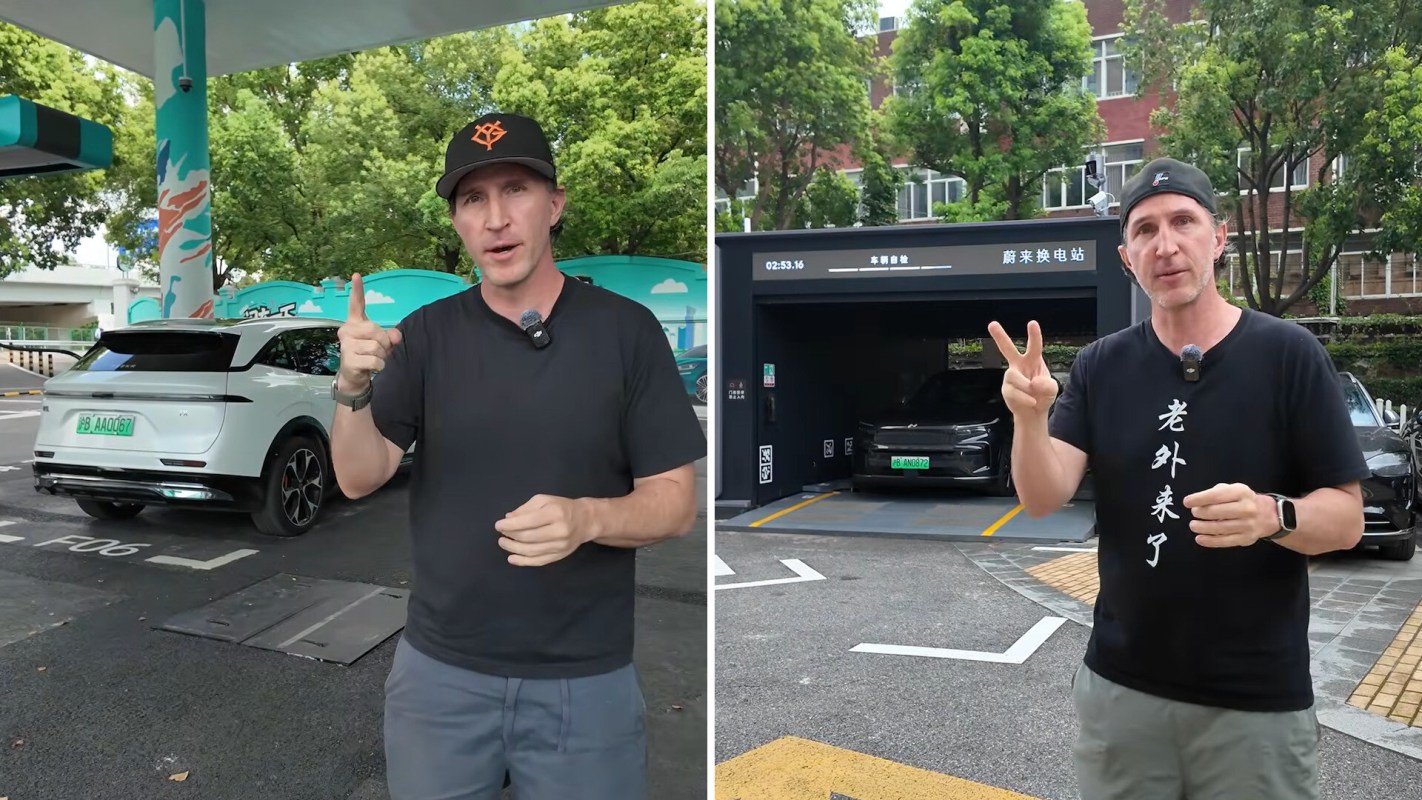
An American creator in Shanghai put two of China's most advanced EV refueling systems to the test — NIO's latest battery-swapping station and BYD's flash-charging hub — and it highlights that drivers in the United States still do not have anything close.
The side-by-side comparison offers a rare real-world look at how quickly electric car charging is evolving when companies build for scale, speed, and convenience.
Here's what to know
Much of the YouTube video focused on the BYD site itself: a former gas station reworked for EVs, with pull-through stalls, overhead charging cables, a convenience store, and battery backups to support ultra-high-power charging. Eric Garrison (@Eric_Garrison) introduced the comparison by saying, "Recently had the privilege of testing both the latest NIO power swap station and the BYD flash charging hub in Shanghai."
Using a Zeekr 7X that arrived essentially with zero battery, Garrison tested BYD's flash charging and later said the session "stopped charging at 14 minutes and 39 seconds and got us 82% full." The charger also reportedly reached output in the hundreds of kilowatts, a level that can rapidly refill large packs in newer EVs.
For NIO's system, he used a Firefly at the company's fifth-generation swap station. What impressed him most was the consistency of the process, prompting him to say, "It's always going to take the same amount of time to refill your car." Garrison added that the battery swap only takes about 3 minutes every time, no matter what type of vehicle you bring in.
The comparison also covered layout, weather protection, queuing, and how much land each system requires.
TCD Picks » Quince Spotlight
💡These best-sellers from Quince deliver affordable, sustainable luxury for all




More background
Expansion is happening on both sides. Figures cited in the video put BYD's network at roughly 10,000 flash chargers across China, with a target of 20,000 by the end of 2026. NIO, meanwhile, has more than 4,000 power swap stations in China, with about 4,600 expected by the end of 2026.
He argued that swapping has advantages that go beyond sheer speed. In his view, drivers can remain inside the car, avoid rain or extreme heat, check queue times before arriving, and benefit from a system where access to a healthy battery is less tied to keeping the same pack for the life of the vehicle.
One commenter wrote, "Thanks Eric G. The EV market is booming everywhere except the US. Thanks for the review, and traveling exhaust-free, this is why we go the extra distance of using EVs."
What's being done?
Chinese automakers are pushing multiple solutions at once rather than treating EV refueling as a one-option race. BYD is expanding ultra-fast charging hubs that can serve more future vehicles capable of handling megawatt-level charging. NIO is continuing to build out swap stations that support multiple brands under its umbrella, including NIO, Onvo, and Firefly.
The creator also noted a key advantage for NIO drivers: flexibility. As one commenter put it, "People always seem to forget that you have two options to charge a Firefly whereas BYD only has one option." Some drivers can still plug in when needed while also having access to swapping.
Better charging experiences are not just about battery chemistry — they also depend on station design, software, and smart planning.
The creator's verdict was straightforward: "Overall, both are really good ways to charge your car and in my opinion, I think some of these technologies should roll out to other parts of the world, namely the United States of America."
Where can I learn more?
The Shanghai comparison is just one snapshot of a much bigger push in China, where battery swapping, ultra-fast charging, and lower-cost EVs are all moving quickly at once. The stories below add context for why the gap the creator pointed to can feel so stark from a U.S. driver's perspective.
• In China, a traveler put BYD's flash charging claims to the test on local roads.
• Chinese automakers are moving so fast that U.S. drivers may be last in line for affordable EVs.
• Across clean tech, Washington has forfeited to China while chasing cutting-edge energy systems.
Seen side by side, these stories make clear that faster EV refueling is only one piece of the larger buildout already underway in China. They also reinforce the article's main point that the technology gap for U.S. drivers is real and increasingly hard to ignore.

Get TCD's free newsletters for easy tips, smart advice, and a chance to earn $5,000 toward home upgrades. To see more stories like this one, change your Google preferences here.






