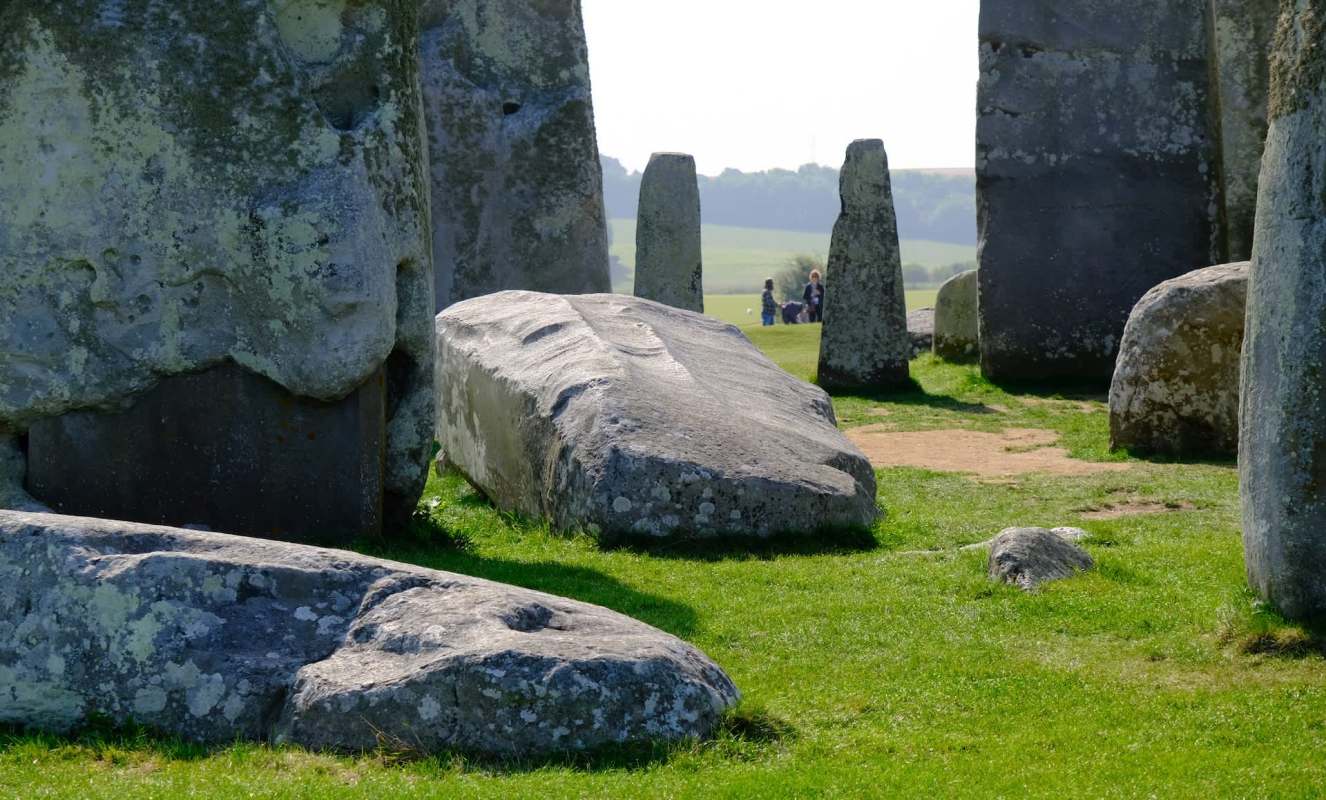
A massive stone at the heart of Stonehenge may have traveled much farther than previously believed — and not likely with help from ice.
New research suggests that prehistoric people, rather than glaciers, likely moved the six-ton Altar Stone roughly 700 kilometers, or 430 miles, from northern Scotland to Salisbury Plain, according to Archaeology News.
The study, led by researchers at Curtin University, revisited one of Stonehenge's biggest mysteries: where the Altar Stone came from and how it reached southern England.
To investigate, the team analyzed zircon minerals in the sandstone. Those minerals act as a kind of geological marker, allowing scientists to compare the stone with candidate source regions.
Sandstone from Caithness on the Scottish mainland provided the strongest match, while other parts of the wider Orcadian Basin were less convincing.
The researchers also used computer modeling to test whether Ice Age glaciers might have carried the stone south. But the models did not support that explanation.
TCD Picks » Good Store Spotlight
Get 10% off your next purchase with code TCD10




Ice flowing from Caithness mostly moved northeast, with only a narrower path sending material southeast toward Dogger Bank, the landmass later lost beneath the sea that once connected Britain to continental Europe.
Even under that glacial scenario, people would still have had to transport the stone some 250 miles from Dogger Bank to Stonehenge. Without much help from ice, the full journey was likely over 400 miles.
If glaciers did not do most of the work, then ancient people likely planned and carried out an ambitious transport effort in prehistoric Britain.
Hauling a six-ton stone for hundreds of kilometers would have required labor, route planning, and detailed knowledge of rivers, coastlines, and overland terrain.
The glacial theory also faces a major timing problem. Dogger Bank was already underwater thousands of years before the Altar Stone likely reached Stonehenge, making a purely natural route of delivery difficult to explain.
Researchers are now narrowing their search for the Altar Stone's exact origin in northeast Scotland. Identifying the source more precisely could help archaeologists trace the route prehistoric communities took and better understand why this particular stone was chosen.
The study also points to a more complex transport story than a single overland haul. The researchers envision a staged journey in which people may have pulled the stone over land and used rivers or coastal waters where those routes were practical.
By matching the stone to specific deposits and comparing that information with ancient travel corridors, scientists may be able to map a long-distance transport effort.
The latest evidence suggests glaciers played at most a limited role in the Altar Stone's journey. Instead, the megalith's presence at Stonehenge appears to reflect the planning, cooperation, and determination of prehistoric people who moved an enormous stone across an extraordinary distance.

Get TCD's free newsletters for easy tips, smart advice, and a chance to earn $5,000 toward home upgrades. To see more stories like this one, change your Google preferences here.