


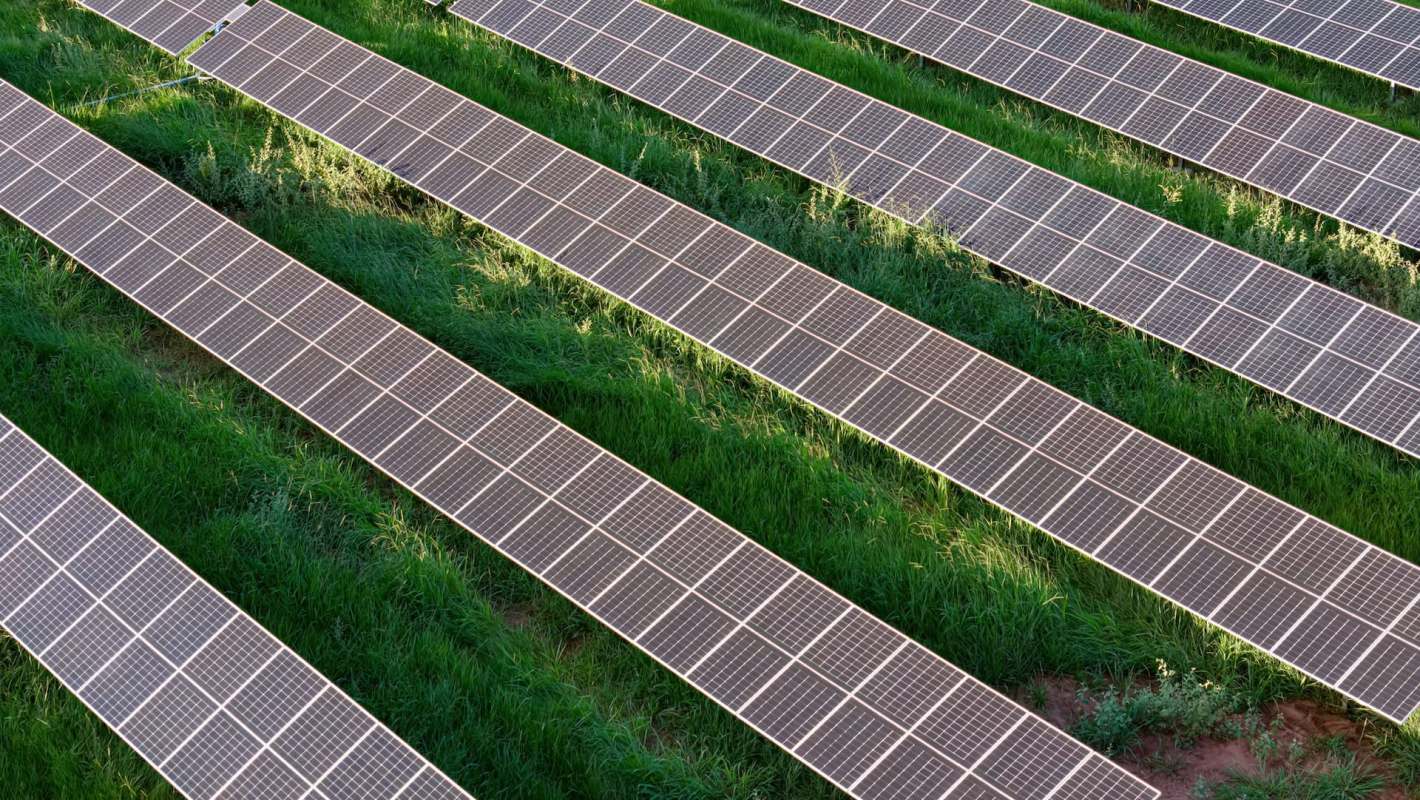
County officials in Illinois have approved plans to grow hay and alfalfa under a solar installation as part of a statewide effort to promote dual-use solar projects.
Here's what to know
At Gillard Solar LLC's 25-acre solar site on Illinois Route 53 in Gardner, alfalfa and hay can now be planted beneath the panels after the Grundy County Board approved a modification to the project's special use permit, according to Shaw Local.
Shaw Local reported that Gardner farmer Joe Houlihan, who has 15 years of hay-farming experience, will oversee the crops. Grundy County Development Director Alec Macdonald said the arrangement also meets the agrivoltaics requirement tied to Illinois Shines, a state incentive for solar projects.
Efforts like these may be a win-win solution for the food supply and for clean energy options. In this case, agrivoltaics — or dual-use solar — means the same land is used for both farming and electricity generation.
More background
The change was approved unanimously, but board member Laura Schiavone said the developer's action should be understood as compliance with Illinois Shines rather than an independent effort to protect farmland.
"Without the renewable energy credits, this project is not financially viable," Schiavone said.
TCD Picks » Quince Spotlight
💡These best-sellers from Quince deliver affordable, sustainable luxury for all




Solar projects can deliver cleaner electricity and create new revenue opportunities, but they can also occupy land that might otherwise be used to grow food or commodity crops.
Agrivoltaic strategies can offer a middle ground. Hay and alfalfa are lower-growing crops that can work around standard utility-scale solar panels, allowing some agricultural activity to continue when the site creates power.
More renewable energy can also help reduce planet-warming pollution from conventional power sources, which is linked to dirtier air and public health concerns, while supporting a grid that can become more affordable and resilient over time.
What's being done?
By allowing hay production beneath the panels, county officials are preserving some agricultural value on land already designated for solar development.
The plan also shows how state policy can shape local project design. Because Illinois Shines includes agrivoltaics requirements, developers have an incentive to think beyond simply placing solar panels in a field and leaving the land underneath unused.
Still, Schiavone made clear that this approach has limits on prime farmland, noting that this project could take up 205 acres of prime soil that could have been used for other types of crops.
"The reason we're limited to hay is because standard utility-scale arrays are not designed for corn or soybeans," Schiavone said. "Corn grows too tall, and equipment cannot operate safely between the rows, and both corn and soybeans lose significant yield under the shade of panels."

Get TCD's free newsletters for easy tips, smart advice, and a chance to earn $5,000 toward home upgrades. To see more stories like this one, change your Google preferences here.






