


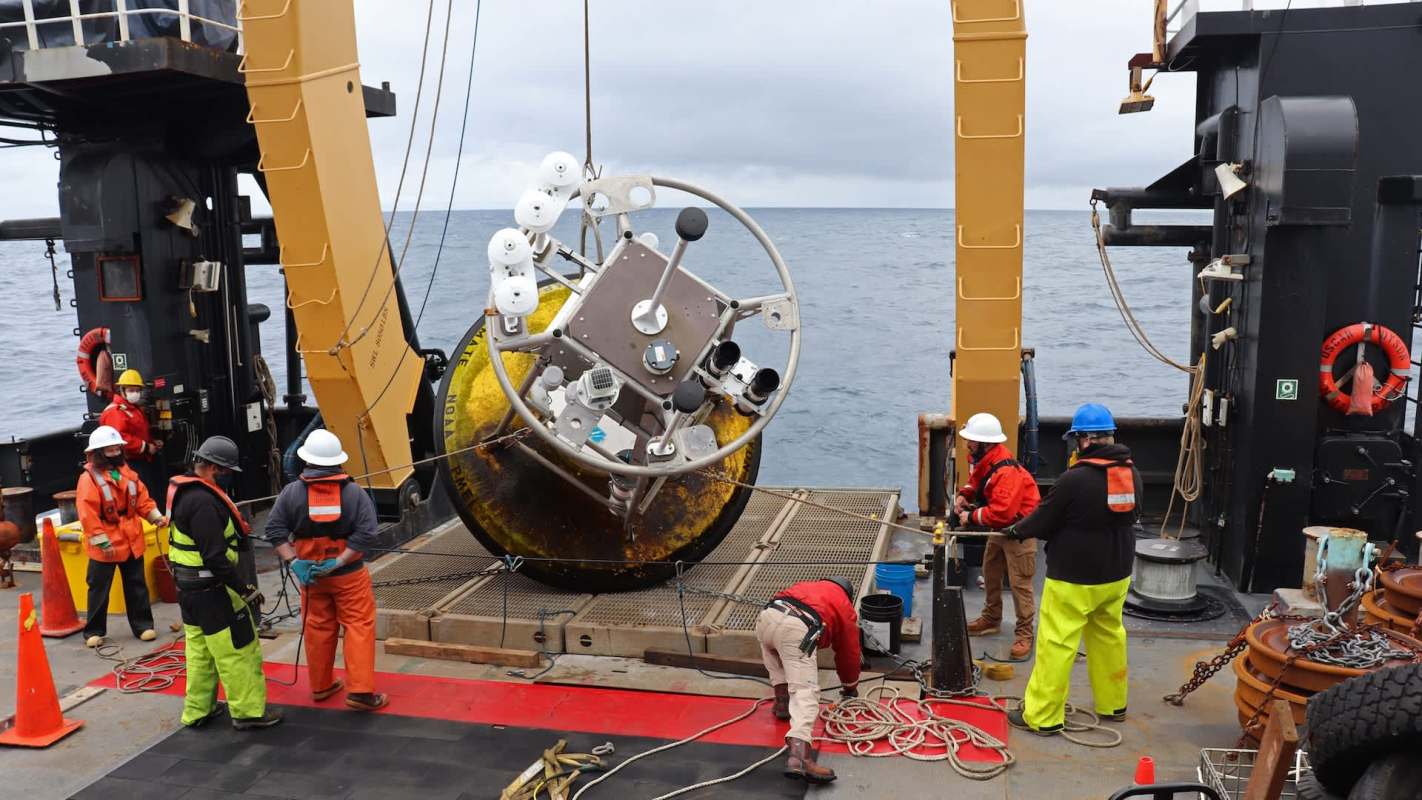
Alaska's fishing industry is warning that a federal plan to shut down a key deep-ocean observing network would take away an important early-warning tool for coastal communities confronting storms, marine heat waves, and fishery collapses.
Because Alaska is heating up at about twice the global pace, advocates told Inside Climate News that losing access to real-time ocean data would make the state's already daunting future even harder to manage.
What's happening?
As the outlet reported, the National Science Foundation unveiled plans last month to retire the Ocean Observatories Initiative, a nearly $368 million network made up of roughly 900 instruments in the Pacific and Atlantic.
A critical part of that system for Alaska is Ocean Station Papa in the Gulf of Alaska, above waters nearly 14,000 feet deep.
The site provides real-time measurements of ocean chemistry, currents, salinity, water temperature, and wave conditions that are used by scientists, fishery managers, weather forecasters, and emergency planners, ICN said.
That prospect has raised concern across Alaska's seafood industry. The state's commercial seafood sector is worth $5.3 billion and supports nearly 42,000 jobs, and experts said observations help inform decisions ranging from harvest levels to storm risk.
TCD Picks » Quince Spotlight
💡These best-sellers from Quince deliver affordable, sustainable luxury for all




"It helps us see where we're going and what's coming at us," Jan Newton, an affiliate professor of biological oceanography at the University of Washington, told ICN.
Why does it matter?
Alaska is already grappling with severe challenges with potentially devastating consequences for jobs, food security, and the stability of local communities.
"We're in the middle of salmon crashes, crab collapses, and repeated marine heat waves, and this decision takes away the data we rely on to understand what's happening and how to manage these fisheries," Michelle Stratton, executive director of the Alaska Marine Community Coalition, told ICN.
ICN indicated remote coastal communities, especially Indigenous ones, could be hit particularly hard because they depend heavily on fisheries and accurate forecasting.
Stratton told the outlet that the monitoring system also supplies data for NOAA and university models used to understand "how storm systems intensify, how water levels along the coast are rising or falling, where and when we should expect the next big flooding event."
What's being done?
The NSF has said previously collected data will remain accessible and that the agency continues to support ocean science, per ICN.
Spokesperson Cassandra Eichner said the decision "aligns with the NSF's wider strategy of a nimbler approach to prioritize support for evolving scientific priorities and emerging technologies."
Scientists and advocates are disputing the move, saying this is the wrong moment to reduce ocean monitoring.
"Losing the information provided by Ocean Station Papa … is like driving down a dark freeway with no lights on," Carol Janzen, an oceanographer with the Alaska Ocean Observing System, told ICN.
Tim Bristol of SalmonState told the outlet that the decision runs counter to a broader demand for stronger information and analysis regardless of stakeholders' position.
"This seems to be a sprint in the wrong direction," he said.
There is a possibility that other nations, such as China, could step in and begin their own monitoring efforts, as University of Alaska Fairbanks climate specialist Rick Thoman suggested.

Get TCD's free newsletters for easy tips, smart advice, and a chance to earn $5,000 toward home upgrades. To see more stories like this one, change your Google preferences here.






