


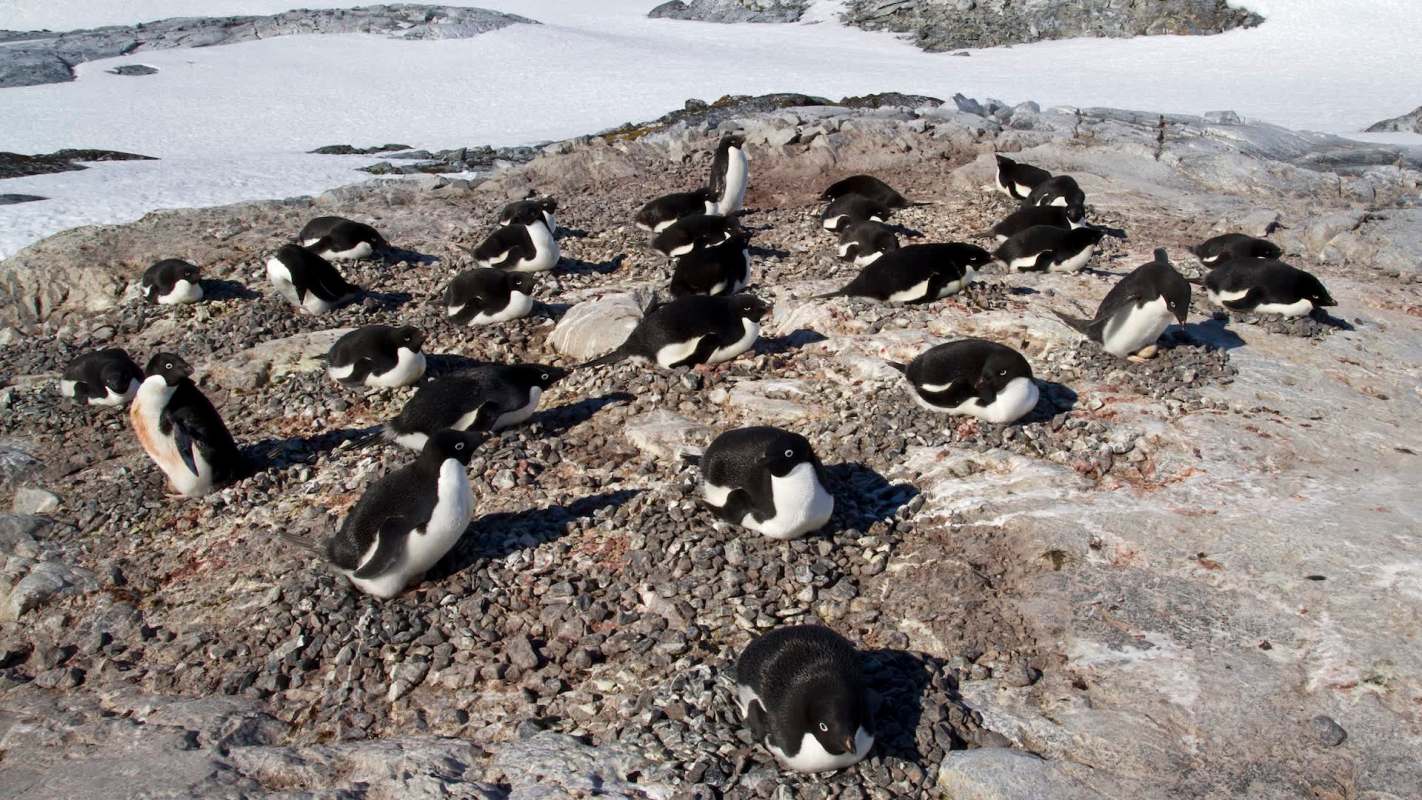
By tracking the color and distribution of Adélie penguin guano from space, scientists found that warming temperatures and shrinking sea ice are changing what the birds eat across Antarctica, offering a look at a marine food web under stress.
What's happening?
The research, published in the peer-reviewed journal Current Biology, shows how even penguin poop, also called guano, monitored from space, can reveal climate disruptions.
From orbit, scientists saw shifts in the color of Adélie guano, suggesting that as Antarctica warms and sea ice retreats, the birds' diets are changing in ways that expose strain throughout the marine food web.
A 30-year archive of NASA/USGS satellite images gave a Clemson University-led team a way to examine Adélie penguin colonies across Antarctica, as Universe Today reported.
The team identified the "spectral signature" of the guano, using visible and infrared light, before using the satellite readings alongside samples to perform a stable isotope analysis. That let the researchers estimate how much fish and how much krill the penguins were eating from 1984 to 2013.
They saw that sea-ice conditions tracked with diet. Adélie penguins generally ate more fish in places with thicker ice and more krill where ice had pulled back.
TCD Picks » Quince Spotlight
💡These best-sellers from Quince deliver affordable, sustainable luxury for all




Why does it matter?
The study described itself as "the first use of satellite observations to capture trophic dynamics at continental and decadal scales." Researchers added that the work "highlights how environmental change might restructure Antarctic food webs and influence the future of a key sentinel species."
According to Universe Today, in some areas, krill is becoming less reliable for the penguins as waters warm and rebounding seal and whale populations consume more of it.
If Antarctica keeps losing sea ice at the record-low levels scientists have observed in recent years, more penguin colonies could be pushed toward krill-heavier diets that may not support the same health or survival.
And because Antarctica plays a major role in regulating Earth's climate and oceans, significant disruptions there can serve as warnings for systems people rely on too, including stable coastlines, predictable weather patterns, and healthy marine ecosystems.
When climate change reshapes an entire food web, the effects can ripple far beyond one species, complicating efforts to build a safer future for communities already facing rising seas and other environmental shocks.

Get TCD's free newsletters for easy tips, smart advice, and a chance to earn $5,000 toward home upgrades. To see more stories like this one, change your Google preferences here.






