


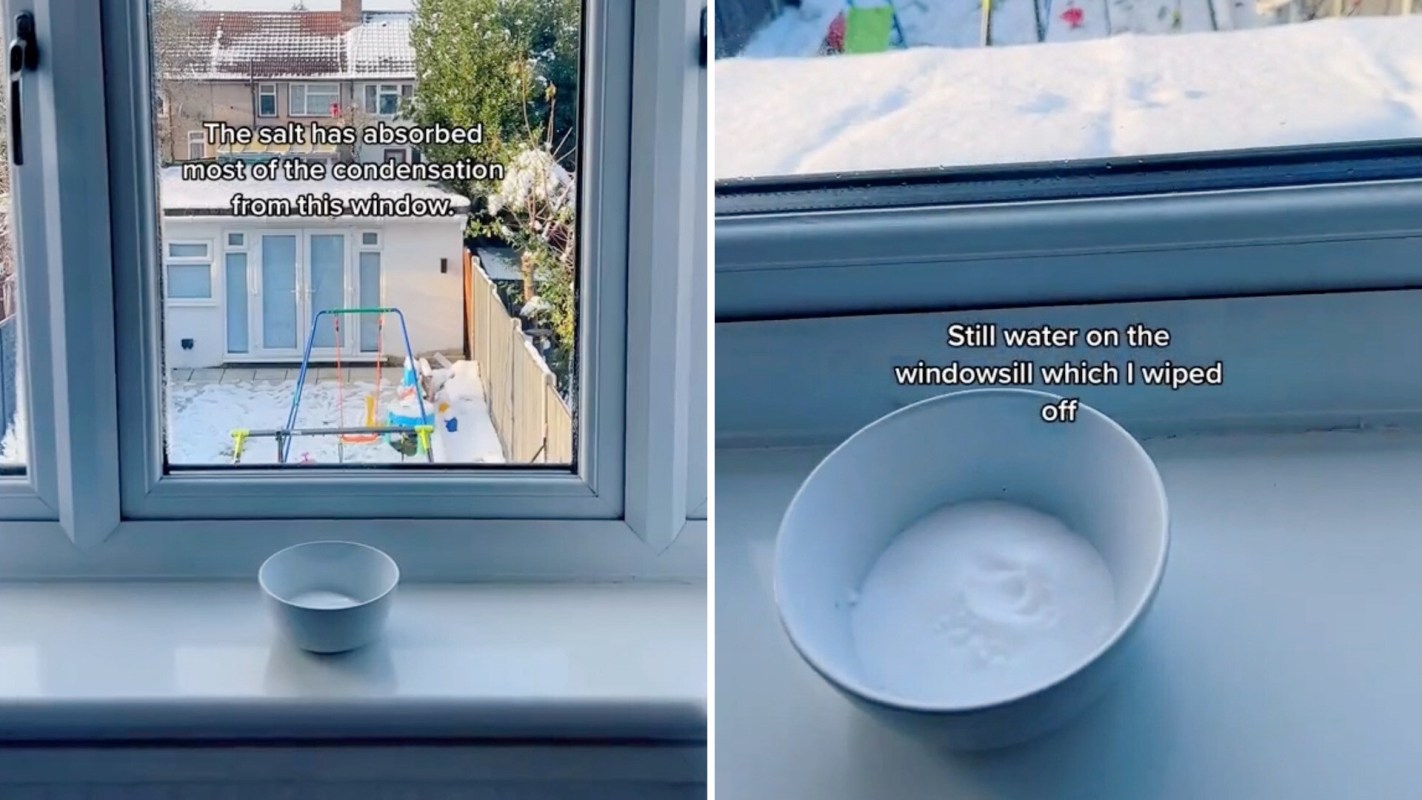
The popular hack of setting a bowl of salt on a windowsill to prevent condensation may actually do very little to stop it.
Here's what to know
A TikTok demonstration of the hack attracted more than 3.2 million views, Ideal Home reported. However, that damp salt may serve mainly as an indicator of moisture near the glass, with little effect on condensation.
EPA guidance explained that when indoor air beside a window cools, its relative humidity rises until condensation forms, which is why water droplets appear on cold window glass. A humidity meter elsewhere in the room may show a reasonable reading, even as condensation collects on a poorly insulated window.
Salt itself attracts water vapor — a property called hygroscopicity. However, anti-caking agents and other additives may affect how commercial table salt responds to moisture, the review explained.
A 2015 research review described by StudyFinds identified roughly 75% relative humidity as the point at which pure sodium chloride absorbs enough moisture to form brine.
The Environmental Protection Agency recommends much lower indoor humidity — ideally 30% to 50%, with a ceiling of 60%.
TCD Picks » Quince Spotlight
💡These best-sellers from Quince deliver affordable, sustainable luxury for all




In other words, the salt by your windowsill might attract moisture from an extra humid area of your house. But it's not doing much to remove water from the area until long past the point when the window is too humid and collecting condensation.
More background
Salt has established uses in humidity control within carefully enclosed spaces, which may be how this supposed hack got momentum.
A 1977 National Bureau of Standards compilation explained how sealed chambers containing saturated salt solutions reach stable humidity levels. For sodium chloride, the balance occurs at roughly 75% relative humidity when the temperature is 68 degrees Fahrenheit.
Gerhard Eggert, a researcher at Germany's Stuttgart-based State Academy of Art and Design, explored the same principle for museum displays in a 2022 study published in npj Heritage Science. Inside a closed case, a saturated solution containing extra solid salt can absorb or release moisture.
Still, large display cases take time to reach that balance, and a wider solution surface helps the process. Tall cases that leak air may also need a fan to distribute humidity evenly.
Building America guidance from the University of Minnesota and Pacific Northwest National Laboratory warned that persistent condensation can rot sills and window frames, according to StudyFinds.
What can be done?
Instead of relying on salt, the EPA recommended checking indoor humidity with an inexpensive meter and addressing activities that add moisture to the air.
Its household guidance identified lengthy showers, food preparation involving boiling or steaming, indoor plants, and laundry dried inside as contributors. Tightly sealed, energy-efficient homes can retain more of that moisture.
Bathroom and kitchen exhaust fans should send moist air outdoors, rather than into an attic, and clothes dryers should also vent outside. The EPA also recommended fixing leaks and using air conditioners or dehumidifiers when needed to control excess humidity.
When droplets collect on windows, the agency advised promptly drying the wet surface and reducing the source of moisture.
Building America guidance also recommended careful air sealing and mechanical ventilation. Slabs with poor drainage or sealing, along with basement walls and crawlspaces, can also contribute moisture.
Beyond reducing humidity, homeowners can address the cold surface itself. EPA guidance says caulking and storm windows help limit how cold the glass gets. Interior storm windows reduce room-side condensation by providing a warmer surface where indoor air meets the window.

Get TCD's free newsletters for easy tips, smart advice, and a chance to earn $5,000 toward home upgrades. To see more stories like this one, change your Google preferences here.






