


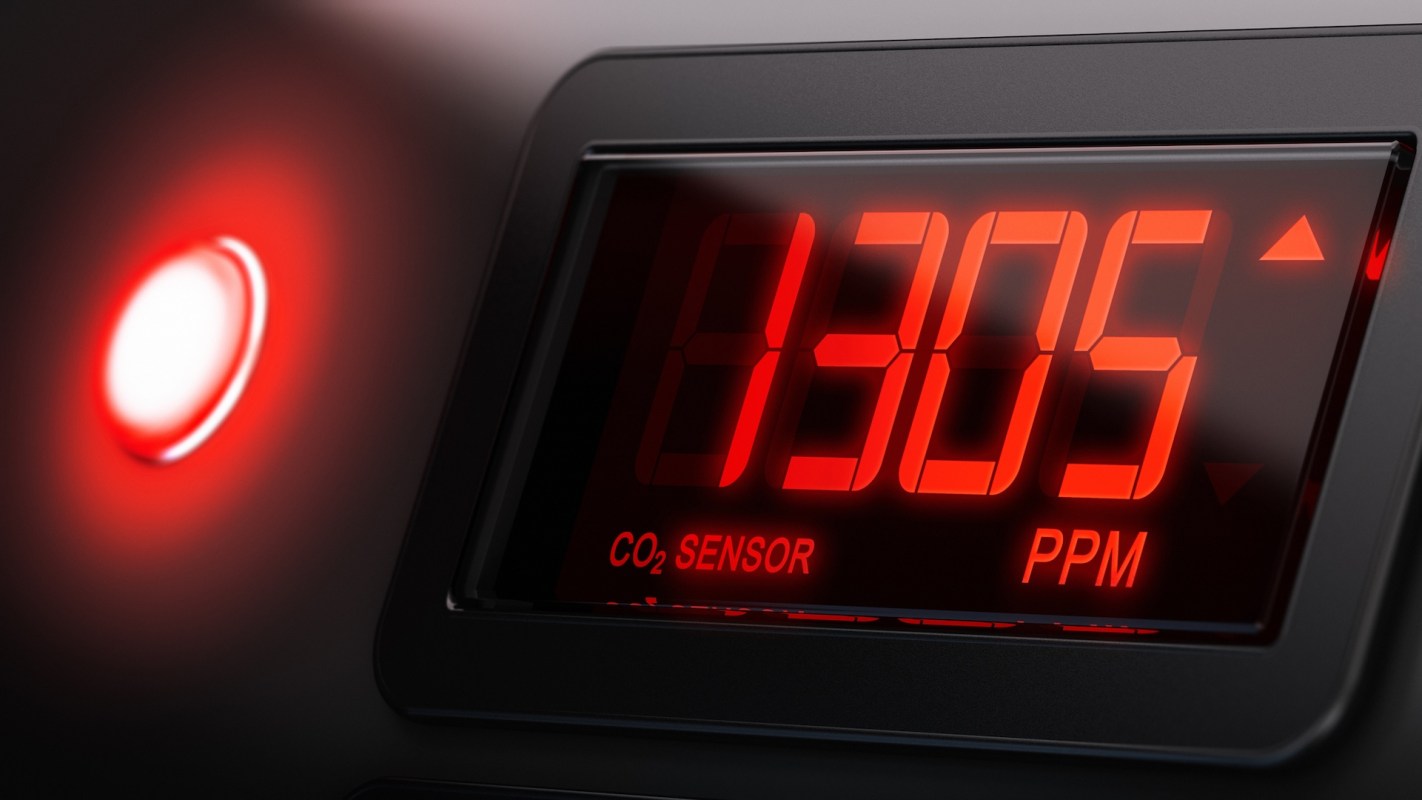
A homeowner trying to troubleshoot stubborn indoor carbon dioxide readings got a crash course in ventilation after asking why the numbers kept climbing even after the windows were opened.
What made the situation confusing was that the levels kept rising even when no one was in the room, prompting the poster to ask whether this was an HVAC problem or something that required a different specialist.
Here's what to know
In a thread on Reddit's r/AirQuality, the poster explained that the puzzling part was that an empty room still showed increasing readings.
"I tried opening my windows for 10-20 min, but all that does is bring it down and bring [it] right back up in the rooms," they wrote. "Whenever I feel funny or a heavy feeling on my head I know the CO2 levels are up."
Several commenters said the first thing to question was not the house, but the monitor.
They noted that some CO2 sensors rely on automatic baseline calibration and may start reporting inflated numbers if they are not periodically exposed to outdoor air.
TCD Picks » Quince Spotlight
💡These best-sellers from Quince deliver affordable, sustainable luxury for all




Others argued the source may be ordinary airflow rather than anything mysterious.
Even a vacant room can receive air circulated from other parts of the house through the central HVAC, effectively redistributing exhaled air from people or pets elsewhere.
"Your central air is likely why it goes up even if [you're] not in there; [it] mixes the air from elsewhere in the house," one commenter observed.
One recurring suggestion was to improve mechanical ventilation, alongside simpler advice to keep levels lower.
"Crack the windows enough to keep the CO2 down. You should try to keep CO2 under 800," another warned.
More background
Opening windows can help quickly, but it can also allow expensive heated or cooled air to escape, especially in homes already relying heavily on air conditioning or a furnace.
Energy recovery ventilators (ERVs) came up repeatedly in the discussion as a way to bring in outdoor air without paying the same heating and cooling penalty as a wide-open window.
One commenter described it as "like opening a window with a fan, but it keeps the cold/hot content and moisture mostly the same."
Overall, the advice was to rule out sensor problems and to fully audit the home's airflow before treating the readings as evidence of a serious hidden hazard.
If readings stay elevated after recalibration and ventilation checks, it may be worth asking an HVAC professional specifically about ventilation options — not just "better air," but outdoor air exchange and ERV compatibility.
What can be done?
If the monitor allows it, recalibrating the CO2 sensor outdoors is a sensible first step.
After that, it helps to review how air is moving through the house.
In a tightly sealed home, a fully closed-off room can quickly accumulate stale air, and running ventilation for longer or changing airflow patterns may be more efficient and effective than a brief 10- or 20-minute window opening.
For a recurring problem, an ERV may be the more durable fix.
As one commenter noted, it won't automatically beat an open window on raw airflow alone, but it can provide fresh air more efficiently and with less impact on heating and cooling costs.
Users advised both the low-cost first check and the higher-cost fix.
"If your CO2 sensor has been inside for a long time also make sure to calibrate it with outside air," one said.
"The real, best way to do this is to install an Enthalpy Recovery Ventilator in your home. (An ERV)," another emphasized.
Where can I learn more?
When a CO2 reading looks consistently high, the next step is usually to look at the house as a whole — where air is escaping, how hard the AC is working, and whether day-to-day settings are driving up comfort costs.
Each of these articles sticks to those practical questions, focusing on whole-home performance and simple HVAC adjustments that can make a difference when ventilation starts affecting the energy bill.
• In many houses, air leaks in your home quietly worsen comfort and waste energy.
• For HVAC-heavy homes, cleaning an air conditioning unit can improve airflow and trim costs.
• During hot spells, testing a thermostat setting hack helped one household cut bills dramatically.
A drifting CO2 monitor is a problem in itself.
These pieces are more useful for sorting out whether the bigger problem points to airflow, maintenance, or overall home efficiency.

Get TCD's free newsletters for easy tips, smart advice, and a chance to earn $5,000 toward home upgrades. To see more stories like this one, change your Google preferences here.






