


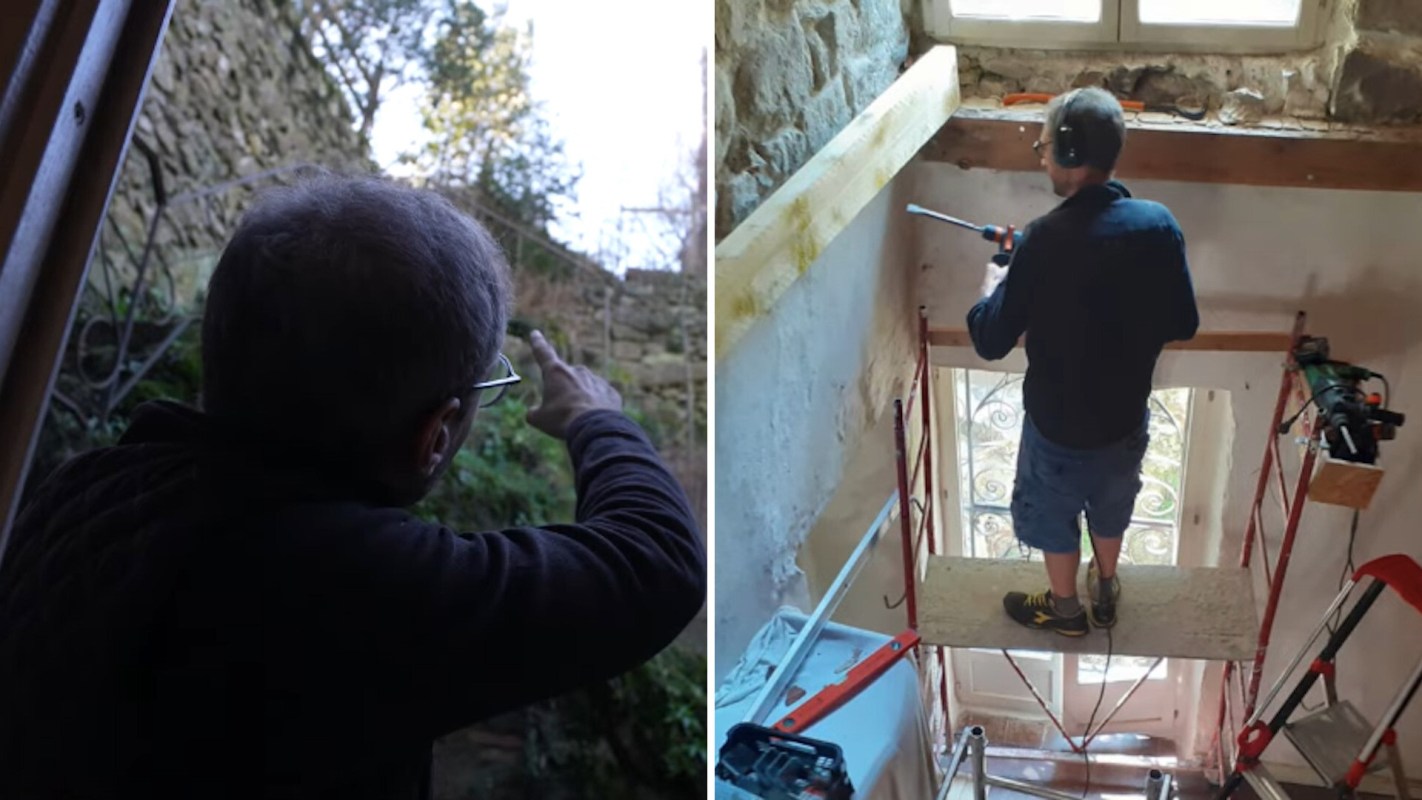
In a hillside village in France, a homeowner transformed a narrow townhouse with no car access into a home that stays cool even when outdoor temperatures reach 104 degrees — even after hauling renovation materials up 50 steps by hand.
Here's what to know
Built into the slope in the historic center of Vals-les-Bains, the old house rises through four levels, including a cellar cut straight from the rock. Olivier Neveu bought it after starting a family and spent roughly five years renovating it while living there with his young son.
According to Neveu, the house stays comfortable in both heat and cold: even at 104 degrees, he does not need air conditioning, and winter takes only a small amount of wood heat.
In a YouTube tour shared by Kirsten Dirksen (@kirstendirksen), Neveu said he achieved that with breathable materials including wood fiber, hemp-based insulation, cork, and lime plaster.
On a frosty day, he says, "I've just put three logs of wood this morning and that's so efficient."
Neveu says he uses "500 kilograms of wood per year" for heating, or 1,102 pounds.
TCD Picks » Quince Spotlight
💡These best-sellers from Quince deliver affordable, sustainable luxury for all




More background
The building preserves signs of an older village way of life: It was previously split into two modest two-room homes, with goats kept underneath and sleeping areas reached by outdoor steps.
To make the house work for a young family, Neveu changed how the interior functioned. A steep ladder became stairs, formerly open edges were protected with netting, small nooks were turned into spots for storage, reading, and relaxing, and a skylight was added to brighten a room that had once been too dark.
The surrounding village is largely walkable.
"You can do everything without a car," Neveu says, showing the maze of lanes leading up to the home.
After leaving a job that required heavy travel, he took a job at a local hotel, accepting lower pay for a slower routine.
What can be done?
Rather than gutting the house, he upgraded it section by section using breathable materials that also help regulate humidity.
Because he did much of the work himself, he could adapt each wall and room to its needs — using wood fiber on stone walls, hemp-lime in other areas, and thick cork where extra insulation mattered most.
As he watched the home improve over time, he says, "It's not just marketing. It works for real."
It also uses radio-controlled light switches that require no batteries.
Neveu says: "It's a slow lifestyle connected to nature."
Where can I learn more?
These articles explore how other homeowners and builders are cutting cooling and heating needs through design choices and energy systems.
• In California, Inaba Williams designed future-proof 'mirror' homes built for net-zero living.
• In 90-degree heat, a homeowner used rooftop solar to power whole-house AC and two EVs.
• At an off-grid cabin, a builder turned rooftop solar panels into an upstairs deck.

Get TCD's free newsletters for easy tips, smart advice, and a chance to earn $5,000 toward home upgrades. To see more stories like this one, change your Google preferences here.






