


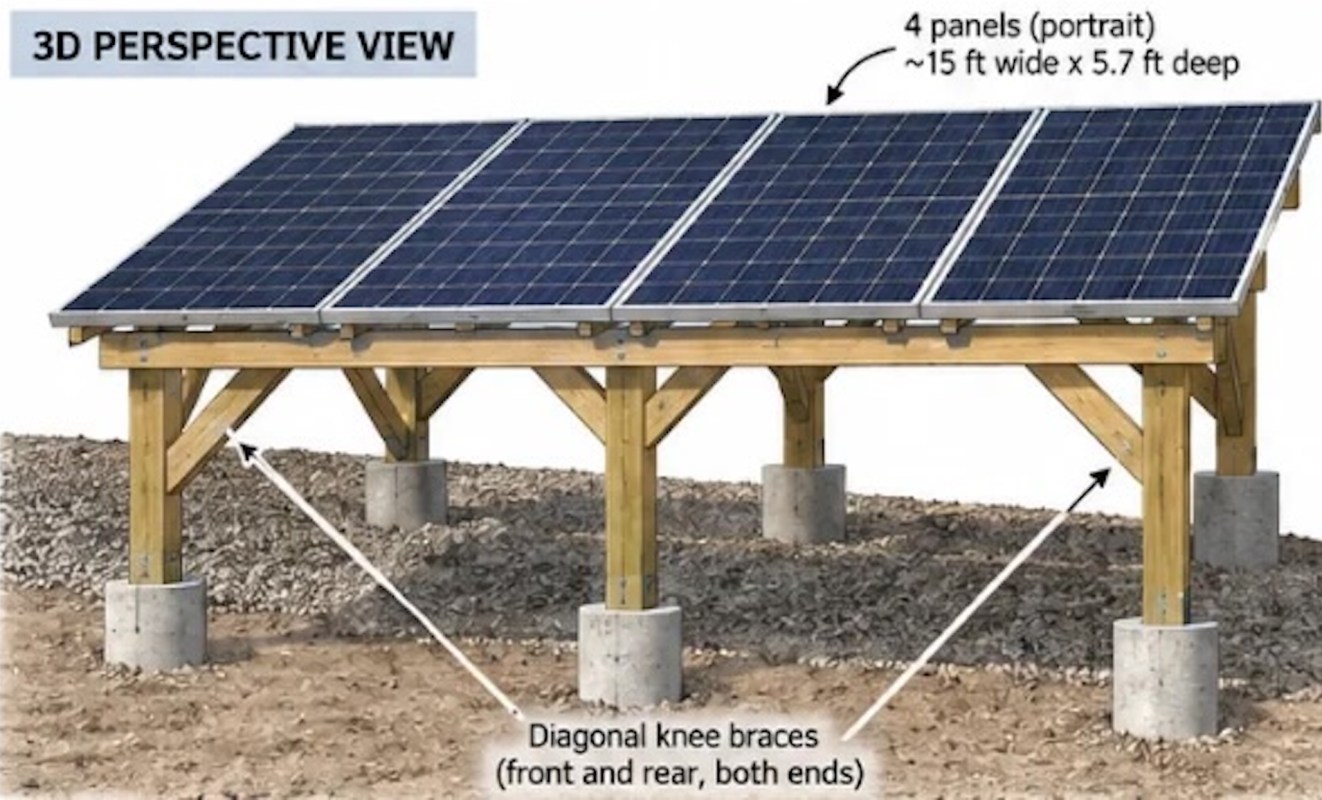
A Southern California DIYer sparked a practical conversation after asking whether an ambitious footing design for a 16-panel ground-mount solar array was too much — or not enough — for clay soil and strong coastal winds.
The question behind it was less about appearance and more about how to keep an expensive solar installation anchored when Santa Ana winds arrive.
Here's what to know
According to a Reddit thread, the project calls for a 7.2-kilowatt array built from four treated-lumber tables, with four 450-watt panels mounted in portrait configuration on each one. The poster weighed two support ideas and asked whether oversized concrete footings at each post were unnecessary or whether treated 6-foot-by-6-foot posts buried directly in concrete would perform just as well.
Most replies centered on the wind hazard. One commenter wrote, "You are absolutely right about the risk. I've seen some serious damage caused by panels flying around." They added that it makes more sense to use calculations or a predesigned system than to rely on instinct alone.
Budget came up quickly as well. The original poster said the mounting structure alone was expected to cost roughly $5,000 and reacted positively to an Integrarack recommendation, writing: "Good thing I asked. So this may be the way to go.. it's a bit cheaper than building a permanent structure! and fairly mobile."
Whether you get them installed on your roof or the ground, adding solar power is one of the best ways to save money on your energy bills. If you're curious what that could look like for your household, EnergySage offers free tools to get quick solar installation estimates and compare quotes.
More background
What makes the discussion especially relevant is that ground-mounted solar can be the best option for homeowners whose roofs are shaded, too small, aging, or poorly oriented. Once panels are installed in an open yard, factors such as wind loading, soil conditions, permitting, and foundation design become much more important.
The thread also filled up with examples from people who had already built similar systems. One commenter praised Integrarack and said it can be installed with ballast, ground screws, or concrete footings. Another described an Iron Ridge array in clay-heavy soil that had handled "strong wind, hail, snow and ice" without any concrete. A different Southern California commenter said their engineered and permitted design used footings that were 12 inches wide and 5 feet deep.
Save $10,000 on solar panels without even sharing your phone number Want to go solar but not sure who to trust? EnergySage has your back with free and transparent quotes from fully vetted providers that can help you save as much as $10k on installation. To get started, just answer a few questions about your home — no phone number required. Within a day or two, EnergySage will email you the best local options for your needs, and their expert advisers can help you compare quotes and pick a winner. |

A solar array is both an energy upgrade and a physical investment. If the structure is underbuilt, repair costs can quickly wipe out any expected utility-bill savings. If it is overbuilt, the total project cost can rise enough to delay or discourage the switch to cleaner, cheaper energy.
For households considering their own systems, EnergySage's free services can make the process easier to navigate. With EnergySage's help, the average person can save up to $10,000 on solar purchases and installations.
Homeowners can also use EnergySage's solar map, which shows the average cost of a home solar panel system by state, along with details on solar panel incentives for each state. Together, those resources can help readers get the best price for rooftop solar panels and access available incentives.
Adding battery storage to a solar setup is one of the best ways to protect your home during outages, save on energy costs, and go off-grid. You can check out EnergySage's free tools for information about home battery storage options, including competitive installation estimates.
More From EnergySage
💡Go deep on the latest news and trends shaping the residential solar landscape

What can be done?
Local code requirements, wind exposure, and soil conditions all affect whether buried posts, concrete footings, ballast, or ground screws make sense. Pre-engineered racking can also make future expansion easier, which mattered to the original poster, who noted that the system could grow later as budget allows.
As one commenter put it, "you have a choice. You can build something that you think is hell for stout, or you can do some calculations."
Where can I learn more?
Here are more stories on roofing advice, California solar expansion costs, homeowners association disputes, and a Texas power program.
• Homeowners pushed back after a roofer gave questionable solar installation advice about roof-mounted panels.
• A California homeowner learned PG&E would slash credits by 75% for adding panels.
• One homeowner considered trying to sidestep HOA solar rules by installing panels quietly.
• In Texas, residents can join a state-of-the-art home solar power program at no cost.

Get TCD's free newsletters for easy tips, smart advice, and a chance to earn $5,000 toward home upgrades. To see more stories like this one, change your Google preferences here.






