


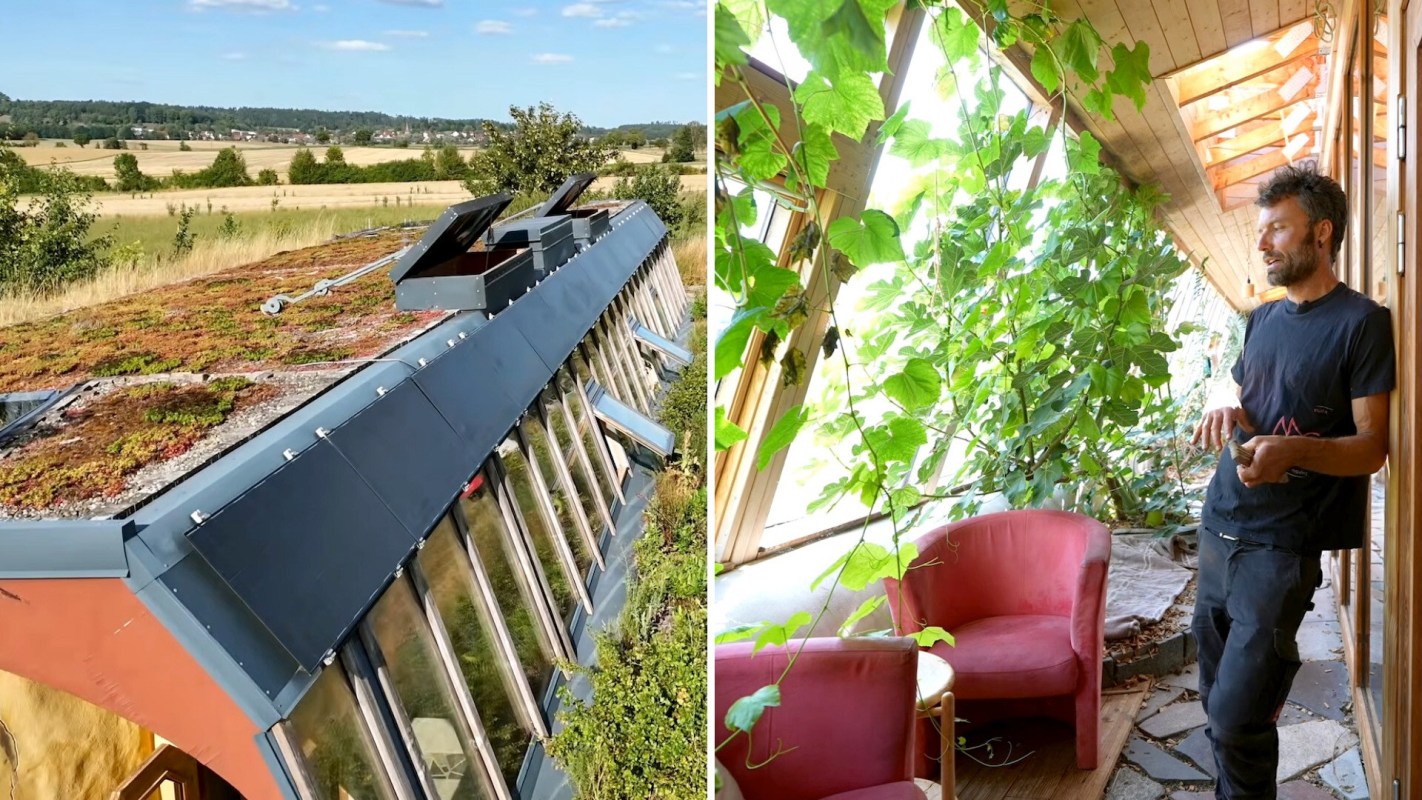
A home built with clay, discarded tires, and glass bottles keeps its residents comfortable through southern Germany's winters without additional heating.
The unusual building uses sunlight, earth-packed walls, and reused water to provide a shared space for a community of tiny-house residents.
Here's what to know
Posting for Eutopia (@eutopiaearth), a content creator toured Germany's first permitted Earthship in the ecovillage of Schloss Tempelhof. Built over seven weeks in 2015-2016, the building provides about 1,776 square feet of communal space for residents of the surrounding tiny houses.
"1,300 used tyres, 7,500 glass bottles and 70 people from 17 countries," the creator wrote in the video's caption, describing the materials and international team behind the project.
Winter sunlight coming through the large, south-facing windows supplies warmth that the floor and rear wall retain, according to resident and tour guide Max. The walls also store heat, thanks to the soil compressed inside them.
Instead of conventional air conditioning, the building relies on passive cooling in summer. Cooler air enters from the north as warm air escapes through upper ventilation flaps, and the angle of the glass reduces sunlight reaching the living areas.
TCD Picks » Quince Spotlight
💡These best-sellers from Quince deliver affordable, sustainable luxury for all




More background
According to the video's caption, four cisterns collect roof runoff, holding a combined volume of around 6,600 gallons (25,000 liters). Figs and passion fruit can grow in the greenhouse-like corridor, which also supports water reuse. Max explained that bathroom greywater flows through the garden space before being reused for toilet flushing.
Shared use of the building brings together several generations. For the 20 to 25 people who share the facility, communal amenities include a roughly 700-square-foot living room, kitchen, and dining area, along with four sinks, four showers, and a bathtub, according to Max.
Max said the building cost €380,000 and relied on substantial volunteer labor, though he noted that housing and feeding those volunteers also involved expenses.
What's being done?
According to Max, the Tempelhof team adapted the Earthship approach with support from architect and Earthship founder Michael Reynolds and Biotecture USA.
Car tires were not certified for use as building materials, meaning the project needed a special regulatory arrangement.
Clay was used wherever possible, but Max said the builders still relied on concrete for stability and because they knew the material. The team also added an airlock to limit winter heat loss and maintain the airflow needed for summer cooling.
While the video offers insight into residents' experiences, it does not provide measured winter temperatures or comparisons of heating demand.
The seven-week building schedule left little time to organize reuse. That experience led Max to advise future builders to prepare more salvaged materials before work begins.
"It's humid, it's warm. There is no heating system on and you come in here and you feel comfortable," he said.
Where can I learn more?
These stories explore straw-bale construction, cooling without air conditioning, off-grid solar renovations, and winter insulation work.
• In Missouri, a man built an off-grid straw bale house for $15,000, with roughly $50 monthly bills.
• In Spain, a couple's stucco home draws cool air from buried pipes, without a compressor.
• In France, a renovated hillside home stays cool without AC when outdoor temperatures reach 104 degrees.
• In Spain, a homesteader secured an old ruin before rewiring its off-grid solar.
• An off-grid cabin builder worked alone to seal the shell before winter after insulation wouldn't fit.

Get TCD's free newsletters for easy tips, smart advice, and a chance to earn $5,000 toward home upgrades. To see more stories like this one, change your Google preferences here.






