


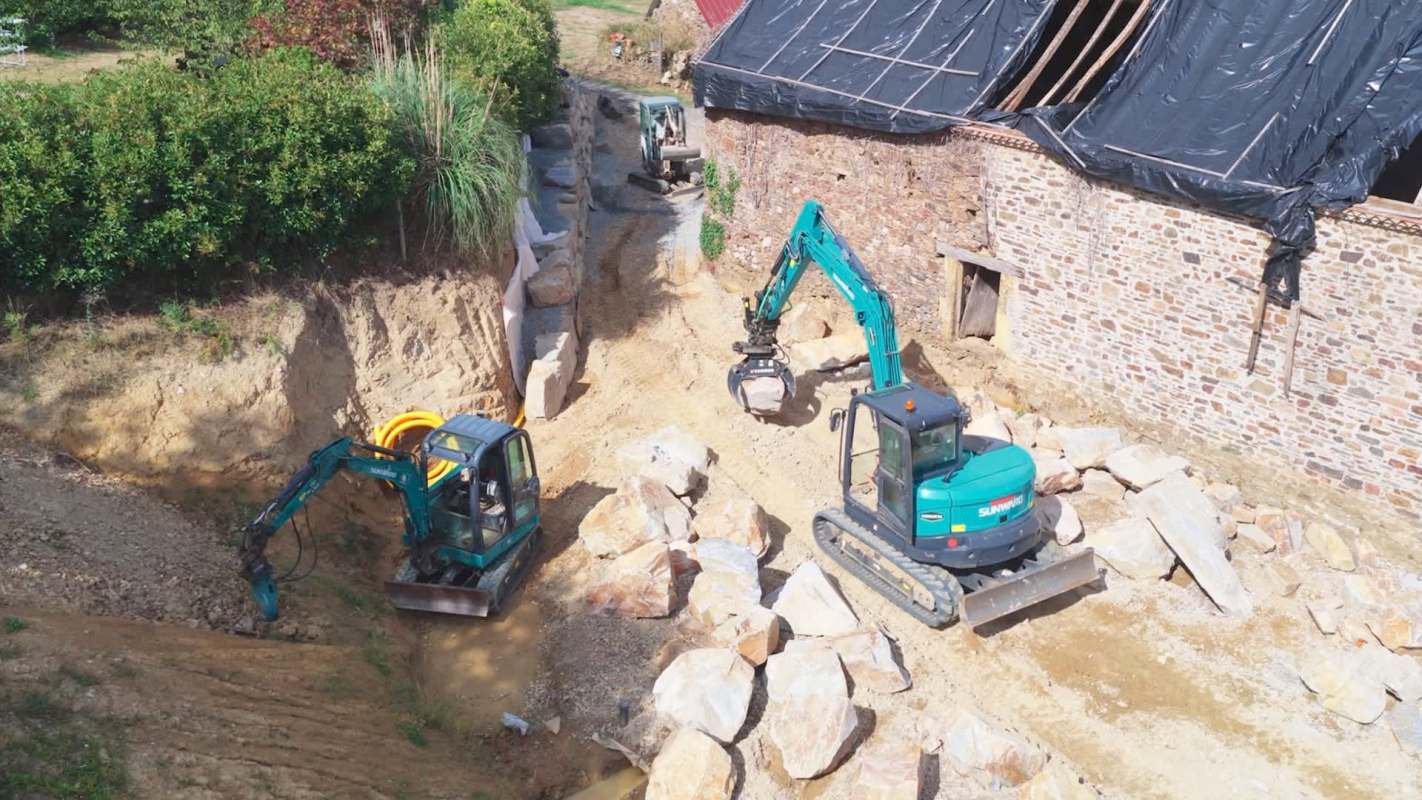
When a month's worth of rain falls in a single night, old buildings tend to reveal every weakness all at once.
For one family renovating a farmhouse in France's Dordogne region, that reality led to a massive but low-tech fix: a 120-ton dry-stone retaining wall designed to keep runoff away from their barn.
Here's what to know
In a YouTube video, the couple who own the property and are chronicling the renovation through their Domaine Sauvage (@DomaineSauvage) account said runoff from the hillside above the property had been damaging the site for years, moving "through the walls, and into places it was never meant to go."
They said the project represented the final major element of their overarching water-management plan, using 120 tons of unsorted quarry stone laid over a geotextile base.
The work took on extra urgency after roughly a month's worth of rain fell in the Dordogne in a single night, following three dry months and five heat waves. On sloped land, that kind of rapid swing can be especially rough because baked, thirsty soil often can't take in a sudden deluge quickly.
To prepare the site, one of the renovators cut the earth wall into a straighter face so the stones could rest properly against it. The excavator operator then maneuvered the biggest rocks into position.
TCD Picks » Quince Spotlight
💡These best-sellers from Quince deliver affordable, sustainable luxury for all




The owners also explained why the hillside had been failing in the first place, stating that "When rainwater hits the surface, it moves downward and reaches a denser layer. It can't easily penetrate, so it finds its way out through the middle of the soil wall instead, eroding it."
More background
Rather than pouring a solid concrete barrier, the family used stone, gravel, grading, and filtration fabric to better control how water moves through the landscape.
Older rural buildings, barns, and homes built into slopes can be especially vulnerable when drainage systems were never designed for more intense bursts of rain.
If water gets trapped or poorly redirected, the result can include erosion, foundation trouble, access issues, and rising repair costs.
A French drain was already in place nearby. But, the family said, the passage had first been opened with the expectation that the soil would stay put with the help of a coconut fiber mat and plants, and repeated washouts convinced them that a heavier-duty solution was needed.
"That wall is a thing of beauty! The amount of groundwork that you had to do is staggering. In awe at your skills and dedication. Just incredible," one commenter wrote.
What can be done?
At this farmhouse, the goal was to slow the water, support the slope, and allow moisture to drain without carrying soil.
Slopes, clay-heavy soil, stains on interior walls, and muddy channels forming after rain can all be signs that runoff needs a safer path away from buildings.
Some fixes are relatively manageable, including clearing gutters, maintaining drains, adding gravel, and reshaping small areas of land so water does not collect against walls. Larger failures, particularly those involving retaining structures or heavy machinery, usually require expert help.
"This coming winter, we'll be as prepared as we can be, and we'll be able to face whatever the sky throws at us with a little bit more peace of mind," the couple said.

Get TCD's free newsletters for easy tips, smart advice, and a chance to earn $5,000 toward home upgrades. To see more stories like this one, change your Google preferences here.






