


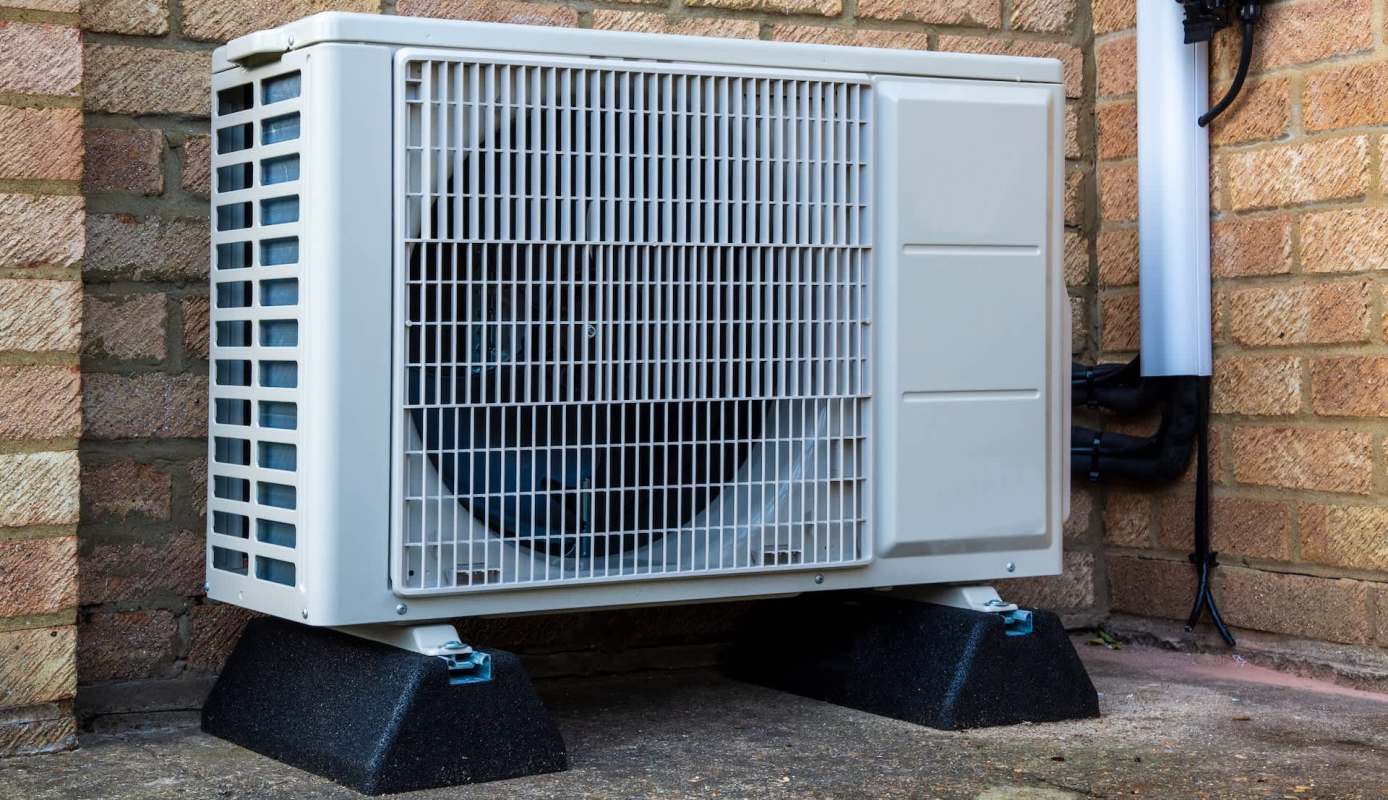
Heat pumps are quickly gaining traction as a way for households to upgrade their heating systems, but homeowners in England could face an unexpected planning hurdle if their unit exceeds a noise limit near a neighbor's window.
Here's what to know
England's "permitted development" exemption allows most household heat pump installations to proceed without a planning application, Devon Live reported.
The East Devon District Council said Devon residents are still asking whether their installations qualify for the exemption, including when a heat pump is part of a larger building project, Devon Live reported.
James Stalker, an Exmouth-based MCS-certified heat pump installer and assessor for the National Association of Professional Inspectors and Testers, explained the sound restriction.
"Noise is what catches people out. The unit has to come in at 37 decibels or less, one meter outside a neighbor's door or window to a habitable room," he said, per Devon Live.
The East Devon District Council said installations that exceed noise criteria or are greater than 53 cubic feet (1.5 cubic meters) in size can require permission.
TCD Picks » Quince Spotlight
💡These best-sellers from Quince deliver affordable, sustainable luxury for all




Protected buildings and some installations in conservation areas also fall outside the exemption.
More background
Annual U.K. air source heat pump installations hit 53,263 in 2025, compared with fewer than 7,500 in 2018, according to government figures cited by Devon Live.
Government grants available to eligible properties are also encouraging household interest in what the outlet described as an "increasingly popular home improvement."
The South West ranked second for installations through the end of June. It accounted for 14% of the U.K. total of 20,895, while the South East led with 18%. The government's Warm Homes Plan was published in January and sets a 2030 target of 450,000 installations a year.
The East Devon District Council explained that inquiries include requests for written confirmation that work can proceed without an application, as well as questions from residents whose projects may require permission.
What can be done?
Stalker explained that homeowners no longer need to leave 3.3 feet (one meter) between an outdoor unit and the property boundary.
That requirement ended in May 2025, giving homeowners more flexibility, although installations must still meet the remaining requirements.
Stalker recommended a noise calculation for the proposed installation site before homeowners commit to a location. The assessment must use MCS 020 a), the calculation specified in Devon Live's report.
He also advised obtaining the intended flow temperature, radiator details, and heat loss figures for each room.
People with listed properties — typically homes considered historically significant or otherwise protected — or those with road-facing walls in conservation areas should verify permission requirements before proceeding.
Stalker identified both as cases that would require advance approval.
The East Devon District Council acknowledged that navigating the exceptions can be difficult.
"Clearly there remain some instances where permission is still needed, such as in the case of listed buildings and in some cases in conservation areas, as well as when they exceed 1.5 cubic meters in size or noise criteria," a council spokesperson told Devon Live.
"These requirements can be confusing, and we are happy to provide advice," they added.

Get TCD's free newsletters for easy tips, smart advice, and a chance to earn $5,000 toward home upgrades. To see more stories like this one, change your Google preferences here.






